How does a label last 20-plus years in an industry built on burnout? Better yet: how does it remain authentically cool? Many may chase relevance, but few set the tone. For Australian cult denim label Ksubi, survival (and success) hasn’t hinged on chasing trends—just the opposite: by holding fast to its DNA.
Born out of Sydney in 1999 by a group of friends fed up with cookie-cutter jeans, Ksubi staked its name on provocation with an ethos forged in defiance; its 2001 debut infamously included 200 live rats on the runway.
Related Stories
Now, with Pip Edwards named creative director—a multi-hyphenate who started her career at the label, had her son with co-founder Dan Single, and has returned in a full-circle twist—Ksubi is betting that consistency and chaos are still the right formula for staying power.
Edwards started back in 2004, initially in the PR department before moving to the design team. This early experience allows her to “slip in with the DNA” and make creative or product decisions “with a brand lens really quite seamlessly.”
Though her return comes nearly two decades after her first chapter there, the feeling was familiar—like slipping on an old pair of jeans,” Edwards told SJ Denim.

It’s a full circle moment for Ksubi, too. Since emerging in 1999, the anarchic denim label has become a mainstay in Australian fashion and beyond, amassing a loyal following with celebrities like Hailey Bieber and Travis Scott in tow.
There’s also the family subplot. Her son, Justice, now works in one of the brand’s stores. It’s a neat, generational twist: the kid who grew up with Ksubi now literally sells it, carrying forward its swagger for a new audience.
“It’s got so many parts and aspects; you couldn’t [even] script it, really,” Edwards said with a laugh.
Ksubi’s origin story is its anchor: it was born from a genuine need, a desire for denim that didn’t exist.
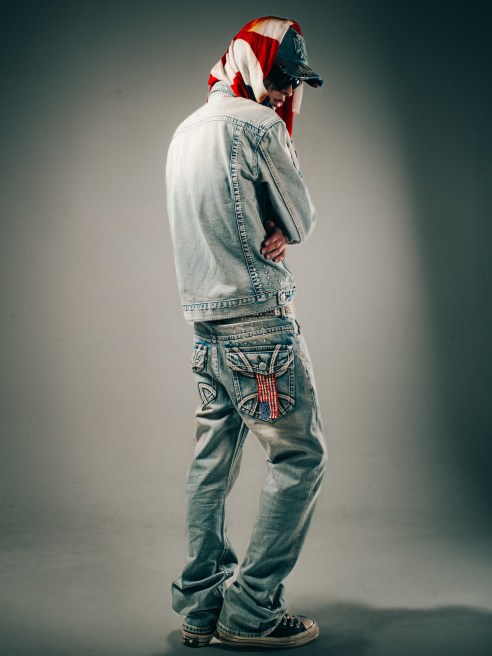
The brand’s foundational “lux rebellion” spirit is expressed through signature distressed denim and an iconic box-cross logo. It’s also how a Ksubi customer from 2004 and one from 2024 can recognize the same essential brand some 20 years apart.
From a product perspective, the brand’s DNA includes the distinctive distressed denim application—what Edwards noted as still being quite prominent—as well as the iconic box cross logo.
While that DNA is fixed, its expression is what evolves. The concept is not unlike the literary trope of regionalism or local color genre—telling the same core story, just tailoring the language and presentation for new audiences and global regions. In the fashion world, that means styles shift, markets expand, campaigns look different.
Edwards is clear on the distinction.
“I don’t think roots, brand roots, shouldn’t really change, don’t really change. It can evolve in terms of product and presentation and marketing,” she said. “But in terms of DNA? That’s never changed. I don’t think it should ever change.”
Need more evidence? Ksubi’s recent collab with L.A.-based Alice Hollywood was explicitly described as a love letter to the days of unapologetic denim: the early 2000s—aligns with Ksubi’s strategy of leaning into its heritage with a modern lens.
“We’re very community led,” Ksubi chief executive officer Craig King added. King has been with the brand for over 20 years in various capacities; something the colleagues have in common. The two worked side by side at General Pants Co. 13 years ago, where Edwards served as design director until forming her athleisurewear brand, P.E. Nation.
“We sort of built this brand from the streets—from the people that really loved the brand—rather than trying to take too much of a lead position and trend preaching,” King said.
Featuring laser-cut leather appliqués, signature metal lighter clips and nods to indie sleaze, the synergistic capsule doesn’t invent something new. Instead, teaches a new audience about a pivotal moment in Ksubi’s history, suggesting that success lies in knowing how and when to reintroduce your past.
“Do things your way,” she said. For Ksubi, that way is rather big—even a “bit brassy,” per Edwards. But it’s their own.
This article was published in SJ Denim’s fall issue. Click here to read more.