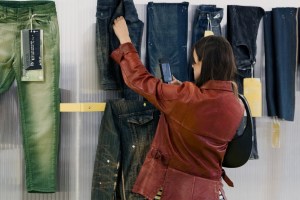
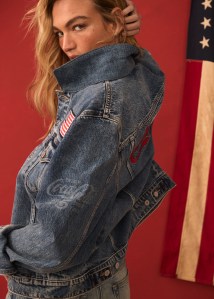
Future Fit, a project by Seoul-based spandex producer Hyosung that tasks designers from various backgrounds to explore how they believe fit will evolve over the next five years, unveiled its second collection at Kingpins Amsterdam last week.
The designs highlighted denim’s versatility and its strong links to the past.
Michelle Branch, Markt&Twigs founder and Future Fit lead, said the idea was born after taking a deep dive into what drive the denim industry forward.
Related Stories
“There’s been so many advances in the denim community, especially in ingredients like fiber, fabric and chemical innovations, but nobody really talks about how fit contributes to what’s moving the needle forward whether its zero waste patterns, dual purpose garments or multi sizing,” she said.
Carme Santacruz, Jeanologia creative director, Esther Knight, founder of Fanfare Label and independent designer Ruben Jurriën participated in the project this season. Each were given two landfill-bound Levi’s 501 jeans to upcycle and two yards of Bossa fabric made with Hyosung’s Creora bio-based spandex to produce their visionary garments. The fabrics were chosen for their ability to marry denim’s heritage with its future.
Santacruz designed a reversible M51 parka. “I wanted to create something that was as iconic as the 501 so that’s why I decided to create a M51 parka,” Santacruz said, adding that both garments began as functional garments and then became cultural icons. “It reflects me design approach, which is creating classic garments that are built to last. And I really like this concept of having something that it’s new but is also linked to the past.
Levi’s 501s are iconic for their fit, but they don’t fit everyone, Jurriën said. The challenges that he encounters while shopping for garments that fit his tall frame inspired to create a unisex jumpsuit that allows “humans to grow.”
“A big inspiration for me as designer is to make stuff that not only I can fit, but that everybody can fit,” he said. “Garments should fit us instead of us fitting the garments.”

Comfort is one of the main drivers of fit. “I see a lot of oversized and I hope that will transform into genuine inclusivity,” Jurriën said.
The upcycling component of Future Fit aligns with Knight’s design ethos. She created a form-fitting asymmetrical dress with different washes to show how fit and versatility go hand in hand with sustainability.
“Cost per wear of garments is hugely important,” she said. “We spend the majority of our time rescuing denim from landfills. Denim is such a durable fabric; there’s so much you can do with it. It shouldn’t be thrown away at end of life.”
Knight explained how her design process focuses on ways to make sure the customer is less likely to throw away the garment.
“The more they can style it differently, the more occasions they can wear it, for casual and formal—all of that goes into the initial concept,” she said.