With the secondhand apparel market in the United States expected to reach $74 billion by 2029—its growth already outpacing the broader retail market by five times—it’s safe to say that vintage and resale have completed their evolution from subcultures to serious business drivers.
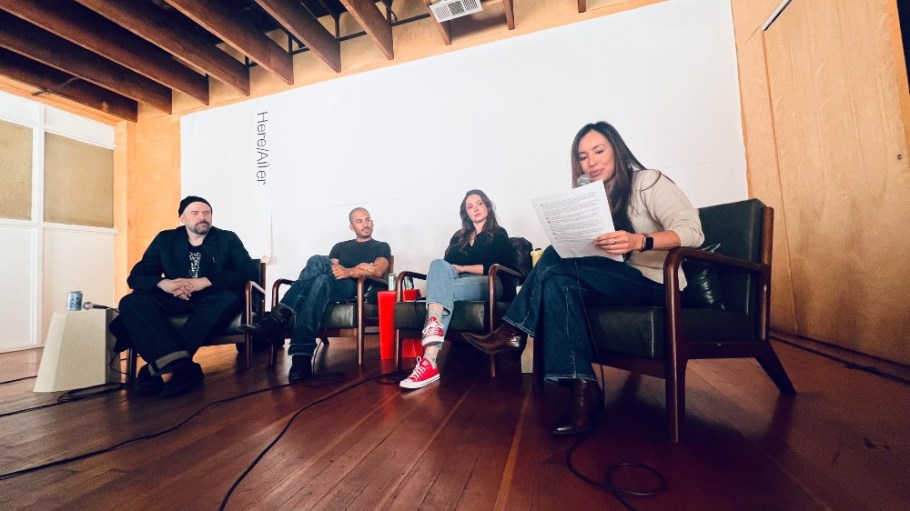
At the Preface show in Los Angeles this week, Denim Dudes and Here|After hosted a panel entitled “Nothing New: The Economics of the Past,” focusing on how brands are being forced to rethink the value of their own archives and their place in the circular economy, as well as how used clothes can become assets once again.
Related Stories
Speaking on behalf of one of the nation’s oldest heritage brands, Paul Dillinger, vice president and head of global product innovation at Levi Strauss & Co., talked about the company’s decision to create its own archives, and the role that resurrecting history has played in developing a perspective on vintage and resale.
“We keep the archives as a source of truth,” he said. Most brands don’t document or record their designs—“There’s no Library of Congress of Tech Packs”—but Levi’s has come to believe that keeping track of history is a worthy endeavor as it looks to build the brand’s future.
“We have what we believe to be currently the oldest pair of Levi’s in the world, within three years of the patent. We’ve got the first women’s jean. We’ve got documentation of every fit change that happened to the 501,” he explained. “We have all the cultural touch points,” from the pair of denim Steve Jobs wore when he debuted the iPhone to the iconic early-aughts, all-denim looks Britney Spears and Justin Timberlake wore on the red carpet.
“It really paints an interesting picture of the history of the American West, the history of American labor movement, the history of the American teenager, the history of American popular music. It’s all there in garment form and in written form,” he said. “But for a brand that really tries to focus on a design strategy to create great future vintage, it’s really important that we refer to that and share those references as broadly as possible.”
Denim enjoys the unique distinction of being perhaps the only apparel category outside of luxury fashion that appreciates in value over time, he said. Whereas a buy from the average mall retailer is worth less the moment it leaves the store, “a culture of curation” has emerged around denim that makes older garments more desirable than newer ones, in many cases.
“I just love it because it proves that not every object is worth less the day after you bought it. It proves that there can be some dynamics that would make that object worth more—they might not be materially objective factors, they might be invented cultural factors that are determining the value.”
But for all of Dillinger’s reverence for the Levi’s history, he doesn’t think that the brand necessarily needs to occupy the role of lead curator when it comes to selling vintage. The company has tried that, launching Levi’s SecondHand in 2020 with lackluster results. Shoppers were largely unable to reconcile the in-store experience of shopping at a traditional retailer—where sizes and color ways are readily available—with combing through racks of vintage one-offs. It just didn’t hit.
As such, “I really do believe that Levi’s role in this is to make the best quality ‘future vintage’ we can, understanding that someone else is going to do a much better job at reselling it down the road,” Dillinger said. “Let the experts in the space who are good at this, who have the following and who have worked with that consumer, do it their jobs, because they’re going to do it better than us. And let us really focus on just doing the damn jeans better.”
But Elijah Baig, co-founder of Springy Jeans, a curated vintage and rare apparel platform, believes brands still have a big role to play in the vintage and resale economies. Springy, which started out doing weekly drops on social media, has evolved its business model to helping service enterprise clients with back-end solutions for brand-owned resale.
“If you participate in this segment, the goal should be getting more and more people wearing the clothing that is literally just being discarded,” he said.
“When we pivoted in the last year and we realized this business that we built was not just applicable to what we were doing”—selling a handpicked assortment of fun vintage finds—”and that if we could apply it towards enterprise clients, that we could continue to not only scale and be a bigger player in the supply chain, but also get more and more people wearing vintage, get more and more people wearing this clothing.”
Springy has partnered with brands like Fanatics and Pacsun, primarily using TikTok to build vintage verticals for them. Baig said that while Springy was only able to comb through about 1,000 pounds of clothing per day when it was just running its own sales platform, it has now graduated to sorting through 10,000 or 15,000 pounds daily.
“[When] we’re selling to our niche audience, our niche customer, we can’t utilize everything that we’re seeing. And that’s such a pain point… because there’s so much good clothing, and we just don’t have the audience for it. We don’t have anybody to sell it to,” he said. Working with brands has allowed Springy to scale up processing, and also to leverage brand equity with consumers who are looking for specific products from their favorite labels.
Isabel Hartley, director of operations at Los Angeles-based Homeboy Threads said the growth of the circular economy—including the interest in vintage and resale more broadly—has opened up new opportunities that few consumers have the occasion to think about.
The organization, which is a division of Homeboy Industries, a workforce development training non-profit, trains ex-gang-affiliated workers to sort apparel and prepare it for resale, recycling or donation. “We primarily work with brands, and in doing that work, that training occurs in sortation, fiber identification, knowing clothing brands, and then also developing skills in digital literacy and technology use,” she said.
When it comes to the machinations of circularity, “It’s really undeniable that it’s very time consuming, very labor intensive, and can also be pretty expensive, especially if you’re in L.A.,” Hartley said.
However, “The labor intensity for us is a really good thing, it’s a bonus for us, because we’re a workforce development program,” she said. Sorting through thousands of pounds of clothing is a task that Homeboy is up for, she said. “It can take time and money to further our goals, but that time and money is really worth it.”
Asked what brands can do to be better stewards of the burgeoning circular economy, Hartley said that she hopes there will be a shift away from chasing microtrends to investing in quality. “The best way to keep something going is for it to be good,” she said. Homeboy can’t control what products come through its doors, but garments have a better chance of finding a second life outside of the sortation center if they’re well-made and have the capacity to endure both wear-and-tear and shifting trend cycles. “Make something that’s good, because people are going to keep wanting it,” she said.