Denim has come a long way since its humble beginnings as an indigo-dyed cotton twill. With the rise of performance fabrics and a growing demand for versatile, comfortable designs and sustainable manufacturing practices, mills are now pushing the boundaries of what denim can be. Through ongoing research and innovation, they’re writing a bold new chapter in the fabric’s rich history.
However, choosing which innovations to invest in is a delicate balance of forward-thinking vision and financial responsibility.
Related Stories
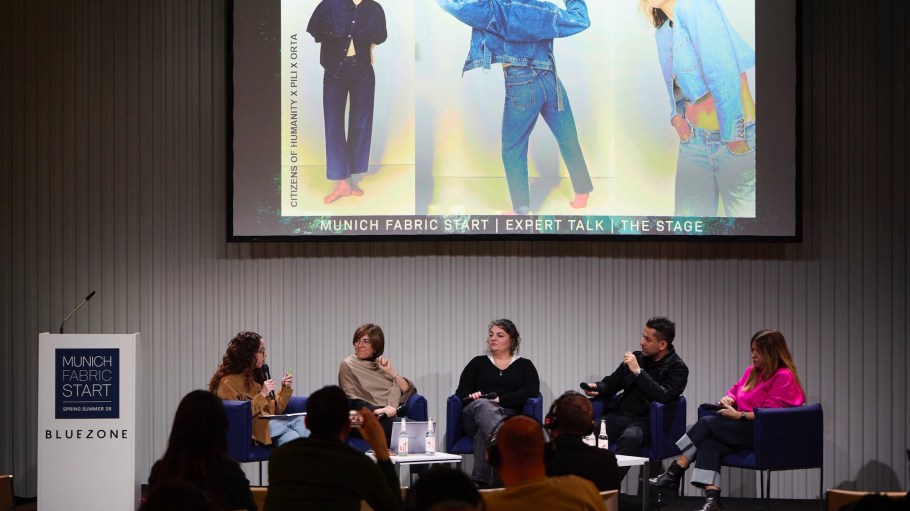
At Bluezone in Munich, Germany last week, representatives from four Turkish mills came together to discuss the benefits and challenges of investing in new innovations.
Isko anticipates the needs of the market rather than responding to demand, said Mirela Slowik, Isko category leader. One example of this mindset is Sanko Group’s Re&Up, the circular textile venture launched in 2023.
In addition to tackling the fashion industry’s waste crisis, Re&Up is helping Isko significantly increase its use of recycled fibers while also preparing clients for upcoming EU regulations, which will mandate that fabrics contain at least 30 percent recycled content by 2026. The mill has overhauled its entire product line to incorporate recycled cotton and polyester, ensuring sustainability across all constructions and performance features.
“Our solution is using recycled materials without compromising the behavior of denim,” Slowik said. “Nowadays, everybody is talking about alternatives fibers, but for us, the most important is the fashion and the behavior of denim.”
As a “product-driven company,” Isko focuses each season on creating new opportunities and elevating the value of its fabrics. One of the latest innovations from the Sanko Group-owned mill is MultiTouch, a blend of yarn finishing and engineering that allows designers to create multiple effects—such as 3D textures, embossing, crinkling, and soft hand feels—from a single fabric.
“It’s a new way to look at innovation—having one fabric for a collection makes it easier to manage,” she said.
“Our aim is always to be a kind of solution partner for our customers and stakeholders. And we are not only focusing on the visual innovation of the product,” said Mehmet Serdar Ozcan, Calik Denim’s sales manager. “We are also focusing on the hidden properties of the product.”
Similarly, Calik’s R&D team has spent years perfecting technologies like E-Last, which stabilizes the shrinkage of high-stretch denim across different wash levels. This not only saves garment manufacturers time and costs during production but also eliminates pattern inconsistencies. The result is a premium product that makes the production process smoother.
At Orta, efficiency is a key consideration for every innovation. Sebla Önder, Orta’s. marketing and sustainability manager, emphasized that a new concept should never compromise sustainability or introduce additional challenges.
“Customers like to have a lot of new ideas and new technology, but they don’t want to pay for it. There should be a balance between what we want to put in the market and what the customer can afford or how they will perceive it. We are trying to make a balance between all these needs,” she said.
One example of the impact a brand’s support can have is the new Citizens of Humanity collection dyed with Pili’s Eco-Indigo, a bacteria-based alternative to petroleum-derived indigo dye.
Though new to the market, Önder emphasized that Pili’s Eco-Indigo has been in development for nearly a decade. The French biochemicals company’s fortunes began to shift in recent years, especially after securing $15.8 million in funding in 2023 and attracting the attention of Citizens of Humanity—one of Orta’s more engaged and proactive clients. “They’re great partners because when they believe in a technology, they support it and help it to grow and [bring it] to market. This is how they work,” she said.
Timing, of course, is critical. Sometimes great ideas are too ahead of their time. Ozcan recalled how Calik began producing cotton 15 years ago, but demand wasn’t strong enough. Now the market has shifted toward cotton grown with regenerative practices. “Trying to understand if there will be a demand climate at the time of launch is the most important and most difficult part for us,” he said.
To bring an innovation on the market, it must be proven, Slowik said. “This is the reason we sometimes work on a concept for years before bringing it to the market,” she said. “We believe that bringing newness and novelties makes a difference.”
Dr. Dilek Erik, Sharabati Denim’s global marketing manager, also emphasized that denim companies are investing just as heavily in innovation as industries like automotive and pharmaceuticals. However, resources—both manpower and finances—are shared across multiple aspects of the business.
“We’re investing in technologies. We are investing in machines. We are increasing our capacity every year…and we are investing in sustainability a lot. We just finished our 100 percent recycled water treatment [facility]. All these things are investments,” she said.
Sharabati is also introducing new sales tools. The mill unveiled a new app at Bluezone that digitizes its entire collection as well as a library of exclusive prints. While ROI on the app may not happen overnight, Erik says it enhances clients’ experiences and provides a remote alternative to discovering new fabrics and concepts when in-person meetings are not possible. “It’s not only about new chemical or new fiber—we are making a lot of investments through all these processes,” she added.
In a volatile market like fashion, companies must continually invest in fresh ideas to stay competitive. “In the automotive industry, an innovation might last several years. In fashion, it’s only a couple of seasons before brands and consumers demand something new,” Ozcan pointed out. “This business is not easy, but we’re investing. We must also be cautious in how we invest, because we are not fully stabilized.”