ZIM is being shopped around.
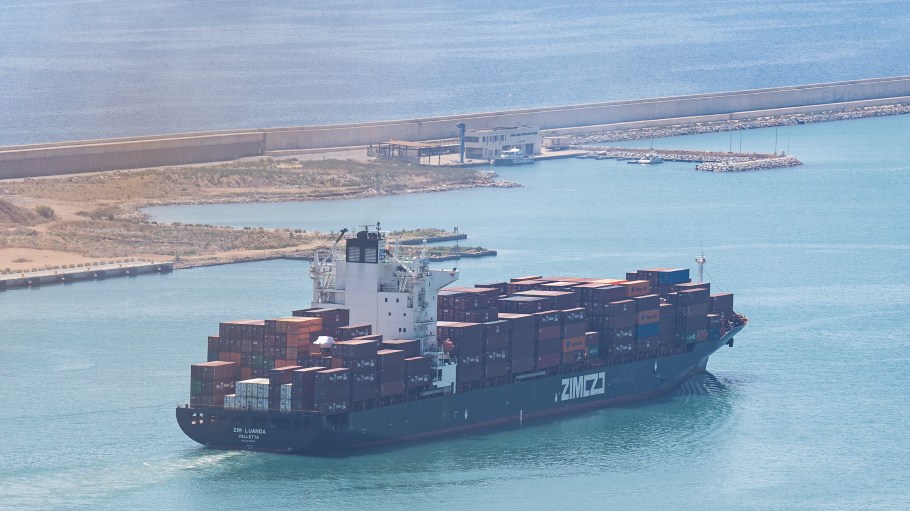
The Israeli container shipping firm is considering buyout offers in the wake of a purchase proposal co-led by CEO Eli Glickman.
A report from Israel-based business publication Globes said German ocean carrier giant Hapag-Lloyd has made an offer to acquire ZIM. However, the bid is in the initial stages and negotiations have yet to begin between the sides.
Such a deal would combine the fifth and 10th largest container shipping firms worldwide by market share of 20-foot equivalent units (TEUs), according to industry research database Alphaliner. Hapag-Lloyd has a 7.2 percent share, while ZIM’s share is 2.1 percent.
Related Stories
ZIM and Hapag-Lloyd would not comment on the matter.
The potential takeover is facing backlash from ZIM employees, Globes says.
ZIM’s workers’ committee sent a letter Wednesday to Israel’s Transportation Minister Miri Regev urging her to block the Hapag-Lloyd sale, saying foreign control could endanger Israel’s supply chain and potential national security in the event of another war.
Two minority shareholders are fueling the workers’ concerns. Qatar’s state investment authority owns 12.3 percent of Hapag-Lloyd shares, while Saudi Arabia’s Public Investment Fund (PIF) has 10.2 percent.
ZIM workers’ committee chairperson Oren Ksafim told Globes that 98 percent of Israel’s trade goes by sea, and that the carrier was the sole container shipping firm that stopped at Israeli ports regularly throughout its war with Hamas.
“If ZIM is in Qatari-Saudi hands, in the next war we shall be cut off by sea,” said Ksafim. “We do not have an open land border. The sea is our vital artery.”
Tying into the workers’ gripes, any ZIM transaction also will also have to account for the Israeli government’s “golden share” provision over the company. This mechanism is designed to protect the country’s interests in private companies deemed essential for national security and transportation.
The provision gives the government veto powers over potential acquisitions if more than 24 percent of the company is sold.
In its letter, the workers’ committee called on the government to invoke the provision immediately to prevent the sale.
As part of the golden share, the government requires ZIM to have a majority-Israeli board, an Israeli chairman and a fleet of 11 ships available for state use in emergencies.
Both Prime Minister Benjamin Netanyahu and Regev would have to sign off on any deal.
In August, after reports came out regarding Glickman’s interest in a buyout, the CEO acknowledged that this would make the ocean carrier a difficult takeover target for foreign entities.
“Not that many people are going to take the risk” in acquiring ZIM, Glickman said.
After Glickman stayed mum on the potential for an acquisition during the company’s earnings call on Nov. 20, the board of directors confirmed in a public statement on Nov. 25 that ZIM had received indications of interest from multiple parties.
The board said the company has been under a strategic review of alternatives for months, with a sale being one of the options that is being evaluated “carefully.”
“There is no assurance that any transaction will occur as a result of this review of alternatives and the ZIM board of directors does not expect to provide updates regarding this review until an agreement is reached or the review is otherwise completed,” the company said.
The statement also confirmed prior reports in August that Glickman and Israeli shipping tycoon Abraham Ungar had submitted a proposal to acquire all public shares of ZIM, which would have taken the company private.
A report from Israel-based technology publication Calcalist said the board of directors rejected a $2.4 billion offer from Glickman and Ungar due to the price not meeting their expectations. That report indicated that five senior ZIM executives were also part of the bidding group.
Coincidentally, as of market close Friday, ZIM’s market cap is $2.41 billion.
The public markets are leaning in favor of a ZIM sale. During the calendar week of Nov. 24-28, which included the board announcement of the strategic review, company stock increased nearly 19 percent.
Globes also reported that both Mediterranean Shipping Company (MSC) and Maersk, the two largest container shipping firms, have expressed interest in an acquisition. However, there are no reports of either company making a bid.
MSC and ZIM already have a working relationship. Although they are the only two of the top-10 ocean carriers that are not members of the three major vessel-sharing alliances, they both launched their own cooperation in February. Under that partnership, the carriers offer six weekly services between Asia and the U.S. East and Gulf Coasts, with some stops at Mexican and Caribbean ports.