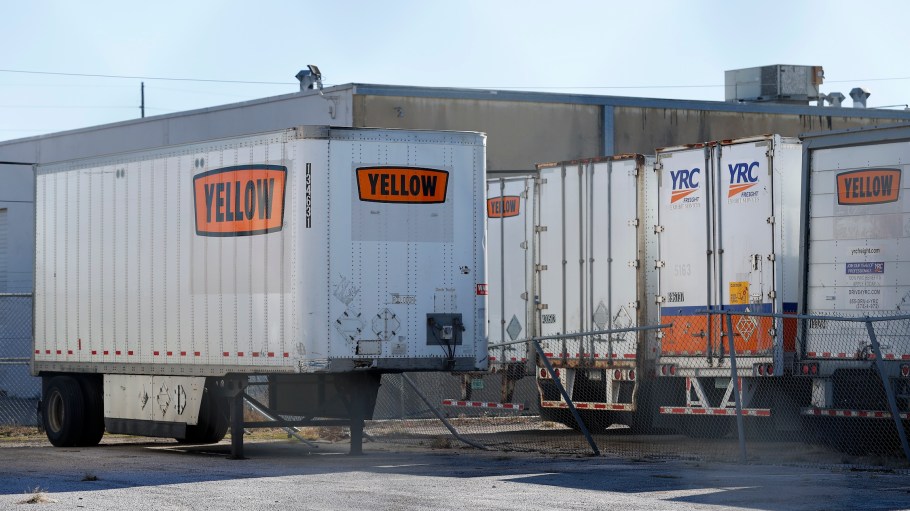
Yellow Corp. was found to be not liable for failing to provide 60 days’ notice to union employees when it ceased operations two years ago.
Bankruptcy judge Craig Goldblatt ruled that the insolvent trucking firm was a “liquidating fiduciary,” rather than an employer, when it laid off roughly 22,000 Teamsters-affiliated employees on July 30, 2023.
The Teamsters had alleged that Yellow was in violation of the Worker Adjustment and Retraining Notification (WARN) Act in not giving its members the proper notice.
Related Stories
But the “liquidating fiduciary” designation meant that Yellow no longer operated a business enterprise by the time it provided the notices. When a company stops conducting business and is merely in the act of liquidating its assets, it is no longer an employer covered by the WARN Act.
“In the real world, the task of shutting down a large and complex business is typically a process that takes place over time. It cannot be accomplished just by flipping a switch,” Goldblatt’s 36-page opinion said. “And that can make the task of drawing the line between when a defendant is a ‘business enterprise’ on the one hand and ‘liquidating fiduciary’ on the other a challenging one.”
The determinant in this case came down to when the less-than-truckload (LTL) provider stopped making deliveries.
During the three-day trial from Jan. 21 to Jan. 23, the court found that Yellow made its final delivery at 11:30 p.m. Eastern Time on July 29, thus determining the company was a liquidating fiduciary from that point forward.
“From then until noon on July 30 ‘the only part of the process left was to ensure all equipment was inside the gates and we had all of our employees back at our facilities before noon so that they could be outside of the gates when the closing occurred at noon Eastern,’” the opinion said, quoting testimony from Yellow’s chief financial officer Daniel Olivier.
The Delaware court had rejected Yellow’s argument that it was a liquidating fiduciary on an earlier date, July 26, 2023, in a prior summary judgment opinion laid out in December. On that date, Yellow decided to liquidate its business, but still was running deliveries until July 29.
While the Teamsters lawyers argued that Yellow had been effectively stalling until July 30 to give the notice to avoid any liability, the court ruling indicated that the trucking company still staged freight for customer pickup and continued to employ security personnel at the terminals. Only after the final delivery, was the company no longer operating its core business functions, the court ruled.
“There is nothing to indicate that a decision as to when particular employees would be terminated was made or communicated to anyone on any date prior to the date on which the WARN notices were given,” said Goldblatt. “Because this is an issue on which the Teamsters bear the burden of proof, the absence of any evidence of an earlier ‘order’ is fatal to their contention.”
The court also concluded that even if Yellow was an employer subject to the WARN Act at the time it ordered the mass layoffs, the circumstances would justify a reduction in damages, from 60 days of back pay and benefits to 14 days’ worth.
Despite the recent ruling, Yellow hasn’t gotten out of this totally unscathed.
Last month, Yellow had already settled a class action lawsuit with two separate groups of claimants—roughly 3,200 non-union employees and a group of 482 mostly union workers—settled for undisclosed amounts. Non-union employees were terminated on July 28, 2003. Those combined lawsuits had looked to collect more than $240 million in claims.
Ahead of that settlement, Judge Goldblatt ruled that Yellow’s two other defenses—that it was a “faltering company” that endured “unforeseeable business circumstances”—permitted the company to have a shorter notice period. However, he contended that the form of notices given to both the union and non-union employees “did not contain enough facts adequately to justify the reduced notice.”
The settlements are still subject to court approval.
Yellow’s estate remains embroiled in another legal battle with its pension funds over $6.5 billion in liability claims as it continues to sell off its remaining terminals.
Earlier this month, the LTL got a partial win in the pension battle, in which five of the funds are claiming Yellow owed $540 million for withdrawing from their plans when it shut down. Goldblatt ruled that the funds set the company’s withdrawal liability too high, but has still not ruled how much Yellow must pay.