For a startup and a major automotive company, autonomous vehicles remain on the roadmap.
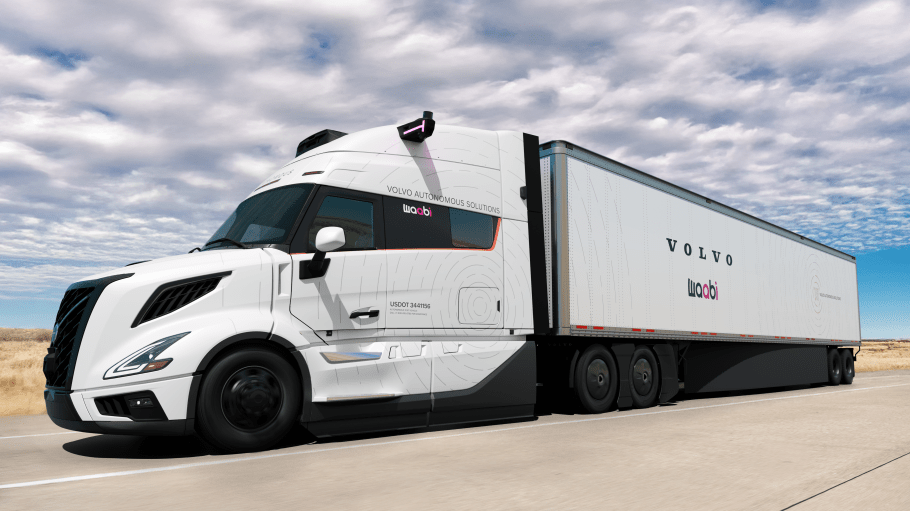
Waabi and Volvo Autonomous Solutions announced Tuesday that the two companies would partner to develop and deploy a fleet of autonomous trucks integrated with artificial intelligence systems, capitalizing on both companies’ work in the space to date.
The Canadian startup uses generative AI systems to develop physical-world applications, particularly in the self-driving vehicle space. Its proprietary technology, Waabi Driver, combines software with hardware, including light detection and ranging (LiDAR) sensors, cameras and radars. The hardware sends data, information and signals to the software system, which then makes decisions about how the truck or vehicle should maneuver and navigate based on external factors.
Related Stories
To train Waabi Driver, the company uses its other technology, called Waabi World, which effectively simulates a variety of situations virtually, helping Waabi Driver learn how to respond to myriad scenarios. Waabi Driver ingests that information and can apply it in the real world, even if the conditions differ from what the system experienced in the simulation; for instance, even when weather conditions or road shape differs, the system can adapt accordingly.
According to the company, Waabi Driver is ready to be integrated into trucks by original equipment manufacturers (OEMs).
That’s where Volvo Autonomous Solutions comes in. The Swedish automotive company has already developed an autonomous truck, called the Volvo VNL Autonomous, which it plans to produce at a recently opened production plant in Virginia. Now, it plans to integrate Waabi Driver into that model of truck.
Raquel Urtasun, founder and CEO of Waabi, said the collaboration feels like the natural next step toward a safe, efficient autonomous vehicle venture for the freight and logistics industry.
“At Waabi, we believe that vertically integrating next-generation AI technology directly into an OEM’s vehicle production is the path forward to bring safe, robust autonomous vehicles to the road, at scale,” Urtasun said in a statement. “Volvo’s leadership in safety, commitment to excellence in engineering and investment in forward-looking innovation makes them an ideal partner to realize the future of self-driving trucks everywhere.”
Waabi and Volvo Autonomous Solutions said in a release that they believe the technology, paired with the truck model, can “support broad commercial deployment” in the trucking industry.
For all the hype that has come with autonomous trucking, the industry has found it a tough nut to crack in some cases. Former autonomous trucking company TuSimple shuttered its U.S. business unit in December 2023, laying off about 150 employees. But in recent months, it has fled the industry completely, moving its assets to China and pivoting to become Create AI and placing its focus on “transforming the animation and video game industries through innovative AI technology.”
While that example is more extreme than others in the industry, the autonomous vehicles market—which is inclusive of self-driving cars, robotaxis, autonomous trucks and other technologies—still faces uphill battles abound. In 2024, companies like Motional, Luminar and Aurora laid off employees, and AV software company Ghost Autonomy shuttered.
Those issues may not let up in 2025; on Tuesday, TechCrunch reported that AV company Cruise plans to lay off half its workforce before it closes its doors. General Motors, which owns Cruise, will be responsible for what remains of the robotaxi company.
But some companies want to keep trucking. Daimler Truck subsidiary Torc Robotics continues its work, as does Silicon Valley’s Gatik, which works with Walmart and others on autonomous middle-mile delivery. By partnering in a more formal way with Waabi, Volvo seems to make it clear it isn’t ready to give up on AVs—even if the process of reaching their full promise is a long and winding road.
The company has supported Waabi for several years; its venture capital group first invested in the startup in January 2023, but later invested in its $200 million Series B round, announced in June 2024.
Shahrukh Kazmi, chief product officer for Volvo Autonomous Solutions, said the synergy between the two companies has the potential to move the industry forward.
“Waabi is at the forefront of developing self-driving technologies leveraging the full power of AI,” Kazmi said in a statement. “We are excited to integrate Waabi’s cutting-edge technology into our autonomous truck platform and work together to jointly develop a safe, efficient and scalable autonomous transport solution.”