The Office of the U.S. Trade Representative (USTR) scaled back plans to impose port docking fees on Chinese ships following significant backlash across American industries and global shipping firms alike.
Among the major changes, fees will come into effect 180 days after the Thursday announcement. Starting Oct. 14, fees on Chinese-owned and -operated ships will be based on net tonnage per U.S. voyage, and will be set at $50 per net ton. From there, an extra $30 per net ton will be tacked on each year through 2028.
Related Stories
Unlike the preliminary proposal, these will be assessed per port rotation, rather than individual port calls. Additionally, fees will not be cumulative. The USTR did not break out fees per container.
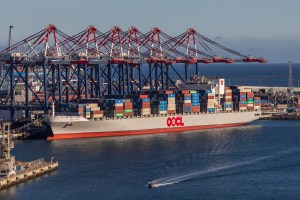
China-based Cosco Shipping and subsidiary Orient Overseas Container Line (OOCL), which made over 1,300 U.S. port calls over the last 12 months, according to data from S&P Global Market Intelligence, would remain the most impacted ocean carriers.
Chinese-built ships owned by non-Chinese companies, which comprise most of the major shipping firms like Mediterranean Shipping Company (MSC) and Maersk, will be charged $18 per net ton, with annual fee increases of $5 over the same period.
The average large 12,000 20-foot equivalent unit (TEU) container ship can carry roughly 60,000 tons, which would amount to a $1,080,000 fee for a rotation.
All fees will be charged up to five times per year, per vessel.
“Ships and shipping are vital to American economic security and the free flow of commerce,” said USTR Jamieson Greer in a statement. “The Trump administration’s actions will begin to reverse Chinese dominance, address threats to the U.S. supply chain, and send a demand signal for U.S.-built ships.”
The fees function as a U.S. penalty on China over what the USTR ruled as an “unreasonable” dominance over the shipbuilding, maritime and logistics industries after a nine-month probe. The office has argued that China has had the benefit of state subsidies, thus making it difficult for other countries to compete with Chinese shipyards.
Not all Chinese-built vessels will be impacted. Vessels sailing less than 2,000 nautical miles from a foreign port will not be fined. Neither will smaller ships that carry less than 4,000 20-foot TEUs.
It is not immediately clear how high the maximum fees would run for large container vessels. The initial proposal called for fees of $1.5 million per port call for Chinese-built ships, and up to $1 million for Chinese-operated ships.
Under the previous proposal, which had included cumulative fees, a Chinese-built ship sailing for Cosco Shipping would have to pay up to $3.5 million in penalties at each port call in the U.S.
The fees do not apply to U.S. government cargo.
The majority of nearly 600 public comments collected by the USTR criticized the first iteration of the levies, before a two-day public hearing took place in March.
The American Apparel and Footwear Association (AAFA) still opposes the fees, arguing that they will reduce U.S. trade that could both result in losses for American businesses and further raise costs for U.S. consumers.
“We are deeply concerned that the newly announced port fees and shipping mandates are destined to have devastating consequences for American workers, consumers and exporters. These measures are driving up shipping costs, shrinking GDP and reducing U.S. exports. When ocean carriers raise rates, American families will pay the price through higher costs and growing product shortages, at a time when they can least afford,” said Nate Herman, AAFA senior vice president of policy, in a statement. “We fully support strengthening the U.S. maritime industry, but penalizing shippers for not using American-flagged or built vessels, when they cost up to five times more and remain in limited supply, is counterproductive.”
Herman argued that smaller regional ports will see fewer vessel calls, putting local jobs at risk and disrupting the flow of U.S. goods.
“We fully support strengthening the U.S. maritime industry, but penalizing shippers for not using American-flagged or built vessels, when they cost up to five times more and remain in limited supply, is counterproductive,” Herman said.
The Alliance for American Manufacturing (AAM), one of the parties that supported the initial implementation, was pleased with the final action.
“The largest obstacles to shipbuilding in the United States are the unfair trade and economic practices of China. While no nation should be faulted for seeking to develop maritime capabilities, Beijing’s ambitions go well beyond that,” said AAM president Scott Paul in a statement. “Our nation’s shipbuilders and workers deserve a level playing field and haven’t had one for decades. We thank the United Steelworkers and their labor partners for initiating this groundbreaking case.”
Beyond the port fees, the USTR has made a new proposal to tariff Chinese-built or -controlled ship-to-shore cranes up to 100 percent, and 20-percent to 100-percent tariffs on Chinese containers and chassis. The crane tariff would be a serious escalation of the 25-percent duties the Biden administration slapped on the equipment last year.
The USTR will hear additional comments on the proposed tariffs until May 8, with another public hearing set to be held May 19.
As expected, China was critical of the USTR’s decisions, with its foreign affairs ministry reiterating that the port fees and tariffs on cargo-handling facilities harm both the U.S. and China.
“The move not only hikes global maritime shipping costs and disrupts the stability of global industrial and supply chains, but also increases inflationary pressures in the U.S. and hurts the interests of American consumers and businesses,” said spokesperson Lin Jian early Friday. “The practice will ultimately fail to revitalize the U.S. shipbuilding industry. We urge the U.S. to respect facts and multilateral rules, and immediately stop its wrongdoings. China will take necessary measures to defend its lawful rights and interests.”
Earlier this month, President Donald Trump signed an executive order aimed at reviving the U.S. shipbuilding industry as concerns develop in Washington about China’s growing gap with the U.S. in shipbuilding and maritime capabilities.
That EO would help incentivize private investment in the construction of commercial components, parts and vessels, enforce the collection of harbor maintenance fees and create a maritime trust security fund.