UPS is showing no signs of slowing down its automation push.
The logistics giant is investing $120 million in 400 robots used to unload trucks, according to a Bloomberg report Tuesday. The company plans on using robotics technologies from Pickle Robot that are built to autonomously unload trailers and containers of non-palletized goods in as little as 90 minutes.
Sourcing Journal has reached out to UPS.
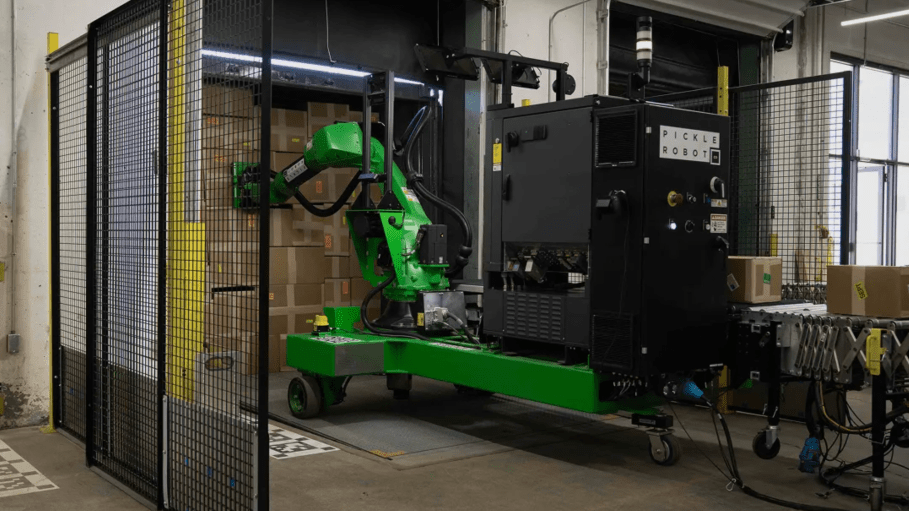
The technology is geared at speeding up the process of unloading trucks at warehouses, which often takes four or more staffers and can be physically demanding. These robotic gripping arms are designed to pick and place packages in constrained physical spaces within a trailer, regardless of location or freight configuration.
Related Stories
According to the company’s website, one Pickle Robot handles packages from small 6-inch cubes up to larger boxes that are 32-inches wide. For loose-packed, floor-loaded freight, it can pick up weights of up to 50 pounds. Depending on the type of freight, the system is estimated to pick and unload 400 to 1,500 cases per hour.
The robotics provider is also developing a software platform it can integrate with third-party hardware, from humanoid robots to autonomous forklifts.
The Bloomberg report said the $120 million investment follows multiple years of experimenting with the technology to demonstrate that the robots can help reduce labor costs.
A previous statement from UPS indicated that the company has used Pickle Robot’s unloading technologies since 2023.
Yusen Logistics already uses the technology in its Long Beach, Calif. transloading facility to process inbound freight, unloading hundreds of containers from trucks per day onto conveyor belts in the warehouse. A full container is typically unloaded in two hours or less.
Another client, Randa Apparel & Accessories, has used a picking robot since October 2024 at its Fort Worth fulfillment center. In the first three months of use, the lifestyle brand said the Pickle Robots unloaded over 1.5 million pounds of apparel, including pants, shirts and accessories.
UPS will deploy Pickle Robots in multiple facilities in the latter half of 2026 and into 2027, the Bloomberg report says.
Last year, during its investor day, the company said it would spend $9 billion on automation projects by 2028. As part of that investment, UPS is currently implementing major automation projections at 63 sites, with the plan to triple the number of facilities with automated technologies to 400 nationwide. Most of those projects are retrofitting existing buildings.
Fitting with that theme, the Pickle Robot can be deployed in existing warehouses, which would be beneficial for UPS since the technology doesn’t require specially designed facilities or extensive upgrades.
Over the past year, automated systems have been deployed in 35 UPS facilities, CEO Carol Tomé said in an October earnings call, with plans to deploy automation projects in seven additional buildings in December.
Progress on the wider network configuration, UPS anticipates 66 percent of its volume will move through automated processes in the fourth quarter, up from 63 percent during the same period last year.
Facility closures have also played a role in this network configuration, with 93 buildings shuttered so far this year, including 19 in the third quarter.
Along with a string of 48,000 layoffs, the automations projects are estimated to help the delivery provider save $3.5 billion in 2025. According to chief financial officer Brian Dykes, the automation investments are also expected to deliver significantly more cash flow over time.
Pickle Robot is just one of a series robotics partners aimed at bolstering the courier’s automation capabilities.
In recent years, UPS has used pick-and-place technologies powered by Dexterity, Fortna and Plus One Robotics to help employees sort small packages. The company has also leveraged autonomous guided vehicles (AGVs) powered by Dane Technologies, Geek+, Locus Robotics, Crown Lift Trucks and Toyota-Raymond. AGVs are designed to help workers safely and more easily move small packages and hard-to-move irregular-sized shipments through a facility.
Although UPS never overtly confirmed the partnership, the company had also reported to be working with
The Pickle Robot is a competitor to another robotics technology gaining recent popularity in logistics circles—the “Stretch” warehouse robot from Boston Dynamics.
In May, DHL signed a deal with Boston Dynamics that aggressively expanded on their partnership, with the robotics giant agreeing to deploy 1,000 addition Stretch units to automate the container unloading process. At the time of the announcement, DHL said it wanted to expand the range of applications for the robots, including case picking and box picking.