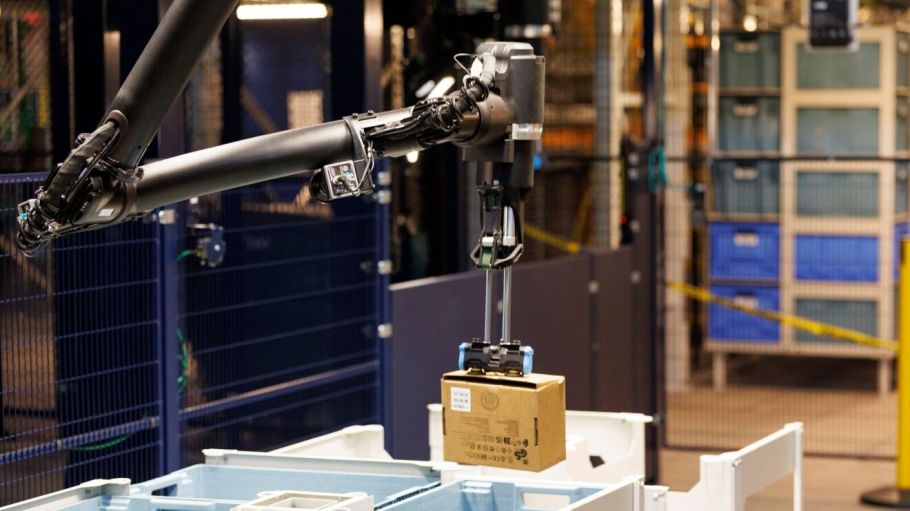
Amazon is quietly shelving its Blue Jay project months after introducing the robotic picking and stowing system in a South Carolina fulfillment center last October.
The e-commerce giant confirmed that “many” employees working on Blue Jay have been reassigned to other projects, but did not specify the exact number of impacted staff.
The technology was touted as the core system to help power the company’s same-day delivery sites, serving as an “extra set of hands” for workers that essentially could collapse three separate stations for picking, stowing and consolidating into one workspace.
Related Stories
When Amazon revealed the Blue Jay system, the company said it was designed to give employees a breather from repetitive physical tasks like reaching for, lifting and stowing items to focus on work like quality control and problem-solving.
The technology was also designed with worker safety in mind, with goals to help improve productivity while reducing the muscle strains that can be incurred performing physically demanding tasks. Amazon has often fielded criticism of its warehouse working conditions, and has been cited in the past for exposing workers to ergonomic hazards.
The news of the shelving was first reported by Business Insider, which said the program shut down in January.
The shutdown comes as the company continues to experiment with robotics all across its supply chain network, operating over 1 million robots in its facilities.
According to Amazon, Blue Jay was launched as a prototype. The company says it intends to apply what it learned from the technology to other programs across multiple areas of its operations.
“We’re always experimenting with new ways to improve the customer experience and make work safer, more efficient and more engaging for our employees,” said Amazon spokesperson Terrence Clark in a statement. “In this case, we’re actually accelerating the use of the underlying technology developed for Blue Jay, and nearly all of the technologies are being carried over and will continue to support employees across our network.”
The Business Insider report said Amazon plans to incorporate parts of Blue Jay’s technology into a new system called “Flex Cell.” While the previous system was mounted to the ceiling, the updated version would originate from the floor.
That report indicated that Blue Jay’s high cost, manufacturing complexity and implementation challenges were reasons the system was put on ice.
The online marketplace referred to Blue Jay as part of a wider portfolio of projects that the company invested in last year, which include a slew of robotics technologies including Vulcan, Sequoia, Cardinal, Proteus and Sparrow.
When Blue Jay was first unveiled in October, Amazon said its development moved from concept to production in just over a year. This process took three or more years for earlier Amazon systems like picking and packing robot Sparrow, package handling robot Cardinal and package sorting robot Robin. The company attributed Blue Jay’s accelerated development to advancements in AI.
According to Business Insider, Amazon’s spurning of the Blue Jay tech coincides with the company’s move away from an automated same-day grocery micro-fulfillment center project known internally as “Local Vending Machine,” or LVM.
Amazon is replacing LVM with a new same-day warehouse operating system called “Orbital.” Unlike LVM’s more monolithic systems, Orbital is designed to be modular, consisting of many components that can be assembled in different configurations. The report suggested that Orbital’s flexibility is better suited to smaller same-day delivery warehouses.
The system could also potentially be installed as a micro-fulfillment solution in the back of Whole Foods stores, according to BI. Like LVM, Orbital is also expected to handle refrigerated products like groceries.
The first same-day warehouse built around the Orbital system is not expected to open until 2027, the report said.
The abrupt shift away from Blue Jay and the LVM system are unlikely to hamper Amazon’s wider robotics and automation ambitions, especially given the technology’s ability to cut down supply chain costs.
The New York Times reported in October that a leaked internal document from Amazon said the e-commerce giant’s robotics deployments could help the firm avoid hiring 160,000 new employees through 2027. That report indicated that Amazon could save about 30 cents per item it packs, picks and delivers to a consumer if it avoids these hires.
An Amazon spokesperson said the leaked documents “paint an incomplete and misleading picture of our plans.”