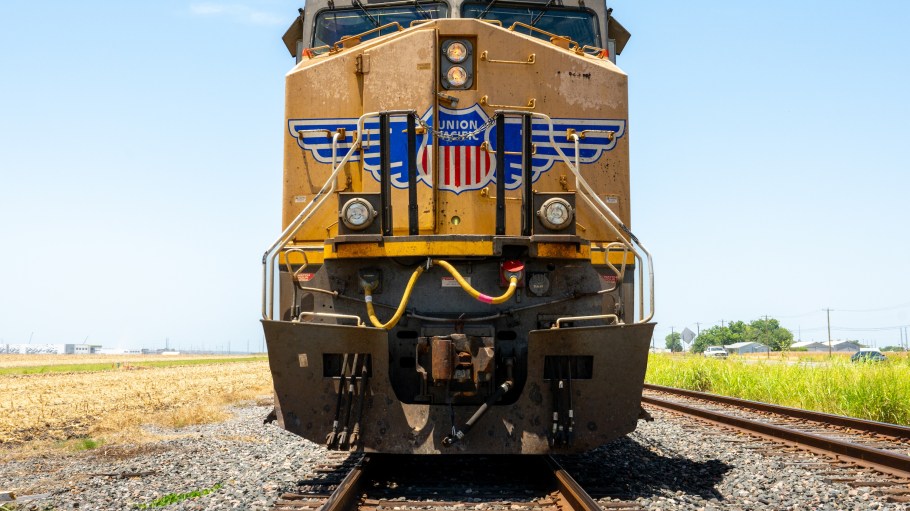
Union Pacific is pushing back its formal merger application for another two weeks, on account of a delay in the filing process.
According to CEO Jim Vena, the railroad had initially planned to file with the Surface Transportation Board (STB) for its proposed $85 billion acquisition of Norfolk Southern by Friday.
But the economists hired to help work on the roughly 4,000-page filing have to revise some of the content before Union Pacific officially submits the application, Vena said during Tuesday’s UBS Global Industrials and Transportation Conference.
Related Stories
“We had one contractor that needed to do some rework on some product. We want to make sure that final product is at the level that is exceptional so that when we give it to the STB, they’re comfortable that we’ve answered the questions and given them the information that they want,” Vena said. “At the end of the day, I think we want to do it right.”
The pending acquisition, which the railroads expect to close by 2027, still has to clear a lengthy review process by the STB. Once the application is filed, the STB will have 30 days to accept or reject it as incomplete.
Union Pacific is already feeling the heat of the expenses that come with a merger process of this magnitude, expecting to incur between $30 million and $40 million in takeover-related costs in the fourth quarter, said chief financial officer Jennifer Hamann at the investor event.
One of UP’s Class I competitors still isn’t convinced the Norfolk Southern acquisition is a done deal, even if it appears to have support in the White House.
“I don’t think it’s a fait accompli. I do not,” said Keith Creel, the president and CEO of Canadian Pacific Kansas City (CPKC), during the same conference. “I think people are grossly underestimating the complexity of what UP and NS are attempting to do and the regulatory path they’re going to have to go through.”
CPKC dealt with the STB extensively throughout its own two-year merger process. The board officially approved Canadian Pacific’s $31 billion merger with Kansas City Southern in March 2023, namely since it combined the two smallest Class I railroads operating in the U.S. at the time. Helping its cause, CP also had the fewest overlapping routes compared to if KCS merged with another Class I railroad.
But that deal had much lighter consolidation implications than the looming megamerger.
While CPKC carried just 3 percent of carload volumes in the U.S. in 2024, Union Pacific and Norfolk Southern had a 43 percent market share of carload volumes shipped, according to data from the STB’s Rail Service Metrics.
The railroad, like fellow Class I operators BNSF and Canadian National (CN), has been open about its stance against the UP-NS merger, calling it “unnecessary” and “not in the public interest” in an advisory on its website.
Despite the public statements, Creel said he’s not threatened by the pending deal and doesn’t “lose any sleep” over it. The CEO pointed out the railroad’s geographic advantages—it is the only Class I to operates trains across Canada, the U.S. and Mexico—and the company’s low (5 percent) volume that rides on Norfolk Southern trains.
But Creel expressed concerns for the wider industry and the potential impacts to service levels, noting that federal approval of the Union Pacific-Norfolk Southern deal “very well might” lead to “a world where you have two railroads.”
“This industry is so consolidated that if you get to a place where there’s only two railroads and one of them gets sick, this nation is going to be on its knees from a commerce standpoint,” said Creel.
BNSF has denied having interest in an acquisition, while the other major Class I, CSX, saw its new CEO recently highlight the importance of operating as a standalone company. The companies have partnered on multiple coast-to-coast intermodal rail services.
Creel said the company would seek concessions during the STB’s approval process.
“We’re going to have markets open to us that today might be closed to us,” Creel said. “In a world where for this to happen, there’s going to have to be perhaps divestitures of lines. There’s going to have to be trackage rights given. There could be zone switches.”
When asked about what concessions Union Pacific would make to fulfill the STB’s requirement that railroads “enhance competition” with a merger, Vena sounded off on the expected enhancement of UP’s service offering, reiterating “We’re keeping gateways open.”
Vena was less certain about the shifting of trackage rights, which allow for trains from one railroad to use the tracks of another.
“Last time I looked, we do not have a lot of overlap,” Vena said. “It just does not make a particle of sense to me…We’re not Santa Claus to give away trackage rights.”
According to Vena, only about 10 customers are jointly served by Union Pacific and Norfolk Southern in the Midwest. And out of 30,000 miles of railroad in its network, Vena said UP and NS only overlap on “a few hundred miles.”
The deal has garnered criticism from more trade groups despite it having support from President Donald Trump and the industry’s largest union, SMART-TD.
On Monday, the National Association of Waterfront Employers (NAWE) sent a letter to the STB expressing serious concerns about the impact of the UP-NS deal on intermodal rail operations at U.S. ports.
That followed up a letter signed by more than 60 trade associations across the agriculture, chemicals and manufacturing industries, which shared similar concerns about potential effects on the supply chain.