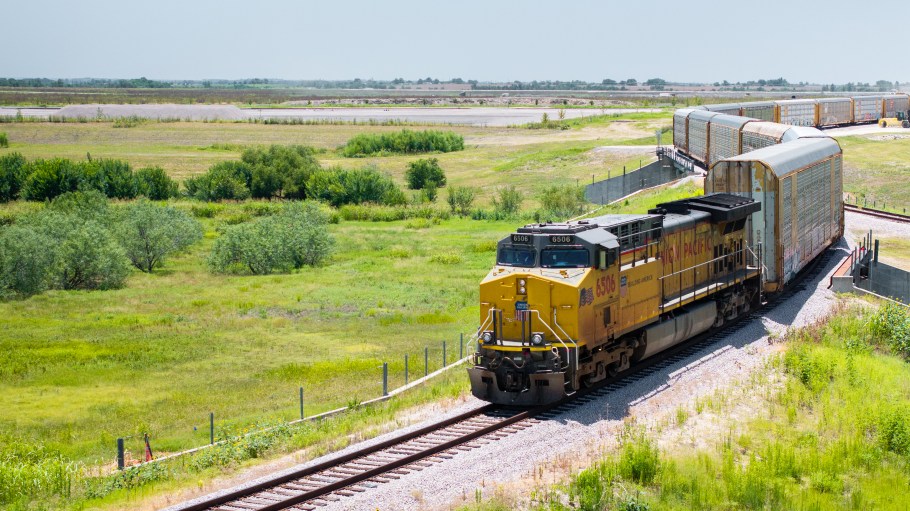
The $85 billion Union Pacific-Norfolk Southern merger may have just seen another domino fall in its favor.
Surface Transportation Board (STB) member Robert Primus was fired by President Donald Trump on Aug. 27, giving the Commander-in-Chief an opportunity to appoint two additional Republicans to the board ahead of its decision on whether to approve the takeover.
With Primus no longer on the board, the STB consists of two Republicans and one Democrat. Two member seats now remain vacant.
Related Stories
In a LinkedIn post, Primus called the termination “deeply troubling and legally invalid,” and has noted in other interviews that the White House did not offer any cause for the firing. Primus said he will continue his duties, and will fight back legally if prevented from doing so.
The White House’s public stance is that Primus “did not align with the president’s America First agenda.”
Trump appointed Primus, a Democrat, to the board in 2020 during his first term. Primus was named board chairman last year by President Joe Biden until Trump elevated another member, Patrick Fuchs, to take his place.
Primus was the only board member to dissent from a March 2023 decision to approve Canadian Pacific’s $31 billion acquisition of Kansas City Southern, now known as Canadian Pacific Kansas City (CPKC).
That deal was the first of its kind under the STB’s consolidation rules adopted in 2001, which established that future M&As would need to prove they could both enhance competition and serve the public interest.
At the time, the merging companies were the smallest of the Class I North American railroads, which worked in both railroads’ favor.
The Trump administration already has shown its hand that the STB would likely support the UP-NS tie-up, with Commerce Secretary Howard Lutnick publicly calling for railroad interchanges to be made more efficient to support transcontinental rail. Additionally, Fuchs has held a series of meetings since July that are designed to discuss ideas of how the STB can update its framework to potentially reduce regulatory barriers.
The SMART Transportation Division (SMART-TD), which represents roughly 125,000 active and retired railroad, bus and mass transit workers, strongly condemned the decision, with the union calling it an “unprecedented and unjustified” removal.
The union did not hold back in its criticism.
“The timing of this move cannot be ignored. Prior to its submission to the Board Mr. Primus has made clear his opposition to the so-called ‘merger’ that would be a corporate takeover combining Union Pacific Railroad and Norfolk Southern Railroad,” the statement wrote. “To eliminate a Senate-confirmed position simply because corporate America disagrees with a regulator’s position is an assault on the independence of federal oversight itself. It sends a chilling message: that regulators who dare to stand up for fairness and balance in the rail industry can be swept aside to serve Wall Street’s agenda.”
Multiple other rail unions, the nonprofit Rail Passengers Association and several Democratic lawmakers also condemned the termination.
Days after Primus’ firing, Knight-Swift Transportation threw its support behind the pending deal, saying that it will “greatly benefit intermodal transportation by enabling seamless single-line service from coast to coast.”
The formation of an intercontinental railroad would ideally cut down transit times, particularly by reducing interchange points, where carloads and containers are moved from one railroad to the other. Union Pacific CEO Jim Vena said he expects transit times on those routes to be one-to-two days shorter.
Knight-Swift CEO Adam Miller called the acquisition a “significant breakthrough” in U.S. freight transportation, saying that a coast-to-coast network would benefit everyone across logistics providers, their shipper customers and end consumers.
“As a company that operates thousands of trucks and thousands of intermodal containers, we know the power of combining modes,” Miller said in a statement. “This unified rail system will let us seamlessly integrate our trucking with rail on cross-country shipments like never before. The result will be faster deliveries, and lower fuel usage, which is great news for American businesses.”
Swift Intermodal, Knight-Swift’s intermodal transportation segment, already partners with both Class I railroads. That division owns roughly 12,500 containers and moves nearly 150,000 loads across all North American railroads annually.
With its truckload fleet of 21,300 tractors and more than 600 intermodal trucks, Knight-Swift says it will leverage the merged railroad to offer customers new coast-to-coast services.
The trucking firm anticipates more shippers will embrace intermodal options if service improves and expects the deal to bolster supply chain competitiveness by maximizing the efficient use of both trucks and trains.
Another logistics player, Hub Group, had already endorsed the deal in the days after it took place, citing that the transaction would further accelerate the company’s long-term growth opportunity.
“A transcontinental network removes friction in gateways, reduces transit times, provides access to new markets and increases competition with truck volume through new single-line service,” said Hub Group in a statement.
Approximately 30 percent of Hub’s intermodal business is transcontinental.
As the deal generates more industry opinions, another department within the SMART labor union ironed out its own collective bargaining agreement with Union Pacific.
The SMART Railroad, Mechanical and Engineering Department (SMART-MD) reached and unanimously ratified an agreement for its members working at the railroad. The union did not disclose the length of the contract.
Based on terms of prior deals reached with other rail carriers, the agreement will include annual general wage increases of 17.5 percent, paid vacation days for new hires and accelerated qualification and accrual of paid vacation for tenured employees. The deal also includes added health insurance benefits.