More tariffs are coming to the trucking industry.
In a post on social media, President Donald Trump said he plans to impose 25 percent duties on foreign medium- and heavy-duty trucks starting Nov. 1.
The White House has not offered any additional details on the tariffs, including whether vehicle parts would be impacted, or whether imports from Mexico and Canada would be exempt if they were compliant with the U.S.-Mexico-Canada Agreement (USMCA).
Related Stories
Under USMCA, imported heavy-duty trucks are currently duty free if at least 64 percent of the vehicle’s value is sourced in North America. This includes parts like engines and axles, raw materials and labor costs. That threshold is expected to increase to 70 percent by 2027.
Mexico and Canada are the two largest exporters of heavy-duty trucks to the U.S., with total units valued at $15.4 billion and $4.2 billion, respectively, according to the Commerce Department.
Late last month, the president had said in a previous Truth Social post he would place these tariffs on heavy-duty trucks on Oct. 1, citing an effort to protect American trucking manufacturers like Peterbilt, Kenworth, Freightliner and Mack Trucks from “unfair outside competition.”
The tariffs come at a time when the trucking industry has already been enduring a three-year freight recession characterized by excess capacity, weakened freight rates and higher operating costs—all exacerbated by a contraction in U.S. manufacturing. Proponents of the tariffs say the policy is supposed to facilitate a boost in domestic manufacturing.
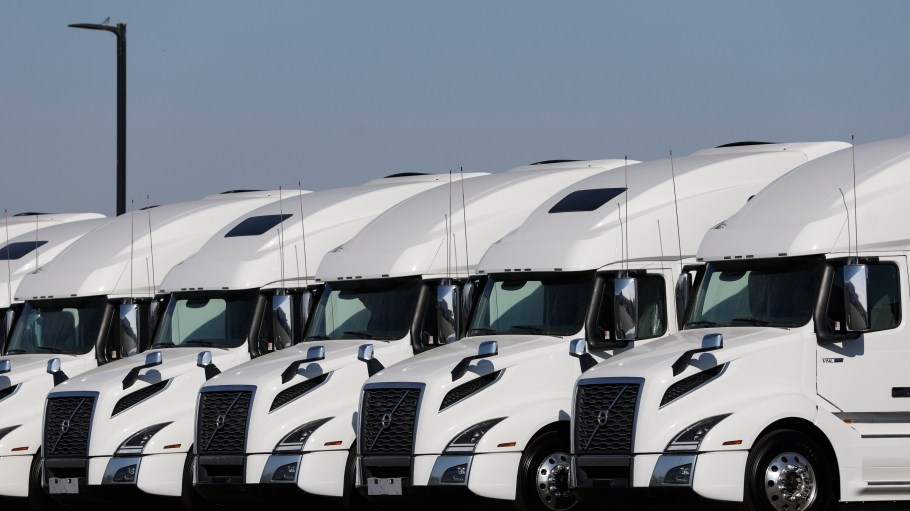
Heavy-duty trucks affected by the tariffs include various vehicles used in apparel supply chains, including tractor-trailer trucks, semi-trucks and delivery trucks. The tariffs would also cover imports of garbage trucks, public utility trucks and school buses.
Heavy-duty trucks carry a maximum operating weight of 26,000 pounds, while medium-duty trucks operate within a range of 10,001 and 26,000 pounds.
The duties follow months after the Commerce Department opened a Section 232 probe into heavy truck imports. Section 232 of the Trade Expansion Act authorizes the president to levy tariffs on imports deemed necessary for national security.
Trump and his administration have already leveraged Section 232 duties on light-duty trucks and cars, as well as a litany of other industries including steel and aluminum. Others like timber and lumber are expected to see tariffs starting Oct. 14.
For the light-duty trucks and cars out of Mexico and Canada, the Trump administration has allowed importers to deduct the value of certain components from the tariffs if the parts originate in the U.S.
Previous trade deals with the E.U. and Japan have included 15 percent tariffs on light-duty trucks.
Derek Leathers, CEO of trucking company Werner Enterprises, told attendees at Wex OTR Summit last Thursday that he had been concerned about any new tariffs placed on trucks in Mexico, estimating that two-thirds to three-quarters of all truck makers manufacture their trucks there.
“If I had been betting on this stage a year ago, I would have lost that bet because I would have said that USMCA would supersede and that there would be no additional tariffs on trucks from our neighbors,” Leathers said. “Clearly that is not the case as we stand here today.”
Trucking manufacturers International Motors and Daimler Truck are overly reliant on imported trucks from Mexico for most of their fleet, at 93 percent and 83 percent, respectively.
In May, the U.S. Chamber of Commerce urged the Trump administration not to go through with the tariff policy, noting that the top five exporters of medium- and heavy-duty trucks to the U.S.—Mexico, Canada, Japan, Germany and Finland—all were allies or close partners posing no threat to U.S. national security.
Top automotive manufacturers are taking opposing sides of the argument, with parent Stellantis reportedly seeking to waive the tariff on medium-duty Dodge Ram trucks imported from Mexico to the U.S.
The other two of Detroit’s “Big Three” automakers, U.S.-headquartered General Motors and Ford, have urged Trump administration officials to dismiss the request, according to Bloomberg.
Ford had argued that voiding medium-duty truck tariffs for Stellantis would give them a cost advantage over U.S.-assembled trucks that contain imported parts already subject to tariffs.
The Section 232 tariffs are different from the more common “reciprocal” country-specific duties used by the Trump administration via the International Emergency Economic Powers Act (IEEPA). Those sweeping global tariffs, which under Section 301 authorize the U.S. Trade Representative to respond to unfair trade practices, are being challenged in the federal courts.
The Supreme Court has scheduled arguments for Nov. 5.