Trucking’s attempts to escape a three-year freight recession have been largely unsuccessful, but the start of 2025 indicated the arrow was possibly pointing in the right direction. Then tariffs kicked in.
In the first quarter, national trucking volumes tumbled 13.8 percent from the year prior, the best year-over-year reading since the third quarter of 2023, according to the quarterly U.S. Bank Freight Payment Index.
The volume decline was an improvement over the 15.7 percent dip in 2024’s first quarter. Total shipments have fallen for 11 straight quarters.
Related Stories
Performance varied widely among regions, with southwest volume down 40.1 percent annually—the largest decline in the index’s history—while northeast shipments increased 2.1 percent. Shipments out of the Midwest fell 13.9 percent year over year, while volumes out of the southeast sank 9.3 percent.
“Lower housing starts and major weather events during the first part of the year negatively impacted the truck freight market. On the other hand, truck freight in the Northeast was boosted by stronger retail sales and increased imports,” said Bob Costello, senior vice president and chief economist at the American Trucking Associations (ATA), in a statement. “All told, there are some signs of improvement amid persistent headwinds for the trucking industry.”
Spending, the other major metric measured by the index, dropped off 8.6 percent to begin the year, marking the ninth straight year-over-year decline. The index measures quantitative changes in freight shipments and spend activity based on data from transactions processed through the U.S. Bank Freight Payment platform, which processes $43 billion in freight payments annually.
However, that was the smallest reduction in two years, since the first quarter of 2023. Spending had declined more than 20 percent for four straight quarters.
With carrier spending declining less than volume, that suggests that industry capacity is tightening as some fleets reduce their truck and driver counts, and other fleets exit the industry altogether.
On a year-over-year basis, trucking transportation jobs have largely held up, according to data from the Bureau of Labor Statistics (BLS). Preliminary BLS data tallies 1,524,500 truck drivers for April, down 0.3 percent from 1,528,500 drivers in the prior-year month. On a month-over-month basis, employment is up 0.1 percent from 1,523,100 in March.
But layoffs across the industry are starting to creep in that could officially take hold in the coming months. Trucking companies like Volvo Group and Mack Trucks, Penske Logistics and U.S. Xpress have all begun select job cuts in recent weeks, while multiple businesses in that time have filed for bankruptcy.
A recent presentation from asset management firm Apollo Global Management projects that mass layoffs across the trucking and retail sectors will accelerate in late May to early June as the knock-on effects of Trump administration’s tariffs play out.
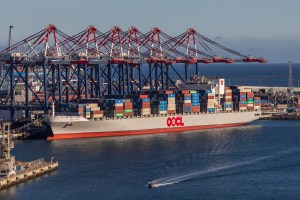
The dearth of cargo flowing into West Coast ports as businesses cancelled shipments out of China has a direct spillover to the trucking industry, as drivers will be picking up fewer loads and making fewer deliveries. A collapse in demand further would sink freight rates and likely force more companies to employ fewer drivers or cut more trucking capacity.
April freight appointments from ports, warehouses and distribution centers sank 41 percent from March, according to dock appointment scheduling platform DataDocks. These problems are most exacerbated in the Northwest (61 percent) and West (52 percent) regions, further illustrating the issues that were foreseen out on the West Coast.
Recent earnings calls from companies like Knight-Swift, Old Dominion, TFI International and Saia all reflected some level of concern regarding demand softness.
Another top less-than-truckload (LTL) firm, XPO, saw its North American LTL division decline 4 percent to $1.17 billion from $1.22 billion in its first quarter on a 7.5 percent decrease in tonnage per day and 5.8 percent decline in daily shipments.
However, the trucking company held up well compared to its competitors, with April tonnage estimates down 5.7 percent year over year—an improvement over 6 percent declines seen in January and February. The company expects second-quarter volumes to remain down “a similar range” to April, said XPO’s chief strategy officer Ali Faghri in an April 30 earnings call.
CEO Mario Harik did indicate there was a more “cautious” tone from customers.
“The majority of customers are expecting to see a flattish demand in the back half as opposed to what they were a quarter ago, where the majority were expecting an acceleration of demand in the back half,” said Harik.