Truckers and farmers in Mexico have been imposing blockades on major highways across the country since Monday, potentially lending to delays for freight crossing the country’s border with the U.S.
These nationwide protests have lingered for a third straight day Wednesday, impacting highways in various Mexican states including U.S.-bordering Chihuaha and Sonora, Guanajuato, Sinaloa, Michoacán, Jalisco and Tlaxcala, among others.
According to the Mexican government’s Ministry of Interior, truckers and farmers carried out 31 blockades across 11 states early Wednesday morning.
Related Stories
The demonstrations are being led by trucking and freight carrier group the National Association of Carriers (ANTAC) and two agriculture groups, the National Front for the Rescue of the Mexican Countryside (FNRCM) and the Agricultural Peasant Movement (MAC).
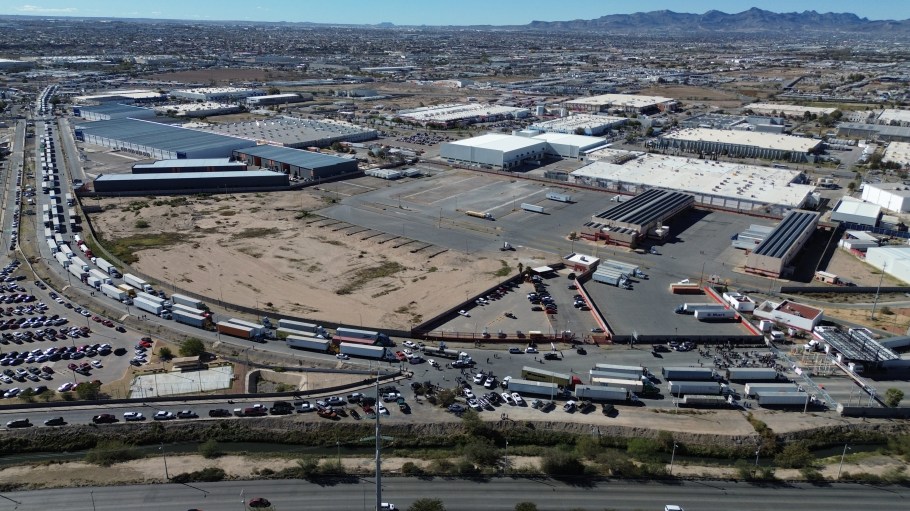
On Tuesday, third-party logistics (3PL) provider C.H. Robinson said there was no movement at bridges entering the U.S. in border cities Ciudad Juárez and Nogales, with delays continuing at Nuevo Laredo, which borders the major land trade hub of Laredo, Texas.
According to U.S. Census Bureau data, the Port of Laredo was the top trade gateway in the U.S. in August, with $30.3 billion in goods passing through the hub. The port surpassed the Port of Los Angeles to take the No. 1 spot, with the California gateway handling $29.5 billion in imports and exports.
Another border crossing from Sonoyta, Sorona, to Lukeville, Ariz. was impacted by the delays, C.H. Robinson said. Additionally, the Port of El Paso extended the operating hours of its cargo facility to 11 p.m. local time to account for the slowdowns.
A day prior, the 3PL said similar events had caused transit delays of four-to-eight hours and customs delays of two-to-four hours.
Across Mexico, truckers at ANTAC are protesting the safety concerns stemming from escalating violence and cargo theft they experience on the job. The association is demanding federal intervention to address security issues.
“We regret that peaceful protest is the only way for our demands to be heard, but today we know that the only way to avoid being robbed, extorted, killed or disappeared on the highways is by staying off those roads. We would rather stop for one day or five than never return home again,” read a social media post from ANTAC. “Every day, between 35 and 40 transport operators fall victim to a crime. If we are lucky, we end up abandoned in the middle of nowhere; if not, we never make it home again.”
ANTAC’s concerns also expand to what it alleges is corruption within law enforcement. Association vice president David Ortiz said a main demand of ANTAC is for the Mexican government to replace municipal and state police officers at roadside stops with National Guard members. The organization claims truckers are commonly extorted by police at the stops.
The truckers are also demanding that authorities improve the processes to issue license plates and driver’s licenses.
The agriculture groups have joined in on the intermittent blockades throughout Mexico, demanding more support from the federal government, namely by increasing the guaranteed floor price of their crops like corn. They argue the lack of predictable pricing threatens production cycles and creates uncertainty for producers dependent on stable purchasing programs.
The groups continued their demonstrations Wednesday after a failed second round of negotiations with the government’s Ministry of the Interior Tuesday night.
“They are suggesting that if we agree to end the protests, they will listen to us,” Ortiz told Mexican radio network Radio Fórmula. “We are certainly not going to do that. We feel deceived and mocked because the negotiation we want to have does not meet our expectations.”
In a statement posted Tuesday night after the four-hour meeting, the Ministry of the Interior called on the carriers and farmers to end the blockade, stressing that they “prevents citizens from exercising their right to free transit and seriously affects the passage of services and products necessary for the life and economy of the communities.”
President Claudia Sheinbaum chimed in on the concerns from truckers in a Wednesday morning press conference, saying “progress has already been made there.” Sheinbaum said she presented the groups with data that highway robberies have decreased from previous years, although she did not explicitly highlight the figures in her speech.
“We have to keep advancing—it’s not zero, it’s true, it’s not zero—but we’ve made progress and we continue to make more,” Sheinbaum said.