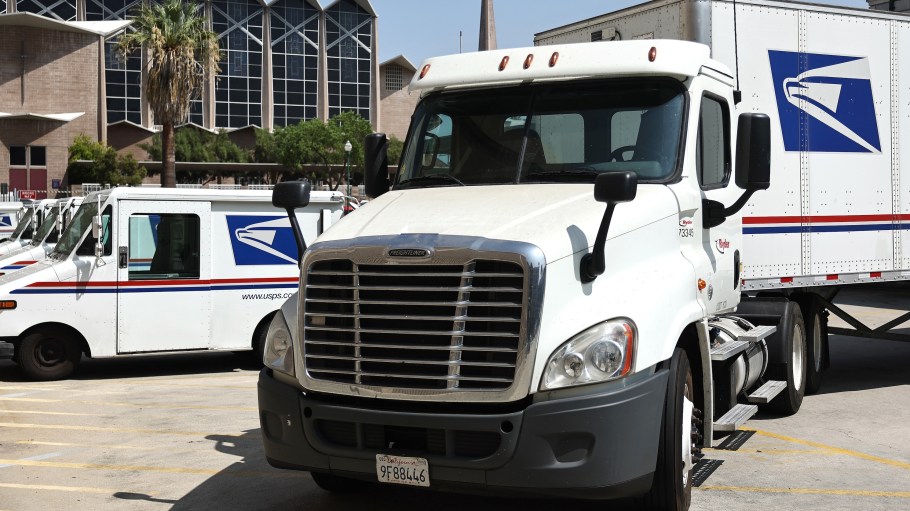
The U.S. Postal Service (USPS) is working with its contracted trucking providers to phase out unvetted non-domiciled commercial driver’s licenses (CDLs) to reduce the risk of trucking-related safety incidents.
The agency’s decision aligns with the Trump administration’s national crackdown on trucking compliance, after a federal audit found concerns with how some states issue the licenses due to “weak oversight, insufficient training and programming errors.”
“USPS just completed an extremely safe and efficient peak season delivering the nation’s holiday mail and packages,” said Postmaster General and CEO David Steiner. “We believe this additional requirement will strengthen the safety, efficiency and reliability of our services into the future.”
Related Stories
According to the USPS, the actions are consistent with the Department of Transportation’s (DOT) interim final rule in September titled “Restoring Integrity to the Issuance of Non-Domiciled Commercial Drivers Licenses (CDL),” which was designed to enforce state driver licensing agencies to restrict the issuance of non-domiciled CDLs and commercial learner’s permits (CLPs).
The rule would require in-person renewals with proof of lawful status such as a passport or an I-94/95A form. It would also require that states verify these documents through the federal SAVE system, which is designed to help federal and state government agencies confirm citizenship and immigration status of individuals within their jurisdiction.
That rule was granted an administrative stay by a federal appeals court in November, meaning states can continue issuing non-domiciled CDLs under old rules for now. The Federal Motor Carrier Safety Administration (FMCSA) has considered a rewrite to the final rule, having received more than 8,000 public comments on the proposed regulation.
“The safety of our employees, our customers and the American public is of the utmost concern to the Postal Service,” said Amber McReynolds, chairwoman of the Postal Service Board of Governors, in a statement.
Concerns about CDLs have been a fixture for the Trump administration, tying in heavily with the White House’s hardline immigration policy.
In one such example, President Donald Trump signed an executive order in April aimed at enforcing an already existing federal law requiring CDL holders to be English-proficient.
Trucking associations have been critical of the CDL-granting process, arguing that it is often too easy to attain a license, particularly for non-U.S. citizens. The issue gained national attention after a high-profile trucking accident in Florida in August, in which an undocumented immigrant got in a crash that killed a family of three after he attempted to execute an illegal U-turn. The driver received a full-term CDL in Washington State, as well as a non-domiciled CDL in California.
Last month, the DOT gave 3,000 CDL schools a 30-day notice to provide evidence of compliance to the FMCSA, or get their certifications taken away.
Since the DOT completed its national audit in September, the department has threatened to pull funding from several states it deems non-compliant. That includes California, Colorado, Minnesota, New Mexico, New York, Pennsylvania, South Dakota, Texas and Washington.
USPS did not provide additional details on what the new vetting process will entail.
The Postal Service moves 55,000 loads by truck every day, amounting to nearly 2 billion miles per year.
As of February 2024, the delivery agency had approximately 4,600 trucking contracts with third parties to move volumes across the U.S. The firm also has its own Postal Vehicle Service with more than 12,000 drivers that operate 2,364 tractors and 7,351 trailers.
For USPS, the changes come a month after one of its former contractors unveiled it would soon cease operations.
On Dec. 1, mail hauler 10 Roads Express announced it would shut down within 60 days and stop service to the USPS by Jan. 30. The trucking company said it saw total revenue dip 70 percent as the courier began to overhaul its operations, and expected to see further declines.
According to the FMCSA’s database, 10 Roads Express currently has 1,934 trucks and 1,704 drivers.
“Our industry has been navigating unprecedented challenges, and despite the dedication of our employees and leadership, the realities of the industry have become impossible to overcome,” said a 10 Roads Express spokesperson in a statement. “This decision was not made lightly, and we are grateful for the years of dedicated commitment and professionalism of our entire team.”