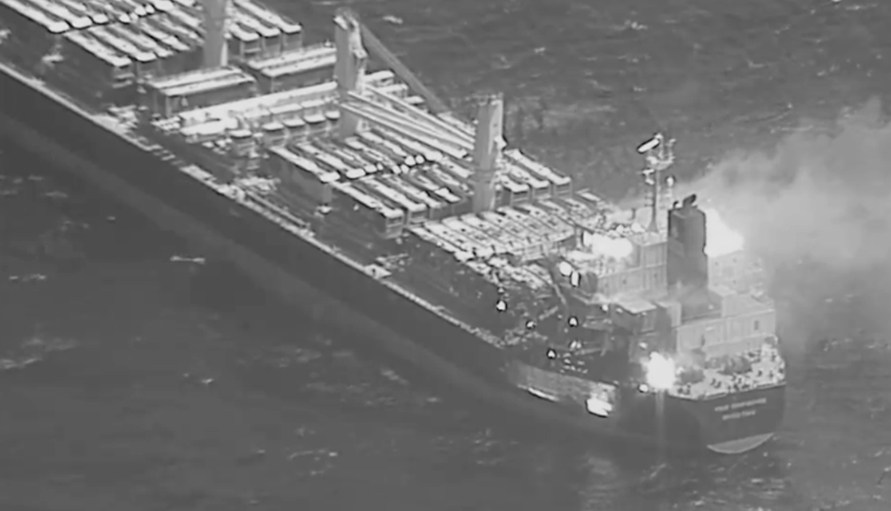
Three sailors were killed in a Houthi missile attack on a merchant ship traveling via the Red Sea on Wednesday, U.S. and U.K. officials said, marking the first reported fatalities since the Yemen-based militants started attacking vessels in November.
According to U.S. Central Command (CENTCOM), which oversees U.S. military operations in the Middle East, an anti-ship ballistic missile struck the bulk carrier True Confidence while transiting the Gulf of Aden. India’s navy evacuated 20 crew members and three armed guards from the stricken vessel, taking them to a hospital in Djibouti.
Related Stories
Two of the sailors killed were identified as Filipino, while the third was recognized as Vietnamese. At least four other seafarers were injured, three of whom are in critical condition.
This is the fifth such ballistic missile fired by the Iran-backed Houthis since Tuesday, with one other having hit the container ship MSC Sky II.
At the TPM24 logistics conference, former U.S. Secretary of Defense Robert Gates warned the audience not to expect any near-term improvement to the Red Sea disruptions.
“[The Houthis] may decide that they like the idea of controlling the amount of shipping going through the Red Sea, and say ‘We’ll continue this for an indefinite period of time,’” Gates said.
Gates is one of many with ties to the Department of Defense who isn’t buying the Houthis implication that their attacks are related to the Israel-Hamas war in Gaza—namely due to the largely indiscriminate nature of the incidents.
“One scenario is that if there is a ceasefire, and if the major military operations against Hamas in Gaza stop, that the Houthis do what they’ve said they will do. I think there’s good reason to doubt their word on this,” Gates said. “In all honesty, we’ll just have to wait and see which scenario plays out.”
While the future of the region remains uncertain, some apparel retailers are enduring varying consequences from the skirmish as container ships continue to be diverted away from the area.
Abercrombie & Fitch, which was previously identified by credit ratings firm Moody’s Investors Service as an apparel retailer at risk of feeling the heat from the Red Sea disruptions, is seeing the impacts in Europe.
“This is mostly an impact to the European market for us. A lot of shipping goes through that area,” said Scott Lipesky, chief financial officer and chief operating officer at Abercrombie & Fitch, in a company earnings call. “Our teams have been read and reacting, changing modes, whatever they need to do to get the product here at the right time at the best price.”
Lipesky said the retailer is “seeing some friction” on shipping costs, which will have an impact on expenses in Q2 and into the back half of the year.
While Abercrombie initially anticipated lower freight costs to be a benefit going into 2024 as freight rates declined precipitously throughout 2023, “we think that’ll be more than offset by the Red Sea,” Lipesky said.
Another apparel retailer that recently reported earnings, Nordstrom, has barely felt the impacts from the Red Sea reroutings. According to CEO Erik Nordstrom, the retailer is not seeing any effects on the merchandise margin.
“We have some portion of our goods that’s delayed a bit, but we don’t see any material effect to our results,” Nordstrom said in an earnings call.
Carter’s is the rare example of a retailer that appears to have felt the impact of the Red Sea on overall demand and sales.
“Demand slowed a bit in February, in part, we believe, due to having less spring inventory in our stores as a result of disruptions in shipping through the Red Sea,” said Richard Westenberger, executive vice president and chief financial officer at Carter’s, in an earnings call on Feb. 27. “We’ve made changes in our product routing to direct more of our import activity to the West Coast and around the southern tip of Africa to avoid the Red Sea. Right now, we’re not expecting significant further disruptions in bringing product to the U.S. from Asia.”
A major byproduct of the Red Sea crisis appears to normalizing by the week. Spot freight rates measured by the Drewry World Container Index (WCI) have declined for the sixth straight week after reaching a 15-month peak on Jan. 25 at $3,964 per 40-foot container, coming down 17 percent to $3,287 per container as of Thursday.
The composite index, which measures ocean spot rates across eight major trade lanes, decreased by 6 percent this week, but is still up by 82 percent when compared with the same week last year.