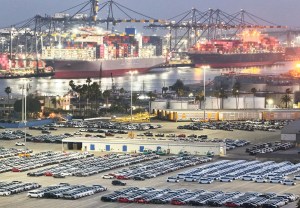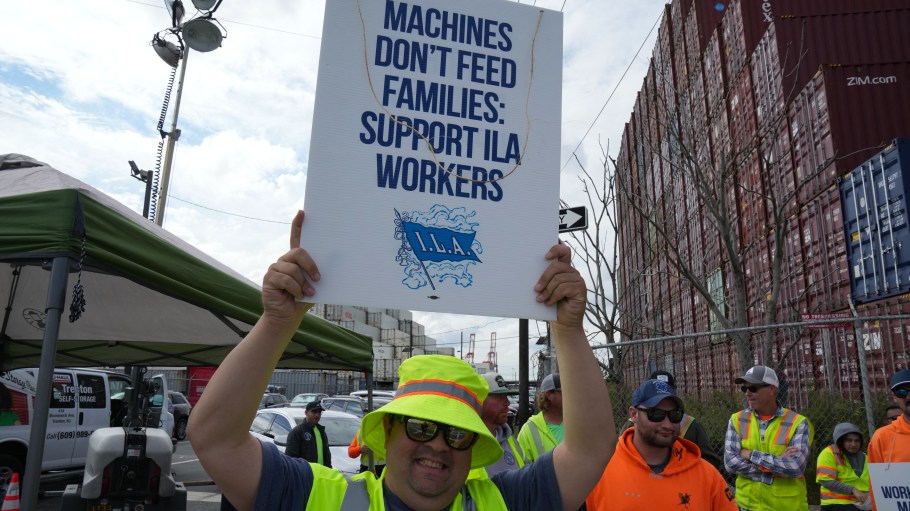
Day one of the East and Gulf Coast ports strike began with union dockworkers walking picket lines shortly after midnight Tuesday.
As the work stoppage brings port operations to a halt and slows down supply chains on the Eastern seaboard, President Joe Biden released a statement Tuesday urging the United States Maritime Alliance (USMX) to “present a fair offer” to the International Longshoremen’s Association (ILA) that ensures that its members are “paid appropriately in line with their invaluable contributions.”
Related Stories
Biden notably called out that the USMX represents a group of “foreign-owned carriers,” which include the likes of Mediterranean Shipping Company (MSC), Maersk, CMA CGM and Cosco Shipping, all of which have made exorbitant profits since the Covid-19 pandemic.
“Executive compensation has grown in line with those profits and profits have been returned to shareholders at record rates. It’s only fair that workers, who put themselves at risk during the pandemic to keep ports open, see a meaningful increase in their wages as well,” Biden said in the statement. “As our nation climbs out of the aftermath of Hurricane Helene, dockworkers will play an essential role in getting communities the resources they need. Now is not the time for ocean carriers to refuse to negotiate a fair wage for these essential workers while raking in record profits. My Administration will be monitoring for any price gouging activity that benefits foreign ocean carriers, including those on the USMX board.”
According to CNBC, the ILA is now demanding a 61.5 percent wage increase over six years. The number would be a step up from the 50 percent raise hike that the union previously rejected from the USMX.
Biden’s comments come as trade organizations have called on his administration to invoke the Taft-Hartley Act, which would extend the negotiating period 80 days and force the ILA back to work. The White House has maintained that it will not federally intervene in the collective bargaining process.
On Tuesday morning, the National Retail Federation called on the Biden administration to step in by using “any and all available authority and tools” including the Taft-Hartley Act to restore operations at all impacted ports and get parties back to the negotiation table.
“A disruption of this scale during this pivotal moment in our nation’s economic recovery will have devastating consequences for American workers, their families and local communities,” said NRF president and CEO Matthew Shay in a statement. “After more than two years of runaway inflationary pressures and in the midst of recovery from Hurricane Helene, this strike will result in further hardship for American families. The administration must prioritize our economy—and the millions of Americans who depend on it for their livelihood and wellbeing—and intervene immediately to prevent further hardship and deeper economic consequences.”
Retailers could feel the heat of a strike if it lasts too long. Even America’s largest retailer, Walmart, isn’t entirely insulated from potential supply chain slowdowns despite the inherent advantages of retailers its size. The retail giant relies on the East and Gulf Coast ports for roughly 86 percent of its total U.S. imports, according to container shipment tracking solution Vizion.
ImportGenius, which tracks global import-export records from U.S. customs at the bill of lading (BOL) level, said Walmart imported 47,680 20-foot equivalent units (TEUs) from Sept. 2023-2024, making it the top retailer exposed to a strike.
Ikea had the second-most imported containers of all retailers in that bracket, with 42,939 TEUs. With the home retailer already feeling the heat of Red Sea disruptions, the company is considering moving more production into the Americas to mitigate potential disruptions.
According to a March earnings presentation, Dollar Tree brings in 50 percent of their goods out of the East and Gulf Coast ports. A Goldman Sachs qualitative survey measuring freight exposure to U.S. indicates that if those shipments needed to be diverted to the West Coast ports, it “would be to ports that they are already sailing past on their usual route.”
While the company also says it has taken proactive measures to either pull forward deliveries or divert them, the prior observation would indicate that shipments coming in on the East Coast would have to stay put and wait out the length of a strike.
PVH Corp., the parent company of Calvin Klein and Tommy Hilfiger, said in the survey that it has “historically utilized East Coast ports,” noting that it has contingency plans in place and “will continue to explore shipping optionality as the situation evolves.”
Academy Sports + Outdoors also could see an impact from the strike, with the Goldman survey reporting that the “majority of its directly imported freight” is handled through the East Coast and Gulf Coast ports. Due to the uncertainty, the company moved “some” goods through the West Coast, but those ports may experience capacity constraints that decrease throughput.
Both VF Corp. and Ralph Lauren highlighted that they were able to preemptively route shipments to the West Coast in anticipation of the strike to avoid any delays. The Vans and Supreme owner said most of their holiday shipments were already received, while Ralph Lauren referred to pulling forward some select fall shipments and leveraging more second-half air freight capacity.
Retailers that didn’t seem to be as worried about the lingering work stoppage included Target and Costco, both of which said most of their imports are processed in the West Coast. Gap Inc., Macy’s and Lululemon also noted that the majority of their goods flow through the West Coast ports.
“The retail and apparel sector, heavily reliant on sourcing from Asia, primarily uses West Coast ports for importing goods,” said Mickey Chadha, vice president Moody’s Ratings. “Thus, disruptions at East or Gulf Coast ports may not directly impact it significantly. However, the sector is vulnerable to interruptions during the peak fall and holiday shipping seasons. With potential diversions to the West Coast due to work stoppages, there could be a temporary surge in freight costs, potentially eroding profit margins.”
Analysts have given varied estimates on the wider effects on the economy, with a range from a daily $540 million by The Conference Board to estimates as high as $5 billion, according to J.P. Morgan.