President Donald Trump signed an executive order Wednesday geared at revitalizing the U.S. shipbuilding industry as concerns on both sides of the aisle mount over the widened gap with China in the maritime sector.
The EO follows up the president’s plan to create an office of shipbuilding within the National Security Council, and comes as the U.S. Trade Representative (USTR) continues to take punitive action against China for what it called an “unreasonable” dominance of maritime, logistics and shipbuilding capabilities that harm American commerce.
Related Stories
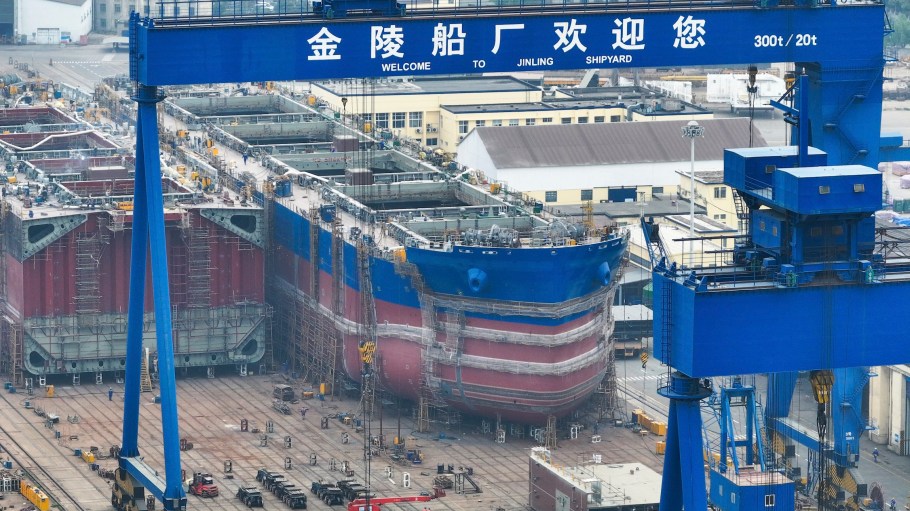
The shipbuilding gap between the U.S. and China over the past half-century has been staggering, to say the least. The U.S. built just five commercial ships in 2022, compared to 1,794 from China and 734 out of the second-largest producer, South Korea, according to data cited by the USTR from BRS Shipbrokers. In 1975, the U.S. led the world with 70 ships constructed.
In his often-exaggerated fashion of acknowledging real-life concerns, President Trump told reporters Wednesday, “We used to build a ship a day, and now we don’t do a ship a year, practically. We’re going to be spending a lot of money on shipbuilding, we’re way, way behind.”
As of March 1, the U.S. only comprises a paltry 0.4 percent of total deadweight tons out on the oceans, according to maritime intelligence service Clarksons Research. Compare that to China’s 34.3 percent of deadweight tons, South Korea’s 31 percent and Japan’s 26 percent, and it’s clear why U.S. lawmakers are apprehensive—especially in the backdrop of an escalating trade war with China where both parties have tacked on 125 percent reciprocal tariffs on imported goods.
The executive order will require the Department of Homeland Security to enforce the collection of harbor maintenance fees and other charges, and to prevent cargo carriers from circumventing those fees by routing goods to ports in Mexico and Canada and then sending cargo into the U.S. via land borders.
Additionally, the EO called for the creation of a maritime security trust fund to provide funding for programs aimed at shoring up this capacity, including consideration of potential new or existing tariff revenue, fines, fees or tax revenue.
Another section calls for a program to help incentivize private investment in the construction of commercial components, parts and vessels; as well as improvements to commercial vessel shipyards repair facilities and drydocks.
There have been multiple institutional issues that have prevented the U.S. from successfully keeping up with China in shipbuilding, including both a complex regulatory structure and high costs to build vessels. There is also a shortage of mariners that can man commercial ships—an issue Transportation Secretary Sean Duffy has recognized.
“If we want to have more U.S.-flag ships, we need more mariners, and right now we don’t have enough mariners to [crew] a significant increase in U.S.-flag ships,” Duffy told the Wall Street Journal.
Maersk CEO Vincent Clerc has his doubts about the reality of the U.S. being a shipbuilding powerhouse any time soon given the barriers.
“If you put tariffs on Chinese-built ships today, it would take at a minimum six to seven years before the first commercial ship would come out of a shipyard in the U.S.,” said Clerc at the World Economic Forum in Davos in January.
Meanwhile, China has had the benefit of state subsidies, the U.S. alleges, which has made it difficult for other countries to compete with Chinese shipyards. That argument was one of the central concerns that caused outcry among some U.S. unions, leading the USTR to open a probe into China’s shipbuilding practices last April.
Shipbuilding has been a rare topic with heavy bipartisan support in Washington, with Sen. Mark Kelly (D-Ariz.) Sen. Todd Young (R-Ind.), Rep. John Garamendi (D-Calif.) and Rep. Trent Kelly (R-Miss.) committing to reintroduce the SHIPS for America Act in the coming weeks.
That act was most focused on bolstering U.S. national security interests, but would have significant trade repercussions.
One of the provisions in the bill would require that within 15 years, 10 percent of all cargo imported into the U.S. from China must be imported on U.S.-flagged vessels that are also and built in the U.S. and staffed by American crews.
“This executive order recognizes the urgent need for a comprehensive approach to reinvigorate the U.S. shipbuilding and maritime industries, sharing the same goals as our SHIPS for America Act,” the lawmakers said in a joint statement Thursday. “America’s maritime industry and shipbuilding capacity have dangerously lagged behind over the years, allowing China to get ahead and pose a serious threat over the oceans. Today’s action by the Trump administration shows they see the same threat and the urgent need to reverse course to strengthen our national security and grow our economy.”
That bill was first introduced in December, with many provisions in the EO mirroring parts the proposed legislation.
Beyond these efforts, the U.S. still awaits the results of the public feedback to the USTR’s proposal to levy port-docking fees against Chinese ships. Retailers, shipping companies, port operators and farmers all held criticisms of the proposals as established, prompting the office to reevaluate the initial plans.
The USTR is expected to finalize those proposals on April 17.