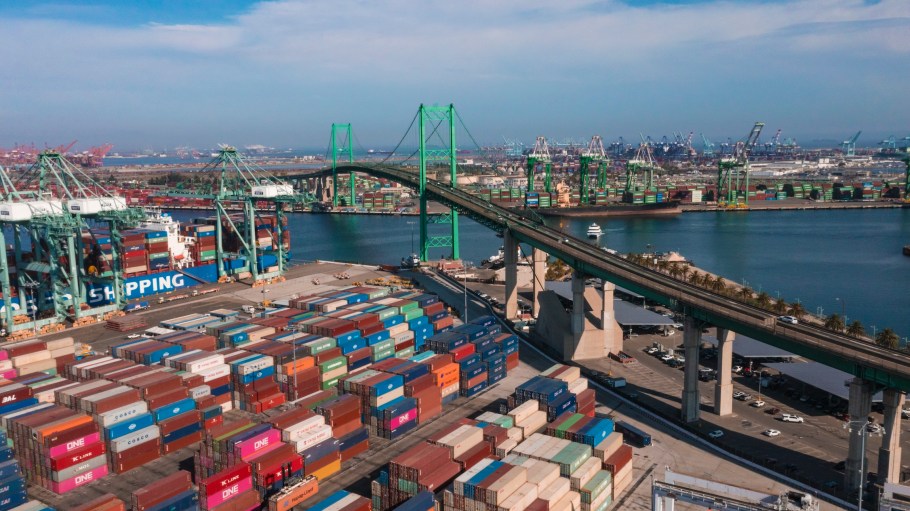
The import deluge keeps flowing into the West Coast ports.
The Ports of Long Beach and Los Angeles both handled a remarkably near-identical number of containers in November as the twin gateways endure a rush of cargo ahead of a presidential transition expected to usher in new tariffs and potential second dockworker strike on the East and Gulf Coast.
At the Port of Long Beach, dockworkers and terminal operators moved 884,154 20-foot equivalent units (TEUs) in November, up 20.9 percent from the throughput in the year-ago month. This was the busiest November on record for the port, surpassing the previous top mark in 2020 by 12.8 percent.
Related Stories
The Port of Los Angeles processed 884,315 TEUs in November, a 15.8 percent increase over the previous year, but still 0.6 percent below the hub’s own November record four years ago—when imports had heavily escalated and ports became congested due to heavy pandemic stimulus-driven spending.
With the November figures, the Port of Long Beach is on course to reach 9.6 million cargo containers by the end of 2024, which would be a record that marks a roughly 20 percent increase over the year prior.
For the L.A. port, the gateway says it is “well on pace” to exceed 10 million container units, the second such year to hit that point since 2021, when it handled 10.7 million TEUs.
Scott Kelly, vice president of ocean services, the Americas at freight forwarder Expeditors International, said in a Tuesday briefing that his company has already been assisting some clients with shifting cargo to the West Coast ahead of the East Coast port contract negotiation deadline of Jan. 15—further flooding the twin ports with more potential cargo.
“Customers will have the options of beginning to ramp up their shipments [into the U.S.] in the next week or so. We’ll see what they do,” Kelly said. “Customers that had already built a model in have adjusted and moved to the West Coast a little bit. We’re already seeing some of that, but other than that, we have not seen a mass migration yet.”
Seroka called President-elect Donald Trump’s recent backing of the International Longshoremen’s Association (ILA) in its contract negotiations with the U.S. Maritime Alliance (USMX) as “pretty unique,” given the meetings with key stakeholders ahead of taking the oath of office.
The port director was optimistic that the incoming administration would keep the wheels moving on the East Coast port talks.
“One of the things we have noticed with the current administration is that Acting [Labor] Secretary Julie Su used a lot of shuttle diplomacy, kept both sides at the table, kept talks moving forward in a variety of collective bargaining environments. That’s shown to be pretty positive as far as the outcomes go,” Seroka said. “I trust that incoming President Trump will have the same mindset of keeping folks at the table and moving the dialogue forward. It is my view, in conclusion, that all ports in the United States need to be running at top speed to fuel this American economy.”
Seroka shared some the mixed results that automation has brought the wider twin port complex, saying longshore work in Los Angeles and Long Beach is up about 32 percent over the past decade. “Could it have been more? Possibly.”
“Three of our 12 terminals have an automated environment,” he said, noting that the L.A. port uses automated stacking cranes, automated straddle carriers and rail-mounted gantry cranes, while the Long Beach Container Terminal uses an automated guided vehicle system.
“Some have opined that productivity is not that great, but costs have been dropped and longer hours of operation can be attained using this robotic mechanism,” said Seroka.
On the other hand, Seroka acknowledged the possibility that members of the International Longshore and Warehouse Union (ILWU) may be disappointed in some automation developments since the language was first implemented in their 2008 collective bargaining agreement.
“Maybe some promises have not been lived up to and maybe job cuts—being replaced by these robotics or automated machines—have been deeper than what was anticipated,” Seroka said.
As the automation arguments continue, the California ports are bringing in imports at a wider pace than the projected total across U.S. ports anticipated for November. Imports took up the lion’s share of the cargo movement at both San Pedro Bay ports, increasing 21.8 percent to 432,823 TEUs at Long Beach, and up 19.1 percent at Los Angeles to 458,165 TEUs.
Although most ports have not reported November’s numbers, the monthly Global Port Tracker from the National Retail Federation anticipates the month’s inbound cargo volume to reach 2.17 million TEUs, up 14.8 percent year over year.
That list includes data tracked at ports like L.A./L.B., alongside Seattle/Tacoma, New York/New Jersey, Virginia, Charleston, Savannah and Houston.