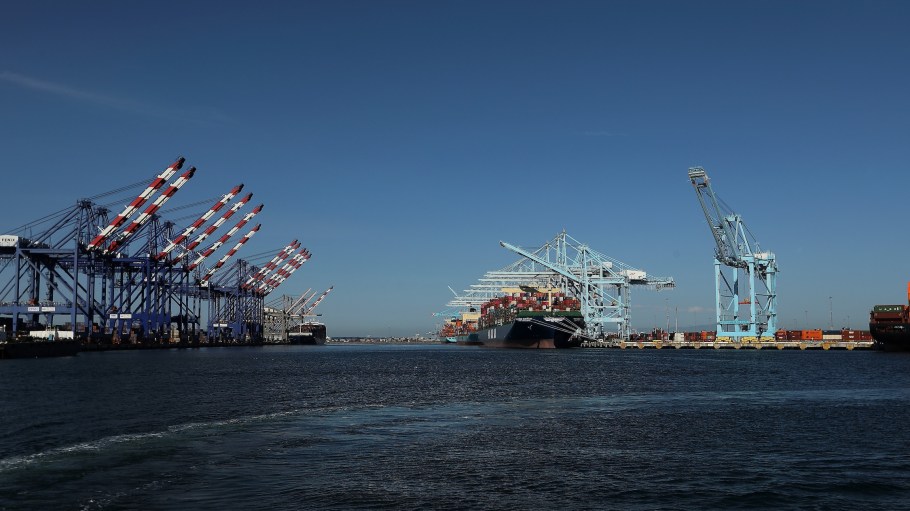
Although temporary relief was granted to China-to-U.S. supply chains when the countries agreed to substantially roll back tariffs for 90-days, West Coast ports are starting to feel the initial impacts of tariffs after a busy April.
The Port of Los Angeles experienced a more than 30 percent decline in inbound cargo volume in the first week of May, with the remainder of the month “likely to be substantial,” according to executive director Gene Seroka.
Its twin gateway, the Port of Long Beach, is now expecting a more than 10-percent drop-off in imports, according to CEO Mario Cordero.
Related Stories
During the first 15 days of this month, 74 container ships arrived at the San Pedro Bay ports, 11 fewer than usual, according to data from Marine Exchange of Southern California.
The Port of Los Angeles processed 842,806 20-foot equivalent units (TEUs) in April, 9.4 percent more than last year. the Port of Long Beach, moved 867,493 TEUs in April, up 15.6 percent from the same month last year and surpassing the previous record set in April 2022 by 5.7 percent.
So far this month, 17 out of 80 sailings have been canceled and another 10 cancellations next month are expected, Seroka said during his monthly news briefing held Monday.
The industry has largely seen a surge in China-to-U.S. cargo bookings in the wake of the rollback, with container movement on the trade lane skyrocketing 157.6 percent week-over-week for the week of May 12, according to data from container-tracking platform Vizion. This is the strongest weekly volume this year by landslide, the company says.
But Seroka has held a more subdued viewpoint about the impacts of the incoming imports on the L.A. port in recent interviews. His recent briefing was no different.
“You won’t see a deluge of freight here at the Port of Los Angeles,” said Seroka. “That likely means that there’ll be lower inventory across a variety of retail sectors. That’ll leave us with fewer selections of products and likely higher prices. But for now, uncertainty remains in every business meeting that I have.”
Based on the lower inventory and higher prices, Seroka expects import levels during the peak season “may be a little bit more muted compared to years past.”
While Seroka acknowledged that the L.A. port was going to see an uptick in bookings from China, he said any potential surge would not overtly impact the gateway’s ground operations.
Seroka highlighted the port’s ability to learn from Covid in moving 25 percent more empty containers back to Asia in April, using it as an example for how it better responds to “the peaks and valleys of import demand.”
“Right now, we have less than 30 percent of the number of containers that we had during the peak during Covid,” Seroka said.
Like Seroka, ZIM CEO Eli Glickman did not want to jump the gun on import projections either, and remained cautious on the expectations for trans-Pacific trade for the remainder of 2025 even after the anticipated surge. According to Glickman, it is “too early” to determine whether the coming rush will represent a return to normalized U.S.-China volumes.
“I think the more important element that will allow us to have a more definitive view as to how volume can look like for the second half of 2025 will be very much where we’ll land from a tariff discussion perspective once the [first] 90-day pause has elapsed, which is now coming up soon July 9,” said Glickman.
Nevertheless, ZIM is one of multiple carriers realigning its network to account for a possible trans-Pacific normalization, with the ocean carrier reversing its prior decision to suspend its Central China Xpress (ZX2) service line. This reinstates a trade lane that travels eastbound directly from the Port of Ningbo to Los Angeles, before traveling west back to the Port of Shanghai.
Ocean Network Express (ONE), HMM and Yang Ming will bring forward their Premier Alliance Pacific South 5 (PS5) service launch to June 5 in anticipation of increased market demand. The six-week service will host six vessels, and will call at the ports of Qingdao and Ningbo before sailing the Pacific to the Long Beach and Oakland ports. It will then turn back to Kobe, Japan, before returning to Qingdao.
One carrier, South Korea’s KMTC, is returning to the trans-Pacific trade lane for the first time in 40 years, joining SeaLead Shipping’s Asia-to-U.S. West Coast service. That line will start sailing on June 17, with KMTC providing one vessel to the grouping.