Panama’s Supreme Court could be the latest barrier to a controversial transaction that would shift ownership of two ports on opposite sides of the Panama Canal.
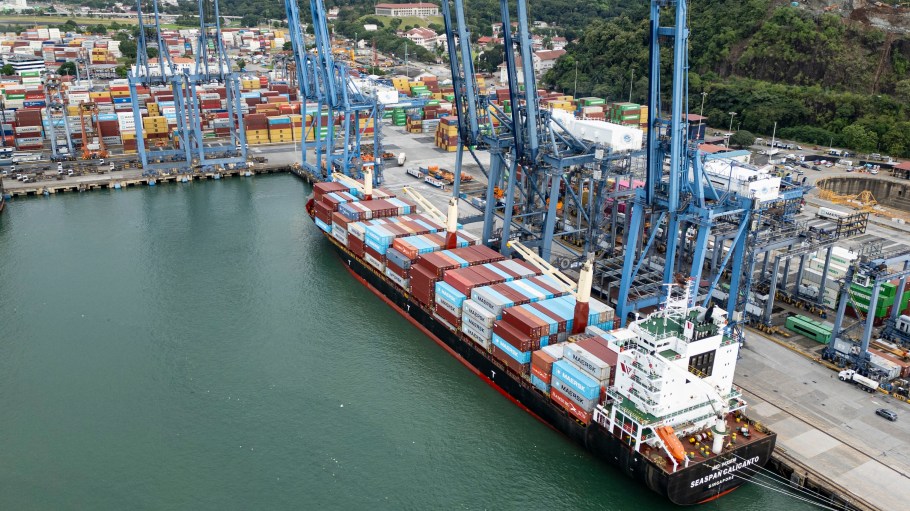
According to a report from The Wall Street Journal, the high court is expected to make a ruling soon on the constitutionality of CK Hutchison’s ownership of the Balboa and Cristóbal gateways.
A lawsuit spearheaded by Panama’s comptroller general Anel Flores in July contended that Hutchison’s contract extension with the Panamanian government should be voided due to financial irregularities.
Related Stories
If the court rules the partnership unconstitutional, Hutchison would no longer operate the two ports it is preparing to sell. This would nullify the lynchpin of a wider $22.8 billion, 43-port sale between the Hong Kong-based company and a consortium consisting of Mediterranean Shipping Company (MSC) and U.S. hedge fund BlackRock that initially took place last March.
That deal has been in limbo due to gripes from China, which would lose a geopolitical foothold near the most heavily trafficked trade conduit in the Western Hemisphere. The U.S. and President Donald Trump would benefit from changing ownership, with the Commander in Chief previously stating a desire to “take back” the Panama Canal itself.
China opened an antitrust investigation into the acquisition shortly after the deal was announced and has reportedly demanded that state-owned Cosco Shipping get a controlling stake and veto power in the deal in response.
While the U.S.-China dynamic has been the more public-facing obstruction to the ports sale, Panama’s issues with Hutchison’s ownership could have a bigger impact than any larger geopolitical conflict.
Felipe Chapman, Panama’s finance minister, told The Wall Street Journal that Hutchison’s relationship with the country has been “very tense and difficult” in recent decades.
A three-month government audit led Flores to maintain that Hutchison breached a deal to share 10 percent of its net income with the Panamanian government from their prior 25-year contract first signed in 1997.
According to the comptroller general, the audit found payment defaults and accounting miscalculations that cost the country $1.3 billion in lost revenue since the start of the deal.
The contract was renewed for another 25 years in 2021.
Hutchison has defended the extension since being hit with the suit, saying the port operator was compliant with all legal requirements.
After Flores levied the lawsuit, Panamanian President José Raúl Mulino called the comptroller general’s demands “well justified,” and suggested that the government would wait for the verdict.
“I do not, at the moment, see the continuation of the Panama ports contract, amended or not,” Mulino said last July.
If Hutchison’s license was terminated, the government would ensure continuity of port operations by recruiting a new terminal operator until officially opening a new bidding process with new license terms, the WSJ reported.
One potential decision could end up separating the Balboa and Cristóbal ports to maximize their value, the report said.
Panama’s Supreme Court justices could also allow Hutchison to continue running the ports, but fine the company or request other remedy measures.
Nullifying the current Panama ports contract would allow the country to potentially redesign the contract terms to be more beneficial to its citizens, but the government can also find itself exposed to litigation from CK Hutchison. The company would take the case to international arbitration panels to protect its investment if the Supreme Court’s justices rule against it.
Hutchison will not be able to appeal a Supreme Court ruling, but it can request clarifications that could delay its execution.
As concerns over the future of the Panama Canal-adjacent ports linger, the country has sought to hedge its bets by building more terminals as part of a more comprehensive $8.5 billion, 10-year canal modernization plan.
The Panama Canal Authority (ACP) unveiled plans to develop two more terminals—Corozal on the Pacific Ocean and Telfers on the Atlantic Ocean—opening a bidding process to global port operators and ocean carriers to run the gateways.
The ACP plans to award contracts for the two terminals in late 2026 and begin operations in 2029. Those gateways would expand Panama’s total container-handling capacity from 9.5 million 20-foot equivalent units (TEUs) to 15 million TEUs per year.
ACP administrator Ricaurte Vásquez Morales said in November that the unease surrounding the legal status of the CK Hutchison-owned ports drove the authority to explore the idea to build new terminals.