As the Suez Canal struggles to get ocean carriers to flock back to the trade artery, the Panama Canal is attracting them in droves.
Container ships traversing the 50-mile waterway have hit an all-time high for the first five months of the year, according to Alphaliner. From January through May, the stretch generated double-digit growth for container shipping sailings from the year prior, both northbound and southbound through the canal. Alphaliner calculated a 10.2 percent year-over-year increase in transits, and a 4.1 percent improvement over the previous record in 2022.
Related Stories
Neo sub-Panamax container carriers, which have a capacity between 7,500 and 10,000 20-foot equivalent units (TEUs), are helping power the increase. Ships of this size accounted for over a quarter of all container ship traffic through the Panama Canal since the start of 2025.
When compared to last year, 30 percent more Neo sub-Panamax vessels crossed the waterway.
Neo sub-Panamax vessels, as classified by Alphaliner, are a subset of Neo-Panamax vessels, which were built to fit within the expanded Panama Canal after it added two new sets of locks in 2016. Neo-Panamax vessels can carry up to 14,000 TEUs in most instances, while Panamax ships can transport as many as 5,000 TEUs.
The Panama Canal Authority (ACP) has not revealed official data for May yet, but oceangoing transit figures from the first four months of the year indicate that container ships took up nearly 24 percent of the 7,083 total crossings. These were followed by dry bulk carriers (18 percent), chemical tankers (18 percent), and liquefied petroleum gas (LPG) carriers (15 percent).
Container ships topped the list of canal transits for the January-to-April period, with Neo-Panamax vessels accounting for 58 percent of the 1,677 crossings.
Even when the Panama Canal had endured a months-long drought that forced the ACP to implement a series of daily transit and draft restrictions throughout the second half of 2023, container ships had largely been unaffected compared to other vessels.
That’s because they had initial booking priority ahead of chemical tankers, LPG carriers and dry bulk carriers that move grains and coal.
The Panama Canal gave container ships another win earlier this year in opening a new transit slot for low-carbon emissions vessels this fall. As of October, the ACP will implement the first phase of a weekly “net-zero slot” for Neo-Panamax vessels.
That slot would benefit ocean carriers that are ordering more dual-fuel vessels for their fleet, and is aimed at pushing the liners toward their decarbonization goals.
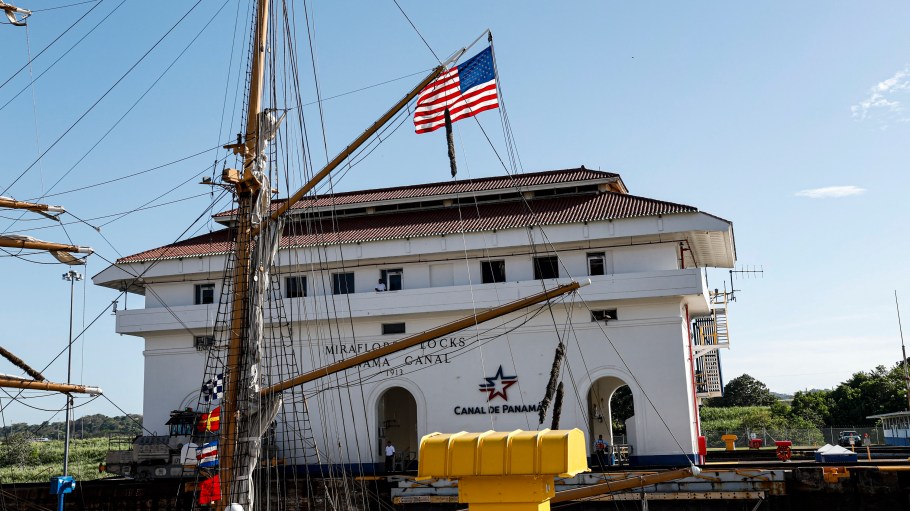
Since the start of 2025, the canal has been the center of a geopolitical tug of war between the U.S. and China, as President Donald Trump has threatened to “take back” the waterway in an effort to curb alleged Chinese influence on the trade chokepoint.
In the wake of Trump’s rhetoric, a consortium including Mediterranean Shipping Company (MSC) and U.S.-based asset management firm BlackRock agreed in principle to acquire two ports on opposite sides of the Panama Canal from Hong Kong-based CK Hutchison.
That move is part of a larger $23 billion offer for 45 ports worldwide, but the deal has yet to pass approval. It has also generated significant criticism from China, which has put the agreement under antitrust review.
Geopolitical ramifications aren’t the only concerns going on with that deal, and the Panama ports. A Wednesday report from the Financial Times indicated that some supply chain industry stakeholders are worried about MSC’s role in the acquisition.
If approved, the deal would allow MSC to become the world’s largest container operator through its Terminal Investment Limited (TIL) business, with a projected 8.3 percent of global market share, according to Drewry.
MSC is already the world’s largest ocean carrier with 900 total vessels in its global fleet, with the TIL subsidiary currently owning more than 70 terminals across major global ports including Singapore, Ningbo, Los Angeles, Long Beach and New York/New Jersey.
Numerous consultants in the Financial Times report highlighted that there were concerns of both reduced competition and higher barriers to entry for other players, especially if MSC’s dominance goes across port operations and container shipping alike.
Additionally, one executive contended that the investment would allow MSC to “get rates higher, and squeeze capacity to make as much money as possible.”
The deal’s supporters have indicated that while MSC would have the lead percentage of terminals, state-owned Chinese companies like Cosco Shipping and China Merchants still hold a combined market share of more than 12 percent of global ports.
Additionally, MSC’s potential 8.3 percent stake wouldn’t be much larger than Singapore’s PSA International, which operated 7.2 percent of global terminals worldwide in 2023, including one in Panama.