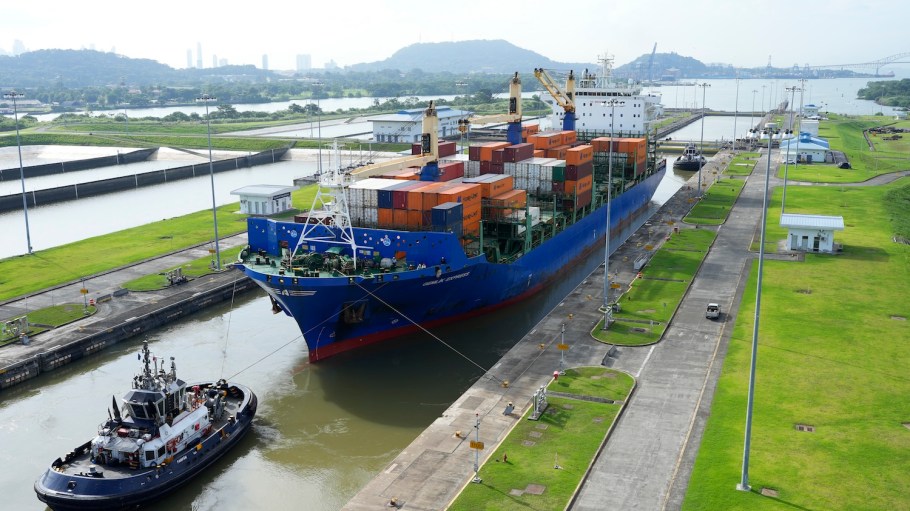
The Panama Canal Authority (ACP) wants to give shippers a new option to transport goods across the isthmus via rail or truck, but it will need a new dose of funding to get the project off the ground.
The ACP is seeking $1.2 billion to $1.4 billion in funding to develop the project, which would allow the canal to move at least 5 million more containers per year by 2045, up from the current 8.3 million boxes that travel through the canal annually.
ACP administrator Ricaurte Vásquez Morales made the announcement during his keynote address at the Houston International Maritime Conference at Port Houston.
Related Stories
The over-the-road network would be designed for containers carried on vessels that are too large to transit the Panama Canal, and would help mitigate the effects of climate conditions that slowed traffic through the waterway throughout 2023.
Last year, the Panama Canal experienced a months-long drought that created a queue of dozens of ships, with some vessels waiting weeks at a time to pass through. At one point last August, as many as 161 ships were queued up awaiting their turn.
The drought had lowered water levels at the manmade Gatún Lake, which supplies the water required to float vessels through the canal’s lock system, forcing the ACP to restrict the number of ships that could travel through on a daily basis, as well as their depth. While the Panama Canal traditionally allows for 36 to 38 transits per day, as few as 22 vessels were allowed by January.
With a land bridge option in play, the alternative could be used as a hedge against potential drought scenarios in the future.
“For this reason, it is important to look at Panama as a main route with the Canal as the keystone, which makes options circumnavigating the Canal critical, as well,” Vásquez explained. “We are looking at different diversification options, including other forms of transportation, such as pipelines that will allow the Panama Canal to look beyond maritime transportation and take advantage of its prestigious geographical location to find alternative income streams.”
The prolonged dry season and the ensuing restrictions resulted in a 29 percent year-over-year drop in the number of transits during the Oct. 1, 2023 to Sept. 30, 2024 period.
Longer term, the ACP is proposing a $1.6 billion plan to build a new reservoir and dam, called the Indio River project, to help supplement the water already provided by Gatún Lake. The reservoir would provide capacity for an additional 12 or 13 transits.
But that development is still contingent on getting approval from the roughly 12,000 people who live in the villages around the Indio River basin. Vásquez told CNBC Tuesday that an announcement is expected in the first quarter.
“Fresh water is one of the main resources used by the Panama Canal, and to that end, we depend on the rainfall to transit vessels,” Vásquez said. “Due to climate change, we expect to see an increase in the number of episodes caused by the El Niño phenomenon. Over that, we have no control, and that’s why we see an opportunity to diversify our operations and to serve the maritime industry in a different manner.”
Additionally, the land bridge project seeks to bring back customers that are now being transshipped via Colombia’s Port of Cartagena.
Early in 2024, Maersk opened its own land bridge service where customers could bypass the Panama Canal to transport cargo across the country. The alternative, temporary route was discontinued in May as the ACP continued to ease some of the 50-mile waterway’s draft restrictions and daily transit limitations.
As the canal adapts to the evolving climate, it recently introduced a long-term booking system to increase transit certainty and reduce wait times to pass through the waterway. Under this system, participants bid through a sealed auction process to lock down a reserved transit date.
According to a Reuters report, in October, the canal allocated about 40 percent of its largest locks’ passage capacity for next year. Container ships and liquefied natural gas (LNG) vessels secured the most slots.
Despite the struggles the canal experienced in 2024 with the traffic decline, it still reeled in a net income of $3.45 billion, doubling that of four years ago. Revenue increased by 1 percent to $5 billion, the ACP said. The authority expects to increase full-year transits by 26.5 percent to 12,582.