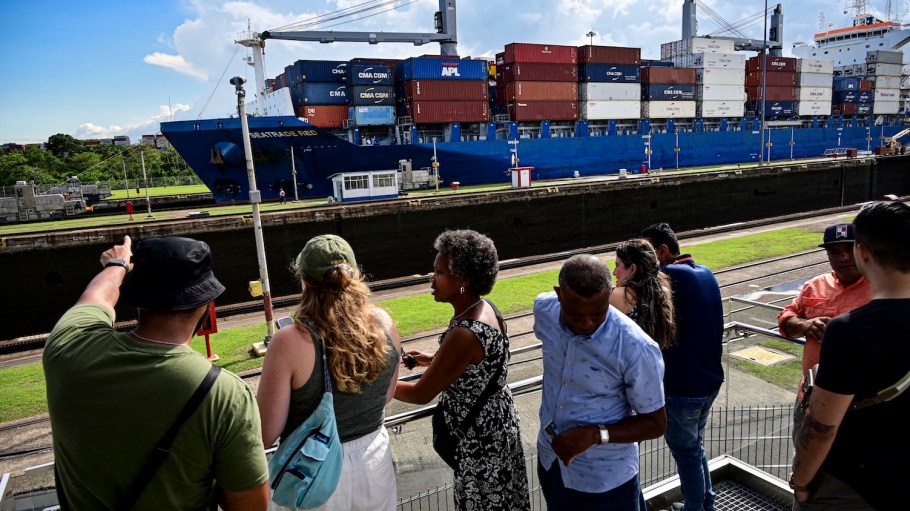
The Panama Canal has now loosened its draft restrictions nearly two weeks ahead of schedule, allowing vessels transiting the waterway’s Neopanamax locks to have a depth of 45 feet as of Thursday.
Citing the arrival of the May-to-November rainy season in the canal’s watershed, as well as current and projected water levels at Gatún Lake over the coming weeks, the Panama Canal Authority (ACP) said in an advisory to shippers that it was lifting the restrictions ahead of its initially scheduled date of June 15.
Related Stories
This brings the restrictions closer to the 50-foot draft typically allowed in the Neopanamax locks, which were built to fit larger ships when the canal expanded in 2016. Previously, vessels couldn’t sit deeper in the canal than 44 feet.
The initial draft limitations were implemented May 30, 2023, when the canal endured a months-long drought that raised concerns about the effects of shallow water levels on the waterway’s operations.
The restrictions resulted in a significant capacity impact on Neopanamax container ships, which are longer than 966 feet. While one of these vessels can carry a load of around 12,500 20-foot equivalent units (TEUs) at a draft of 50 feet, reducing this draft to 44 feet resulted in a 40 percent capacity reduction at around 7,500 TEU.
Vessels prepping their voyage through the Panama Canal have slowly but surely heard more good news as 2024 rolls on.
As of May 16, the number of daily transits in the Panamax locks increased from 17 to 24, and starting June 1, the number of daily transits in the Neopanamax locks will increase from 7 to 8. This adjustment will raise the total number of vessel transits allowed through the 50-mile waterway per day to 32. Under normal circumstances, 36 to 38 vessels are allowed to be booked to transit the Panama Canal per day.
If rainfall keeps up as expected, the ACP said in April that the conditions in the canal should fully normalize by 2025.
According to the authority, since May 26, the water levels of Gatún and Alhajuela Lakes have, for the first time in 2024, risen above those recorded on the same date in 2023.
As of Friday, official water levels at the rainfall-fed Gatún Lake were 81.2 feet deep, which is still 1.3 feet shallower than the 82.5-foot average depth for May since 2019. But this gap is a far cry from the 5.5-foot average differential that the levels had widened to in January.
For June, the second month into Panama’s rainy season, the five-year average water level inches up to 82.8 feet.
Container ships in general have borne the least of the impacts that the restrictions posed since they were first implemented last summer. These vessels have been able to avoid long queues and expensive transit auctions at the Panama Canal, largely because they have initial booking priority ahead of other ships like chemical tankers, liquefied petroleum gas (LPG) carriers and dry bulk carriers that transport grains and coal.
But with the restrictions lifted further, some liner services that had been affected any transit limits returned to their regular operating schedules in May.
Maersk phased out its temporary “land bridge” across Panama upon reinstating transit on its Oceania-to-the Americas “OC1” service, while Mediterranean Shipping Company (MSC) resumed its “Santana” service’s westbound sailings, with a new rotation skipping the U.S. East Coast to focus on Central America.
In total, container ships represent 28.5 percent of ships that passed through the canal in April, marking the largest percentage of any vessel category that uses the waterway. The figure is still a major jump from the typical share of cargo vessels—in the ACP’s two previous fiscal years, container ships represented 19.8 percent of traffic.
On Friday, 35 pre-booked boats were waiting to transit the canal, according to ACP data. Four vessels in queue had not made a reservation. For non-booked vessels, it currently takes 1.5 days on average to go north through the canal. Southbound ships take 1.4 days on average.
The ACP said it continues to monitor weather conditions daily to respond to the increased inflows to the watershed and will accordingly implement necessary operational actions.
As the canal’s water situation improves, the ACP endured a brief obstacle when it had to clean up an oil spill from a MSC container ship bound for Ecuador last Sunday.
The authority said it saw little to no interruption to its transit schedule following the rupture of the MSC Katya R, which ruptured a heavy fuel oil tank when it struck a protruding part of the canal.
The oil spill occurred in the chamber of the Miraflores lock in the canal’s east lane, and remained closed all day on Monday. The spill was quickly cleaned up with ships continuing to use the west lane and the Neopanamax locks.