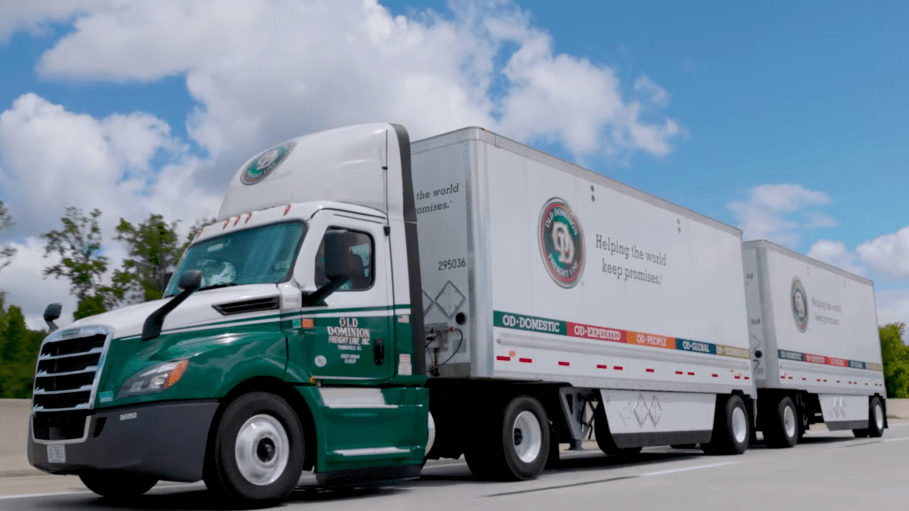
Old Dominion says softness in the domestic economy has tanked demand and volumes, costing the trucking giant revenue.
In a second-quarter sales update, the less-than-truckload (LTL) giant acknowledged that revenue per day decreased 5.8 percent in May from the year prior.
The average total is a slight improvement from the 6 percent decline that Old Dominion forecast for the full month of April, when macroeconomic uncertainty surrounding the Trump administration’s tariffs began to show its face.
Related Stories
But the 5.8-percent drop is still worse than the initially expected 5-percent-per-day weakening of revenue for the full second quarter, outlined by chief financial officer Adam Satterfield in an April earnings call. At the time, he expected total revenue for the quarter to come in at $1.4 billion.
Old Dominion Freight Line CEO and president Marty Freeman didn’t explicitly mention tariffs in his statement. But trucking companies in general, which already have been navigating through a three-year freight recession, have had to deal with blowback from the duties initially put into effect in April.
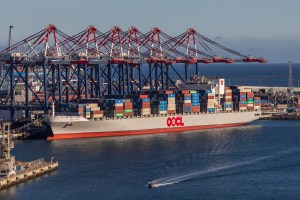
As import bookings into the U.S. fell and ocean carriers began blanking sailings on the Pacific Ocean, trucking firms endured a brief period where cargo pickups out of America’s two largest ports—Los Angeles and Long Beach—plummeted.
Alongside the tariffs, the Purchasing Managers’ Index (PMI), which gauges the overall monthly health of the manufacturing sector, stayed in contraction territory during May at a rate of 48.5 (an index over 50 represents growth). Struggling domestic manufacturing activity has hampered trucking industry demand throughout the freight recession.
May’s overall tonnage numbers did not help Old Dominion’s case. The main culprit for the trucking firm’s daily revenue decline was an 8.4 percent decrease in LTL tons per day—itself a larger descent than the 6.3 percent decrease the company experienced in the first quarter.
A 6.8 percent dip in daily LTL shipments, along with a 1.9 percent decrease in LTL weight per shipment, contributed to the tons-per-day decline.
The falloff was partially offset by an increase in LTL revenue per hundredweight, which refers to the revenue generated for each 100 pounds of freight shipped.
Total May revenues for Old Dominion were also impacted by lower fuel prices, which kept down rates.
Although the company didn’t have a material stock price change due to the update, BofA Securities analysts revised their price target for the company down from $183 to $171. The change came just two days after Goldman Sachs increased its target for Old Dominion from $190 to $200, while upgrading the company from “neutral” to “buy.”
Nevertheless, Old Dominion remains undeterred in maintaining its place among its LTL brethren. Satterfield said market share remained within 12 percent to 13 percent in the April call, with Freeman indicating that its position was unchanged.
“We believe that our market share has remained relatively consistent throughout this extended period of economic softness, despite the year-over-year decrease in our LTL volumes,” said Freeman. “Customers have continued to value our industry-leading service, which supports our ongoing yield management initiatives. While the macroeconomic environment remains uncertain, we will continue to focus on executing on our long-term strategic plan.”
Chief rival XPO also reported May metrics for its LTL operation on Wednesday that were a slight improvement from Old Dominion, but still negative.
LTL tonnage per day decreased 5.7 percent from the year prior, while shipments per day declined 5.7 percent. The company saw a 0.7 percent decline in weight per shipment.
XPO did not break out revenue figures.
Yellow unloads four more terminals
As Old Dominion and XPO navigate the soft demand environment, one of their top former competitors is still aiming to offload more real estate as it liquidates.
Yellow Corp., which ceased operations in July 2023 and has since endured a two-year bankruptcy process, laid out plans to tentatively sell four more terminals for $6.8 million.
The trucking company’s estate filed a motion with a Delaware bankruptcy court Friday requesting approval for the sale.
The owned properties include a $2.6 million, 68-door terminal in Knoxville, Tenn. and a 46-door site in Southington, Conn. that would sell for $2.8 million. Two smaller sales would be a $1.2 million, 31-door terminal in Port Allen, La., and a $285,000, 12-door service center in Tupelo, Miss.
Unlike many of Yellow’s other terminal sales, which have gone to companies like Old Dominion, XPO, Estes Express Lines and Knight-Swift, these divestitures are not to trucking firms. Prior to these sales, the estate sold off 10 service centers last month for $14.3 million, including three to another former competitor, Saia.
A separate Friday filing with the court showed that Yellow is rejecting unexpired leases on four terminals with a total of 328 doors.
Those facilities are in Phoenix; North Billerica, Mass.; Visalia, Calif.; and Manassas, Va.
Yellow’s estate has sold roughly 190 terminals for more than $2.2 billion since its liquidation first began in December 2023. The first bankruptcy auction divested the bulk of terminals, with 130 offloaded for a combined $1.88 billion.
The company now has roughly 70 owned and leased terminals that have remained unsold.