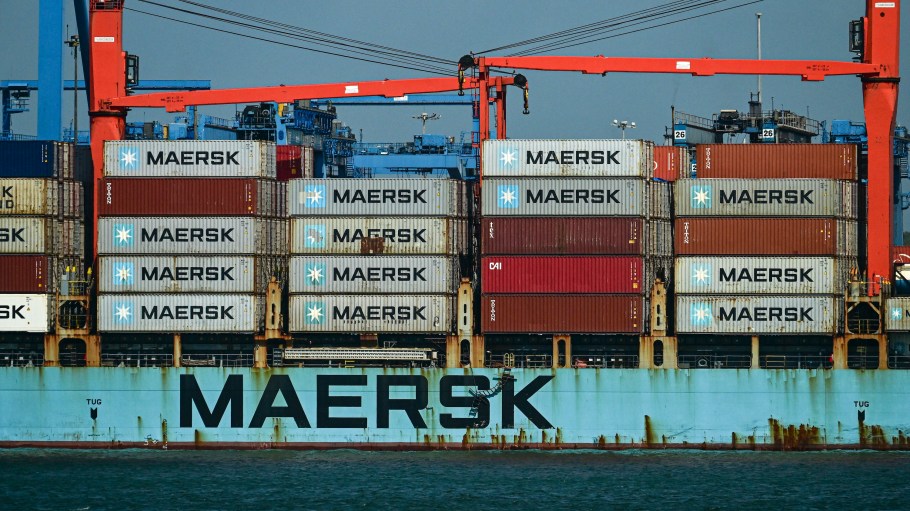
Maersk aimed to calm customers’ nerves ahead of the anticipated fees on Chinese vessels docking at U.S. ports next month, assuring that it will not apply surcharges to ship cargo into the country.
The company is following in the footsteps of CMA CGM, which previously said it would not impose its own extra charge when the port fees go into effect Oct. 14. Mediterranean Shipping Company (MSC) also said it already “proactively restructured its global vessel network” and that they will either absorb or avoid the cost of the new fees.
Related Stories
“No surcharge will be applied,” said Maersk in a customer advisory Tuesday. “We have no intention to introduce any surcharge in connection with this rule.”
Echoing other carriers, including Chinese state-owned ocean carrier Cosco Shipping, the container shipping company said it does not expects to have changes to its services.
“Your services remain unchanged,” Maersk said. “We do not anticipate adjustments to our U.S. port rotations or your existing service plans. We continue to monitor the regulatory landscape closely and will keep you informed of any changes.”
Back in May, Maersk said it did not see any direct costs from the anticipated port docking fees that would impact either the carrier or its customers.
Starting Oct. 14, any non-Chinese operators like Maersk will be charged $18 per net ton, or $120 per container, for every U.S. port rotation they take with a vessel built in China. On April 17, 2026, that will increase to $23 per net ton, or $153 per container. The fee will escalate by $5 two more times through April 2028, when the extra charge per rotation maxes out at $33 per net ton, or $250 a container.
When accounting for the fact that a container vessel hosting approximately 12,000 20-foot equivalent units (TEUs) carries roughly 60,000 tons, Maersk would be paying a $1,080,000 fee per rotation.
The U.S. Trade Representative’s (USTR) office levied the Section 301 fees with intent to penalize China for what both the Trump and Biden administrations have agreed is an “unreasonable” dominance over the logistics, maritime and shipbuilding industries.
Maersk has not publicly stated how many of its Chinese-built ships, if any, would still be in use on any routes headed toward U.S. ports. Earlier this year, container shipping research firm Alphaliner said that only 38 out of a total of 214 U.S. port calls from Maersk in February came via a Chinese vessel.
In total, Maersk operates 742 container vessels, with roughly 200 having been built in China, Alphaliner said.
According to a report from HSBC, Maersk and Gemini Cooperation partner Hapag-Lloyd already deploy South Korean-built vessels on the Asia-to-U.S. route to minimize exposure ahead of the looming fees.
Maersk’s decisions are essentially intertwined with those of Hapag-Lloyd, as the companies share roughly 340 vessels within their Gemini network.
According to Alphaliner, roughly 70 of Hapag-Lloyd’s fleet of 313 vessels were built in China.
With a lower concentration of Chinese vessels at both Maersk and Hapag-Lloyd, the companies can more easily switch compliant ships in to call at U.S. ports once fees go into effect.
However, if the fees do cut into profits or harm service on other trade lanes due to the shifts, surcharges could still be on the table in the long run.
Currently, China produces more vessels than any other country, accounting for 70 percent of container ships on order, according to another industry research firm, Linerlytica. As of March, an even higher 79 percent of Maersk’s orderbook will be built in China, while Hapag-Lloyd and MSC are ordering 89 percent and 92 percent of their ships from China, respectively.
MSC indicated that it could change its tune on absorbing the port fees depending on the surrounding environment.
“Although this new fee structure may present certain challenges, MSC does not plan to introduce any USTR-related surcharges at this time,” MSC said in its customer advisory. “Nevertheless, we reserve the right to revisit this position should the cost implications or regulatory guidance change in the future.”
Chinese carriers like Cosco and subsidiary Orient Overseas Container Line (OOCL) have not commented on whether they will pass along port fees to customers. Both companies are projected to be the most impacted by the USTR levies, with the businesses set to pay a combined $2 billion in fees in 2026 without a network adjustment.