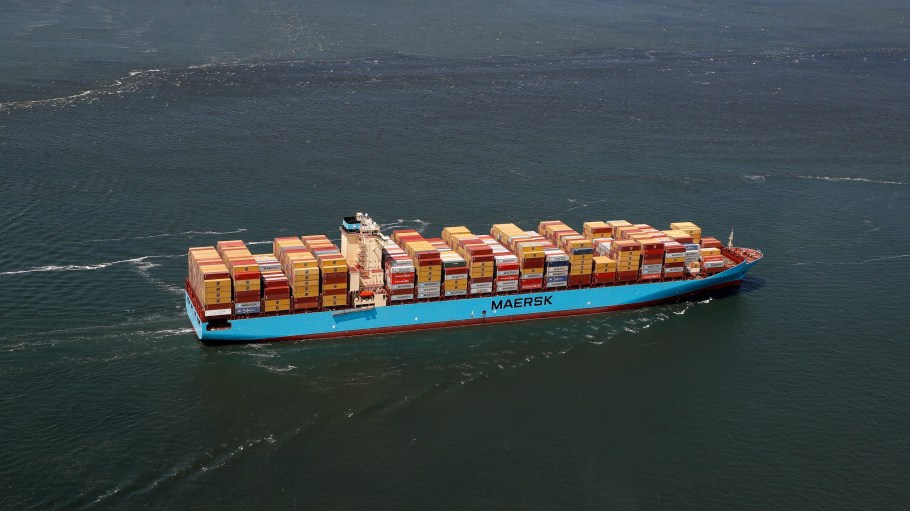
Maersk leadership is feeling better about the remainder of 2025 as the global container market has shown resilience amid ongoing tariff whiplash.
The Danish ocean carrier giant now expects worldwide container market growth to expand between 2 percent and 4 percent for the full year, raising the bottom end of the range from a 1 percent contraction.
Amid the improved outlook, Maersk highlighted that the market demand has been resilient across all markets outside of North America. Both ends of the guidance assume “a fairly continued, sluggish” U.S. market for the rest of the year, according to CEO Vincent Clerc.
Related Stories
The projection follows President Donald Trump’s sweeping “reciprocal” tariffs on global U.S. trade partners, which officially took effect Thursday after a 90-day negotiation period ended Aug. 1. The U.S. and China have held talks in Stockholm where officials discussed a possible extension of a 90-day tariffs pause due to expire on Aug. 12.
Although the China-to-U.S. trade lane has been by far the most impacted by President Trump’s tariffs, China’s export economy has remained robust, with Clerc calling it “the engine behind stronger demand growth.” Chinese exports grew 7.2 percent year over year in July, accelerating over the 5.8 percent increase in June and May’s 4.8 percent bump.
Other regions are pulling their weight in propping up the container market, Maersk said. According to the container shipping company’s second quarter earnings report, the contraction in North American imports was “more than offset” by strong import growth into Europe, Latin America, West-Central Asia and Africa.
In the second quarter, global container demand is estimated to have increased between 3 percent and 5 percent year-on-year, according to Maersk.
Maersk’s total revenue rose 2.8 percent year-over-year to $13.1 billion from the year prior on $845 million in earnings before interest and taxes (EBIT). Ocean revenue increased 2.4 percent to $8.6 billion.
Maersk boosted its profit outlook as the carrier saw its ocean volumes increase 4.2 percent from the year prior and demurrage and detention revenues increased 20 percent.
“When you see a deceleration of demand, there tends to be more demurrage because customers are slower at picking up their containers,” said Clerc. “When the economy heads strongly up, then you see actually less demurrage because customers are eager to pull their containers and get the goods moving through supply chain. So what we had is higher demurrage revenue because of a lot was dictated by the uncertainty on tariffs.”
Maersk now expects underlying EBIT between $2 billion and $3.5 billion, up from the prior EBIT range of $0 to $3 billion.
Throughout Thursday’s earnings call, Clerc touched on other major goings on across the supply chain that have impacted the wider container market.
With the Houthis relaunching their attacks on commercial ships in July and threatening to target Israeli-affiliated vessels, Red Sea disruption is still expected to last for the full year. Clerc said a reopening of activities looks “unlikely,” which has been consistent with the liner’s mentality since the start of the crisis in late 2023.
Clerc also commented on the elevated port congestion that has been seen through Europe in 2025.
“Given the growth that there has been, there is a general undercapacity in terms of ports in Europe, where we’re starting to feel more points of congestion that are impeding the networks,” Clerc said. “This is the results of terminal capacity being added over the last 15-20 years at a slower pace than market. At some point, something is bound to happen.”
According to the CEO, the European congestion is “likely to be to be with us for a while in some shape form,” for a few years.
Maersk also completed its full phase-in of the Gemini Cooperation in the second quarter, achieving 90 percent schedule reliability for the first five months since the vessel-sharing alliance with Hapag-Lloyd began.
When asked if the carriers would begin charging premium rates, Clerc said that was “too early,” and that the liners had to prove to customers that they would always be able to deliver on the high reliability promise before making such pricing changes.
“We need to sustain this for a while and then we need to move towards a more commercial discussion. I think it’s premature at this stage,” said Clerc. “I don’t think customers have experienced this long enough that they’re ready to entertain such a discussion, but it is something that is going to come.”