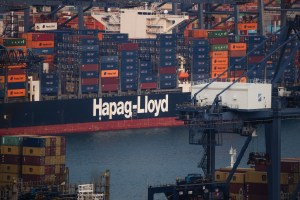
The vessel-sharing agreement between ocean carrier giants Maersk and Hapag-Lloyd is taking more shape ahead of its official launch on Feb. 1.
According to a customer advisory posted by Maersk on Monday, the twin carriers of the Gemini Cooperation will not include the Port of Felixstowe, the U.K.‘s largest container port, on their Asia-to-Europe services. Although Felixstowe had been part of the alliance’s initial routing plans, the carriers will instead call at another major U.K. port, London Gateway.
Related Stories
In the statement, Maersk said it concluding during a review that “London Gateway is the most optimal port to serve our customers importing/exporting cargo to/from the U.K.”
London Gateway recently opened its fourth berth, which is expected to increase trading capacity at the port by more than a third. Port operator DP World expects to build two more berths after that, which would make London Gateway the country’s largest port by volume within five years.
The investments clearly have the carriers’ attention. Maersk and Hapag-Lloyd say the decision is part of their dual ambition to reduce network complexity with mostly single operator loops and fewer port calls per service, and incorporate terminals with the highest level of productivity and operational efficiency.
“The big benefit of the structure that we have chosen with Gemini is that on average, our ships will be better utilized because you won’t have these long shoulders of the services in Asia and Europe where you have very low utilization in the first [three to six] ports,” said Hapag-Lloyd CEO Rolf Habben Jansen in a Thursday earnings call. “If you have better asset utilization, you can transport more cargo with the same number of ships across the entire network.”
Currently, there are three Asia-to-Northern Europe service lines that call at the London Gateway port, with a fourth skipping the U.K. entirely.
Only the Asia-to-Europe trade lanes will be affected by the U.K. port changes, Maersk said. The alliance’s previously announced Middle East-to-Europe service will call at London Gateway as anticipated, while the trans-Atlantic lane will dock at Southampton.
Individual services from Maersk and Hapag-Lloyd outside the scope of the Gemini Cooperation also remain unchanged.
Neither carrier has listed any other port changes yet as part of the shared service, although Habben Jansen acknowledged in the call that the cooperation is planning fewer port calls in Asia, Europe and also in the U.S. “because we believe that having a fewer port calls gives us a better chance to sail on time.”
“As our solutions and products are scoped to the customer demand, we expect to be able to share further details of this plan over the next couple of weeks,” Maersk said in the advisory.
Bookings for the Gemini Cooperation will start in December, with accessibility to 57 services across 340 vessels, and roughly 3,700,000 TEUs of cargo capacity available.
The alliance has set an audacious goal to deliver schedule reliability rates north of 90 percent once their network is fully phased in, which should take 13 weeks after the Feb. 1 launch, according to Maersk CEO Vincent Clerc. However, the wider container shipping industry is far behind the expectations that the Gemini partners have for schedule reliability.
Industrywide, global schedule reliability in September was 51.4 percent, significantly down from 64.3 percent the year prior, according to data from maritime trade advisory service Sea-Intelligence.
On a monthly basis, reliability declined 1.2 percentage points from 52.6 percent in August.
Both Gemini Cooperation members have a long way to reach the projected 90 percent schedule reliability goal.
Maersk was the most reliable top-13 carrier with schedule reliability of 55.5 percent in September, a far cry from its leadership among the major container shipping companies with a 70.7 percent reliability rate during the year-ago period.
Hapag-Lloyd has a 48.7 percent schedule reliability rate across 34 different trade lanes, the third-best behind Maersk and CMA CGM and down from the 57.3 percent on-time from last September.
In an Oct. 31 earnings call, Clerc said the modularization of the network would be a key factor in bolstering the new cooperation’s reliability.
“If you have a disruption in one port, it doesn’t get transmitted into the network the way that it does today. It gets contained into its module,” Clerc said. “That’s how you can produce a significant uplift in reliability.”
The Maersk CEO also said that the alignment in philosophy with Hapag-Lloyd will make it “cheaper than an operating a network with 50 percent reliability.”
If both carriers can deliver on their reliability goals, Habben Jansen expects the alliance to draw in more customers as well.
“I do not expect us to attract cargo at lower rates,” said Habben Jansen. “If anything, I would expect that because of higher schedule reliability and better predictability in the supply chain, people might be willing to pay a little bit more.”