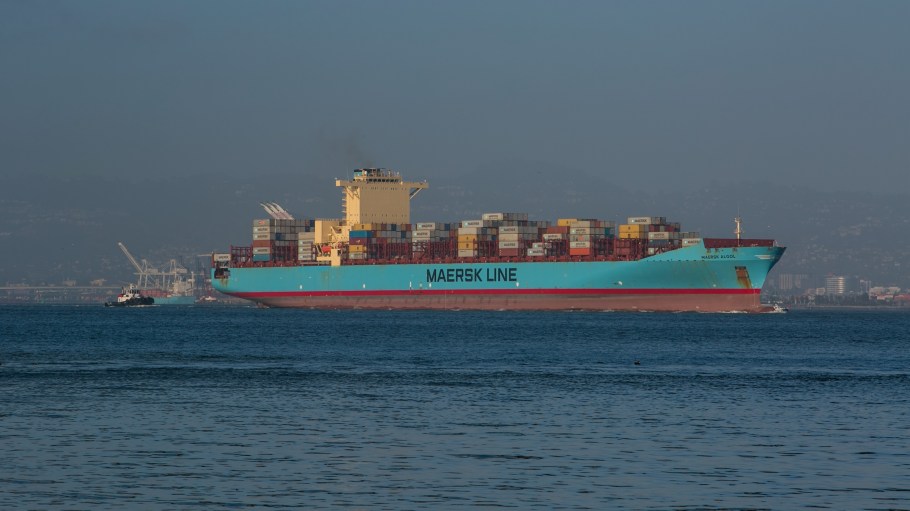
Maersk is sending a message to customers ahead of a possible second strike at the East and Gulf Coast ports—pick up your cargo before Jan. 15.
The container shipping giant said in a Tuesday advisory that it strongly encourages customers to retrieve their loaded containers from the ports ahead of the contract expiration date, as well as return all empty containers to the gateways.
“This proactive measure will help mitigate any potential disruptions at the terminals,” said Maersk in the update. “Our teams are actively developing contingency plans to minimize the impact should a labor disruption occur. “
Related Stories
The International Longshoremen’s Association (ILA) has maintained that it will go on strike for a second time in more than three months after walking away from negotiations in November. The ILA went on strike for three days from Oct. 1-3 before coming to an agreement on a 61.5 percent wage increase spread over six years.
The 45,000-member union has been unable to agree with its employers, the United States Maritime Alliance (USMX), on the future of automation at the ports. The ILA has sought a total ban on automation over concerns that the technology will eliminate union jobs on the docks, while the USMX has argued that keeping current automation language in its contract is pivotal to port modernization.
According to Maersk, a USMX member, the situation remains “unchanged, and we continue to monitor developments closely.”
The ocean carrier said the contract negotiations have had no new developments since its last communication on Dec. 19.
At the time, Maersk said the situation remained dynamic, “but the possibility of a strike increases each day that passes without a settled contract.”
Earlier this month, the ILA got its biggest vote of confidence yet when President-elect Donald Trump met with union brass and voiced his support for the dockworkers in the negotiations.
Trump took their side on automation, saying the money saved from the port technology is “nowhere near the distress, hurt and harm it causes for American Workers, in this case, our Longshoremen.” Like President Joe Biden before him, Trump took a pro-U.S. stance against the USMX as well, calling out the alliance’s mostly foreign companies for generating “record profits.”
An ILA strike could take place mere days before Trump’s inauguration as commander-in-chief on Jan. 20. Given Trump’s comments, it appears unlikely that the former and future president would invoke the Taft-Hartley Act, which would shoot down a strike for 80 days, and extend the window for the talks.
Maersk is the only major carrier that has updated its customers since Christmas. Hapag-Lloyd last gave a public update on Dec. 19, while CMA CGM gave a similar update on Dec. 13.
As uncertainty about the ports escalates closer to the Jan. 15 contract expiration date and Trump’s inauguration, December is forecast to see 2.14 million 20-foot equivalent units (TEUs) enter the U.S., which would be a 14.4 percent increase over the year prior, according to the Global Port Tracker from the National Retail Federation and Hackett Associates.
That would eclipse the December record of 2.11 million TEUs of inbound cargo volume in to close out 2020, further illustrating importers’ push to front-load more goods into the U.S. ahead of possible disruption.
Ocean spot freight rates for cargo entering the U.S. have increased in kind.
According to Drewry’s World Container Index (WCI) as of Dec. 19, the average container price across eight major trade lanes was $3,803 per TEU, an increase 8 percent from the week prior.
But by far the biggest increases came on the Asia-to-U.S. routes, effectively keeping the wider WCI afloat. Cargo from Shanghai to New York saw a 17 percent jump to $6,074 per TEU, while containers headed to Los Angeles from Shanghai soared an even higher 26 percent to $4,499 per TEU.
When the most recent rates were released on Dec. 19, the maritime consultancy mirrored thoughts by many throughout the ocean freight industry, saying it expected an increase in rates on the trans-Pacific trade in the week ahead “driven by front-loading ahead of the looming ILA port strike in January 2025 and the anticipated tariff hikes under the incoming Trump administration.”
Drewry did not release data on Dec. 26 for Christmas week, but is expected to release its first WCI for 2025 on Thursday.
On top of likely freight rate increases, container shipping firms will be commanding extra fees. Both Hapag-Lloyd and ZIM are preparing for a second ILA strike by tacking on surcharges for imports entering the East and Gulf Coast ports.