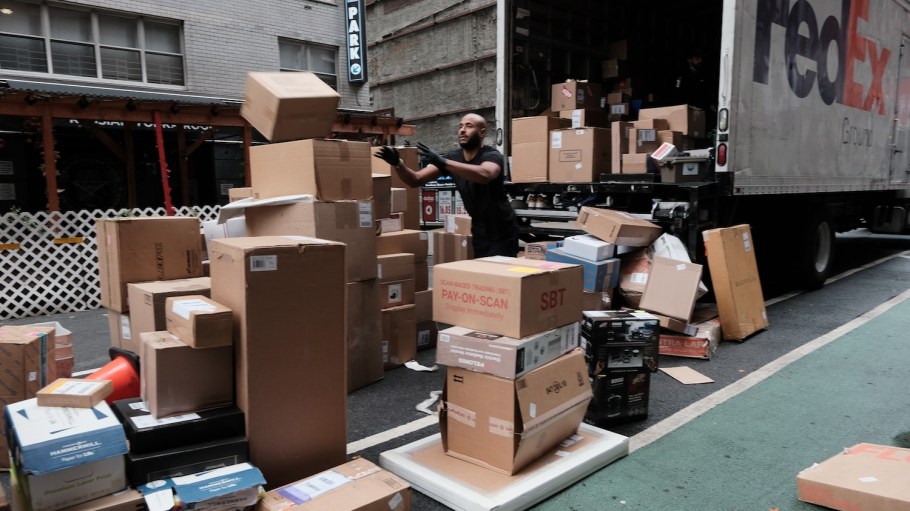
The last-mile delivery ecosystem is getting more expensive to maintain as consumer expectations for free shipping persist.
Customers expect a maximum 3.5-day delivery time for free shipping, with 92 percent saying free shipping impacts their purchase decision, according to 1,100 U.S. consumers polled in a recent survey from global consulting firm AlixPartners.
But these demands have only resulted in more cost pressures for retailers. Seventy-six percent of executives say their delivery cost on a per-package basis has increased since last year.
Related Stories
Marc Iampieri, global co-leader of AlixPartners’ logistics & transportation practice, said there’s a big disconnect between what the consumer wants and what executives are trying to offer, largely due to concerns about profitability—only 28 percent of execs say home delivery is accretive to their profitability as compared to in-store transactions.
“You can hit, with four distribution centers, most of the U.S. population in the contiguous 48 within three days for ground delivery,” Iampieri told Sourcing Journal. “Half of the executives said, ‘We’re not even trying to do that.’ It could be that they’re smaller. ‘Hey, we import from China, and we’ve got one distribution center in California.’ If you live in New York, you’re not getting it in three days unless you pay for premium expedited freight. And most people don’t want to do that.”
In cases like this, cost cuts are a chief concern, as 85 percent of the 110 North American transportation, logistics and supply chain executives surveyed reducing total cost per order is their top priority for last-mile delivery.
“It’s tough for the retail industry, especially for traditional stores. It’s tough on Macy’s, it’s tough on Neiman Marcus, Nordstrom, Saks and some of the other high-end retailers,” said Iampieri. “The discount stores and value-oriented retailers have been doing better, but it’s tough to compete when the cost of these packages continues to go up, and people are just using it to buy all kinds of disposable goods on a regular basis. To make that profitable, they got to have bigger orders.”
To address this, 64 percent of executives say they require a minimum order value to offer free shipping, while another 15 percent saying they need a minimum order value along with membership to be eligible.
Raising these minimums seems to be an answer for a lot of companies. Nearly half (49 percent) of the logistics executives said they increased their minimum free shipping spending requirement in the last 12 months.
UPS loses last-mile market share to Teamsters deal
Already enduring a rough second quarter that resulted in the cutting of its revenue guidance and operating margin target, UPS is still trying to regain its footing.
According to the survey, UPS’ leading market share of last-mile deliveries dwindled from 35 percent in 2023 to 25 percent in 2024. And it seems FedEx, as expected, was the major beneficiary of the UPS exodus.
FedEx now delivers 42 percent of total last-mile packages, up from last year’s 30 percent.
UPS has been transparent about the fact that it lost customers in the wake of the Teamsters contract negotiations last year. The impact of a potential strike cost UPS roughly $200 million in lost sales in the 2023 second quarter, and has had lingering effects in the time since.
In a Tuesday earnings call, UPS CEO Carol Tomé acknowledged that there were “customers who left us during the contract negotiation that have not returned. They left us. They locked themselves into long-term contracts, and they have not yet returned.”
Twelve percent of last-delivery market share comes from retailers’ internal fleets, while USPS delivers 6 percent of last-mile packages. Third parties including OnTrac, Pandion, DoorDash and Instacart take up the remaining 16 percent of market share.
Overall, two out of five retail executives surveyed said they made some volume switch away from either FedEx or UPS to other providers in the past year. In general, most shippers aren’t beholden to one carrier. Nearly three-quarters (74 percent) use of mix of carriers for their last-mile needs.
A major part of this shift could be attributed to general rate increases (GRI) imposed on the shippers, which have been largely implemented because of the inflationary post-Covid environment, and increases in wages, equipment costs, vehicle insurance, fuel, maintenance and more.
“The volumes are down, and when volumes are down, the tiers for your discount go down. That is a killer for some of these shippers, because if their volumes a little bit down, they get even less of a discount,” said Iampieri. “That obviously inflates their final price, and all this is absorbed by the retailer, of course. They don’t pass that along to the consumer. A lot of times your inflation will be put into your goods if you’re a brand or CPG, but for retailers, they’re absorbing all those freight costs and just eating it.”