The trucking industry might be keeping a keener eye on the 2024 presidential election now that former President Donald Trump has selected his running mate.
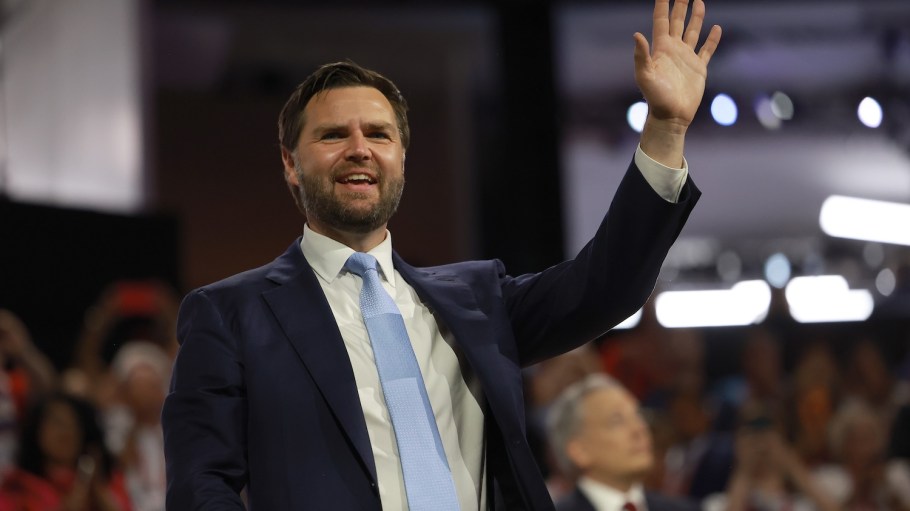
Sen. J.D. Vance (R-Ohio), who was named as Trump’s pick for vice president at the Republican Nation Convention on Monday night, is backing two pieces of legislation that truck drivers are hoping will come to light in the coming years.
Vance was a co-sponsor of the Truck Parking Improvement Act and the DRIVE Act, both bills that were introduced in Congress in 2023.
Related Stories
The Truck Parking Improvement Act, introduced in March, would authorize $755 million in competitive grant funding to expand commercial truck parking capacity across the United States.
This bill directs the Department of Transportation (DOT) to provide competitive grants for projects that provide public parking for commercial motor vehicles and improve the safety of commercial motor vehicle drivers.
States, metropolitan planning organizations, tribal governments and local governments are eligible for these grants. The grants must be used for projects on federal aid highways or a facility with reasonable access to such a highway or a freight facility.
In providing these grants, the DOT must determine that the project will likely increase the availability or use of commercial motor vehicle parking, facilitate the efficient movement of freight or improve highway safety, traffic congestion, and air quality.
The American Trucking Associations (ATA) applauded the bill when it was introduced in March, saying that there is a parking shortage that has a costly, measurable impact on supply chain efficiency, driver health and wellbeing, highway safety and the environment.
“The lack of safe and accessible truck parking places an enormous and costly burden on our nation’s truck drivers as they work to deliver for the American people. Given the chronic nature of this issue and its national scope, it is imperative Congress takes action to provide dedicated funding to expand commercial truck parking capacity,” ATA president and CEO Chris Spear, who said the piece of legislation “will strengthen our supply chain and improve highway safety for all motorists.”
The second bill, the DRIVE Act, prohibits the Federal Motor Carrier Safety Administration (FMCSA) from issuing any rule or regulation to require vehicles that have a gross vehicle weight of more than 26,000 pounds and are operating in interstate commerce to be equipped with a speed-limiting device set to a yet-undetermined maximum speed.
The Owner-Operator Independent Truck Drivers Association (OOIDA), another trade association representing professional truck drivers, has been a major proponent of both bills.
In regards to the first bill, OOIDA said that the time drivers waste finding safe parking is time not spent getting goods to their destination, slowing the supply chain and raising the costs for consumers.
“Most folks probably don’t realize that 70 percent of American freight is transported by truck, yet incredibly there is only one parking spot for every 11 trucks on the road,” said Todd Spencer, president of OOIDA, in a statement. “When truck drivers don’t have a designated place to park, they end up parking on the side of the road, near exit ramps or elsewhere. This isn’t safe for the driver and it’s not safe for others on the road.”
And in the case of latter legislation, the association argues that speed-limiting devices on large trucks create unnecessary congestion and dangerous speed differentials among vehicles. This results in higher rates of vehicle interaction and higher crash rates.
OOIDA appears to be happy with the decision.
“We’re a non-partisan organization, but unabashedly pro-trucker,” said OOIDA spokesperson George O’Connor in a statement. “We’ll work with anyone and everyone who supports our members’ priorities, regardless of party affiliation. There’s no question that it’s helpful to have someone advising the President with a proven pro-trucker legislative record.”
Vance has his hands in other potential logistics legislation that could come to pass in the next few years. The Trump running mate is one of six senators who introduced the Railway Safety Act, a bipartisan bill that arose in the wake of the February 2023 Norfolk Southern train derailment in East Palestine, Ohio—Vance’s home state. The bill awaits a vote in the U.S. Senate.
That bill is designed to take steps to improve rail safety protocols, such as enhancing safety procedures for trains carrying hazardous materials, establishing requirements for wayside defect detectors, creating a permanent requirement for railroads to operate with at least two-person crews, increasing fines for wrongdoing committed by rail carriers, and more.
Like many of his Republican cohorts in D.C., Vance’s policies are not electric vehicle-friendly, posing the potential for a setback for EVs in the U.S. supply chain if the Trump-Vance ticket gets elected in November.
Last September, Vance introduced the Drive American Act aimed at eliminating $100 billion in EV subsidies and replacing them with up to $7,500 tax credit for new gas or diesel-powered vehicles, including hybrids, made in the U.S.