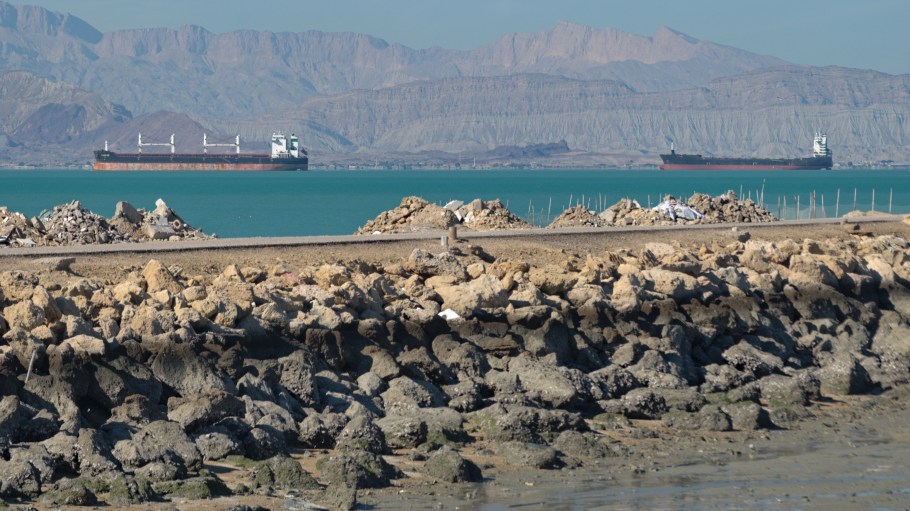
The escalating conflict between Israel and Iran has not had a direct impact on global freight yet, but shipping companies are growing leery of traversing through the Strait of Hormuz, the channel that connects the Persian Gulf to the Arabian Sea.
While the trade chokepoint remains open for business, traffic through the strait dwindled over a week’s span, according to data from the Joint Maritime Information Center (JMIC).
In an advisory update on Monday, JMIC illustrated that 147 cargo-carrying vessels sailed through the Strait of Hormuz on June 9, three days before Israel carried out a series of airstrikes against Iranian nuclear facilities. By June 15, only 111 vessels were passing through.
Related Stories
According to the JMIC, threat levels for ships operating in the Strait of Hormuz, Arabian Gulf and Northern Arabian Sea remain elevated.
JMIC was clear in its advisory that “there are no confirmed indications of an immediate threat to maritime traffic,” but confirmed reports of electronic interference affecting vessels’ ability to accurately transmit positional data via automated identification systems (AIS) in both the strait and the Arabian Gulf.
Jakob Larsen, head of security at international shipowners’ association BIMCO, told CNBC the conflict resulted in a “modest drop” in the number of ships sailing through the area.
The attacks on Iran have created some concern that the country’s military will block off access to the strait, which hosts the flow of approximately 20 percent of the world’s liquid oil supply, according to the U.S. Energy Information Administration.
But such a closure would impact container shipping operations as well, even though only 2 percent to 3 percent of estimated global container traffic passes through, according to data from Container Trade Statistics (CTS).
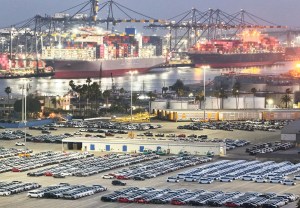
Major Middle Eastern transshipment hubs in the UAE, including Dubai’s Jebel Ali Port and Abu Dhabi’s Khalifa Port, would lose access to the vessels and their cargo. These ports play a significant role in trade across the Middle Easta and facilitate large volumes of sea-to-air relay shipments, while also linking the region to markets in the Indian subcontinent and Africa.
“A ripple effect of such action would be a sharp increase in handlings in transshipment hubs outside of the Persian Gulf with high risk of a wider Asian congestion issue,” said Lars Jensen, CEO of Vespucci Maritime, in a post on LinkedIn. “It would be a major problem related to imports and exports to and from Saudi Arabia, UAE, Qatar, Bahrain, Kuwait and Iraq. Likely we would see container lines not affiliated with the conflict trying to pick up the slack from those affected—same as we have seen for Red Sea transits.”
As such, capacity concerns could spring up if too many vessels are instead forced to stop at other already crowded transshipment ports, whether it Shanghai, Singapore or the Port of Colombo in Sri Lanka—ultimately resulting in more shipping delays.
“Any closure of the Strait of Hormuz would see services rerouted, with increased reliance on India West Coast ports for connecting the Far East to the Indian subcontinent,” said Peter Sand, chief analyst at Xeneta. “The inevitable disruption and port congestion, as well as the potential for higher oil prices, would cause a spike in ocean freight container shipping rates, with carriers likely also pushing for a ‘security surcharge’ on these trades in the coming days.”
On Monday, Maersk slapped a $4,000 peak season surcharge on all containers exiting the Middle East and Indian subcontinent on the way to the North American West Coast set to go into effect July 16. Hapag-Lloyd is adding its own $1,000 surcharge on all containers shipping from those origin regions to all ports in North America, which will begin July 15.
There’s also the concern of spiking war-risk insurance premiums, which had been prevalent in Red Sea travels and a reason many container shipping companies havankers e still opted to avoid the waterway.
Until June 13, the additional premium for a commodity’s transit through the Persian Gulf was around 0.05 percent of the cargo’s value for companies with annual sales of $500 million or higher, and closer to 0.1 percent for others, according to S&P Global Commodity Insights.
But as the conflict escalates, costs could potentially double, the firm says.
As uncertainty surrounds the Strait of Hormuz and the Middle East, two oil tankers collided and caught fire near the conduit on Tuesday morning. One of the tankers, the Adalynn, evacuated 24 people. Personnel on the second tanker, the Front Eagle, were reported safe. No injuries or spillage were reported.
British maritime security monitor Ambrey said that the collision was “not security related.”
In the wake of the collision, Qatar asked liquefied natural gas (LNG) vessels to wait outside the Strait of Hormuz until they’re ready to load amid escalating tensions in the region, according to Bloomberg.
Iran has interfered with container shipping in the Strait of Hormuz in the past, having seized the 14,000 20-foot equivalent unit (TEU) MSC Aries ship last April. Although Iran released the crew the next month, the country still retained control of the vessel.