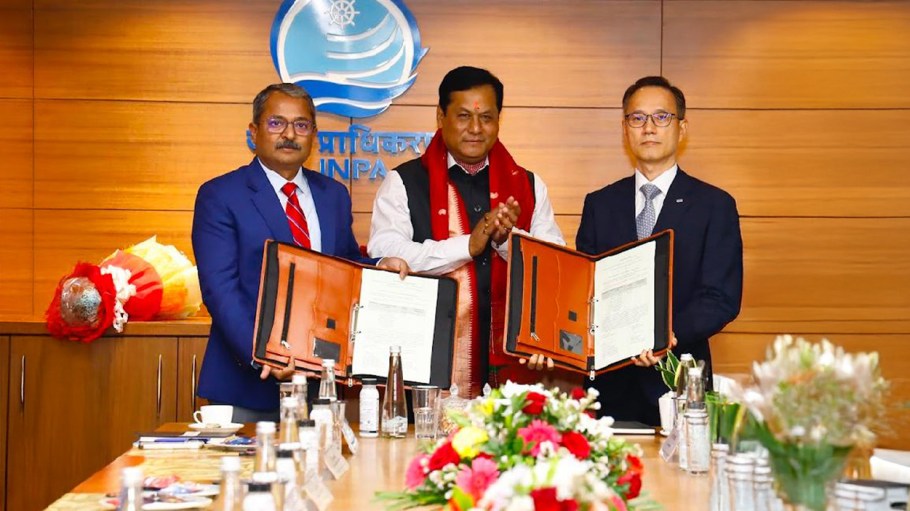
As India wills its $9.1 billion mega-seaport off the ground, the operator of one of the country’s other state-owned ports has teamed up with South Korean ocean carrier HMM to develop the project.
HMM and the Jawaharlal Nehru Port Authority (JNPA) unveiled their cooperation to help support the construction of Vadhvan Port, a nine-terminal port that is projected to handle 23.2 million 20-foot equivalent units (TEUs) per year by 2040.
The project is being developed in two phases, with Phase 1 slated for completion by 2029 and Phase 2 by 2039.
Related Stories
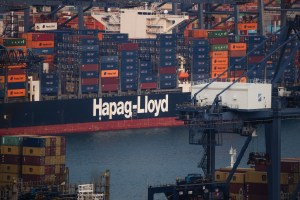
By the time the port is completed, it is expected to be the largest container handling hub in India, and one of the 10 biggest in the world. The port’s natural depth is expected to be 65.5 feet, which expands on the 50-foot depth at Jawaharlal Nehru Port. This allows the gateway to accommodate ultra-large container ships, including HMM’s 12-vessel fleet of 24,000-TEU vessels.
The port is intended to strengthen India’s trade connection with Central Asia, Europe and Russia—all with the goal to improve India’s standing in global maritime trade.
For HMM, it gives the container shipping giant more access to an accelerating market that is expected to continue growing its apparel exports and textile sourcing capabilities.
“India’s fast-growing market has drawn global attention, and HMM is expanding its services in the region, including INX (India-North Europe Express), which will be starting in February this year, FIM (Far East-India Mediterranean) and IAX (India-America Express) routes,” said HMM, in a statement.
The Korean container shipping giant plans to strengthen its Indian services and enhance its port business competitiveness via the agreement.
“We will continue investing in terminals to grow our integrated logistics business, a key part of our mid-to-long-term strategy,” an HMM spokesperson said.
HMM isn’t the only ocean carrier with ties to the port development project. The agreement builds on JNPA’s December agreement with MSC’s container terminal operator Terminal Investment Limited Sàrl (TIL), which committed $2.3 billion to the port and its surrounding ecosystem. Other global terminal operators, including DP World, Singapore’s PSA, Maersk-owned APM Terminals and CMA CGM, have also expressed interest in the project.
The Vadhvan port project is being developed as a public-private partnership, with state funding covering $5 billion for core infrastructure and private sector investment for additional facilities.
In late August, Prime Minister Narendra Modi laid the foundation stone at Vadhvan Port, which is expected to reduce congestion at Jawaharlal Nehru Port, where terminal utilization surpassed 90 percent capacity in 2024.
Vadhvan is located in Dahanu, a coastal town that is roughly 70 miles north of Mumbai, where Jawaharlal Nehru Port is located.
The port’s container terminals will each be roughly 3,300 meters long. It will include four multi-functional berths, four bulk carrier berths, a roll-on/roll-off berth, as well as room for small pilot boats and tugboats. In total, Vadvhan is expected to span 3,578 acres of sea and include construction of 6.3 miles of offshore breakwater and cargo storage facilities, with connections to major highways and a freight railway corridor.
The Vadhvan Port project is one of multiple massive construction plans taking place throughout India, including an expansion at the Jawaharlal Nehru Port itself.
The second phase of the port’s Bharat Mumbai container terminal was commissioned this month, which would add another 2.4 million TEUs to JNPA’s total capacity. The authority also will be doing upgrades at Nhava Sheva Freeport Terminal in 2025, which is also likely to add capacity to the port.
Jawaharlal Nehru Port handled its highest ever container volume of 7.05 million TEUs in 2024, but the port wants to expand to become India’s first to handle 10 million TEUs by 2027.
“With growing infrastructure, including creating capacity to handle larger vessels, JNPA is poised to play a crucial role as a key gateway for India’s global trade,” said Sarbananda Sonowal, India’s minister of ports, shipping and waterways, in a statement. “As India’s trade volume increases, from sectors as diverse as manufacturing to textiles, from electronics to agriculture, our ports are investing in capacity building as well as creating efficient solutions to support growing container traffic.”
The privately owned Mundra Port, which is currently the largest container handling hub in India, got regulatory approval last June to double the port’s capacity.
The port’s operator, Adani Ports and Special Economic Zone Limited (APSEZ), is fueling the project with $5.2 billion to expand the port’s capacity by 289 million metric tons to 514 million metric tons. Mundra currently has capacity to handle 225 million metric tons of cargo annually, including 9.5 million TEUs.
Mundra Port handled 7.4 million TEUs in its 2024 fiscal year and has seen 4.2 million TEUs of throughput in the 2025 first half thus far. According to APSEZ, the H1 handling number is 19 percent higher than its closest competitor in India.