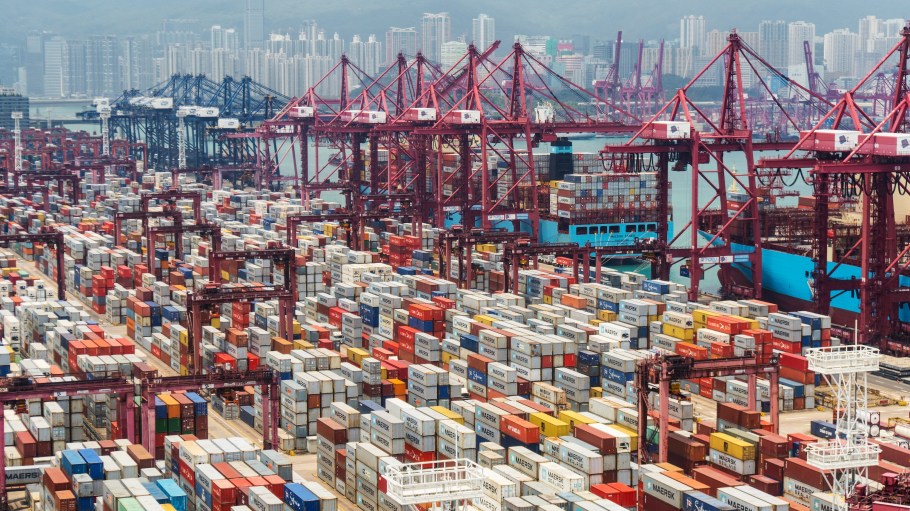
Hong Kong is rolling out a digital platform aimed at tracking cargo in real time and sharing data across different modes of transport including sea, land and air to bolster end-to-end visibility for supply chain stakeholders in the special administrative region.
In launching the Port Community System (PCS), Hong Kong wants to promote digitization within its port community, improve information interconnectivity across sectors, enhance the Port of Hong Kong’s competitiveness as a transshipment hub and better connect the port with other global gateways.
Related Stories
First announced last May by Hong Kong’s federal Transport and Logistics Bureau (TLB), the platform is set to debut in January. The government allocated 215 million Hong Kong dollars ($27.6 million) to install the system.
A presentation from the bureau indicated that the port had lacked a unified data-sharing system for stakeholders involved in the cargo delivery process, and sought to follow in the footsteps of major port cities such as Singapore and Europe’s Rotterdam and Hamburg, which gradually developed their own systems.
Mable Chan, China’s secretary for transport and logistics, said in a post on the TLB website in June that the system is designed to make shipping fully transparent to promote fast and accurate logistics operations.
“The PCS, as a one-stop platform, can ‘internally connect’ all relevant units in the local logistics supply chain and ‘externally link’ with domestic and international ports, as well as global shipping commercial data platforms, keeping us at the core of the digital shipping world,” Chan said.
Importers and exporters, shipping companies, warehousing companies, trucking firms, freight forwarders and port terminal operators can all participate in the PCS.
The bureau’s presentation indicates that users can enter a bill of lading number in the PCS to gather a vessel’s location, departure and arrival time, alongside expected container release status. Similarly, users can enter a waybill number for air cargo to track boarding, departure and arrival time.
Users can also generate a QR code to facilitate identification of cargo by transportation and logistics companies operating on land. A truck driver can activate location tracking to share the truck’s real-time location with other parties, while warehouse staff can scan the provided QR code for confirmation, so all parties are informed of the goods’ arrival at the warehouse.
Operators in Mainland China can enter a customs declaration number to find out the clearance status of the cargo.
According to program documents, 49 container shipping companies opted into the system as of September, including the largest global ocean carriers such as Mediterranean Shipping Company (MSC), Maersk, CMA CGM, Hapag-Lloyd, Cosco Shipping and Ocean Network Express (ONE).
Air cargo carriers including FedEx, UPS, Hong Kong-based Cathay Pacific, Atlas Air, Qatar Airways, China Southern Airlines and Lufthansa are among 112 airlines involved in the program.
The pilot data-sharing platform began phased testing of specific cargo clearance processes in early 2023, incorporating feedback from industry stakeholders to bolster the system.
After the testing and optimization process, Hong Kong’s government-funded Logistics & Supply Chain MultiTech R&D Centre (LSCM) assisted the bureau in the full development of the system. The LSCM will continue to operate the system for the bureau upon its launch.
The bureau said in May that the PCS can also help facilitate trade finance processes due to the real-time cargo status data that is collected, helping financial institutions and small and medium-sized businesses reduce credit costs and processing times.
During May’s launch ceremony, the bureau unveiled that it signed its first agreement with the Guangdong e-Port Management Company to enhance cooperation between the Port of Hong Kong and ports in South China’s Guangdong province.
The Guangdong e-Port Management Company operates digital platforms that handle customs declarations, cargo manifests, inspections and data exchange for cross-border trade that are used in the province’s major ports like Shenzhen and Guangzhou.
With the agreement, the parties can use the PCS to complete and submit ocean manifests before vessels enter the South China ports.
At the time, Hong Kong’s government said it would continue to explore other ports across Mainland China to partner with via the PCS.
“The PCS is a critical infrastructure for the future development of Hong Kong’s port and maritime sectors. It marks a significant step in our port community’s digital transformation,” said Chan during the ceremony. “It will also help facilitate trade and capital flows, enhance Hong Kong’s resilience and influence as an international maritime center to meet the challenges of an increasingly complex international environment, and serve our country’s strategic goal of becoming a maritime powerhouse.”
According to the TLB presentation, PCS can interface with existing cargo tracking systems so information can be shared with minimal disruption to the workflow.