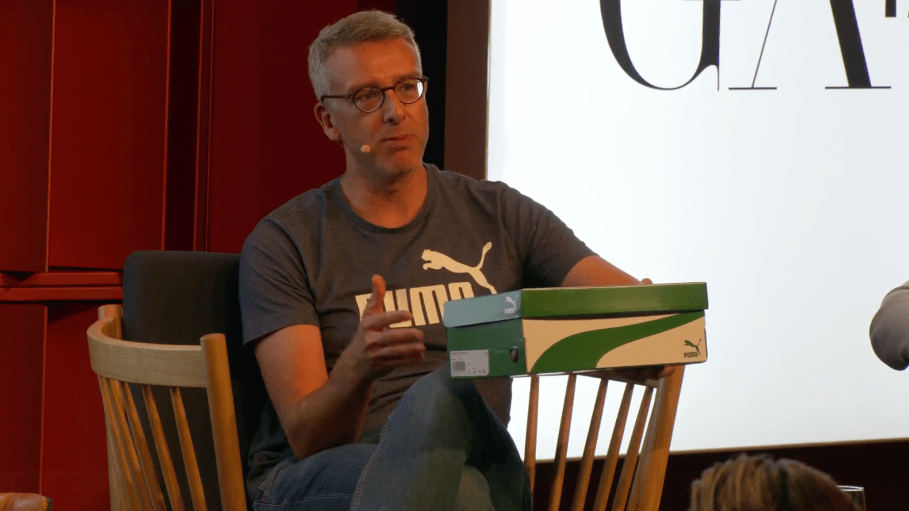
At the Global Fashion Summit in Copenhagen last week, Puma, H&M Group and Maersk discussed how they are making sustainable progress by decarbonizing logistics.
As part its 2040 net-zero roadmap, H&M Group plans to cut absolute emissions 56 percent by 2030.
According to Leyla Ertur, global head of sustainability, H&M Group, the fast-fashion retailer cut Scope 1 and 2 emissions roughly 8 percent in 2022, while cutting Scope 3 emissions 7 percent.
Related Stories
Puma plans to reduce carbon dioxide emissions by 33 percent by 2030 when compared to 2017 levels. The German athletic company realized it could make big gains by reducing air freight usage.
While Puma air shipped roughly 3 percent of its goods in 2019, that’s now just 1 percent, said Thomas Liske, global director of logistics for Puma.
“Now we’re aiming even further,” Liske said during a panel discussion at the Global Fashion Summit on June 27. “We can also see that has a very positive impact on CO2 emissions, obviously, because air versus ocean is a factor of 100 to one.”
Henriette Hallberg Thygesen, the chief delivery officer for Maersk, urged companies to consider more sustainable supply chain practices, including supply chain visibility solutions, lower-impact transportation and establishing green corridors. Brands and retailers should also strive for greater efficiency where possible, she added, saying the average shipping container is just 70 percent full.
Ertur pointed out that H&M has worked on partnering with peers shipping out of the same locations in an effort to use fewer vessels.
“It’s important to catch this partnership logic continuously, because it won’t always increase our business or profitability, but it definitely will contribute to our long-term relations,” Ertur said. “When you have partners like that in different parts of your value chain, I think it makes your journey much faster.”
Puma discovered that it could increase its container fill rates by 10 percent in the past year, simply by conferring with its sales team and examining dashboards to better understand where products are selling well.
The Adidas rival is also shipping more product out by right-sizing the average shoe box to pack more into one container, and ship fewer containers overall.
“Normally, you have 6,000 of these shoe boxes in a container, but then you ask yourself, ‘What happens if I put …6,600 shoe boxes in there?’” Liske said. “When you pack your suitcase, you make sure everything fits. With a shoebox, we’ve done the same. We said, ‘What’s…the right size we need?’ There you can create a lot of efficiency by looking and getting the right box and not shipping air around. That helped us reduce our CO2 emissions.”
Logistics currently accounts for 5 percent of H&M’s Scope 3 emissions—which come from areas in the supply chain not owned or controlled by the retailer—but Ertur understands the value of eliminating all emissions throughout the product journey.
For example, H&M shipped 100 percent of online packages in the Netherlands with electric vehicles (EVs) through a joint initiative with Volta Trucks and electric motorcycle maker Cake.
“We want to duplicate this in multiple countries and find partners like this in different type of solutions,” said Ertur, citing opportunities in last-mile delivery as well as shipping and warehousing.
Both H&M and Puma work with Maersk, which continually updates its emissions dashboard and is updating its own fleet with green fuel as part of a wider decarbonization effort.
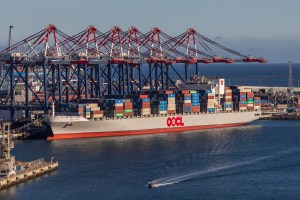
This month, Maersk is deploying its first-ever container methanol vessel, a 2,100 20-foot equivalent (TEU) feeder ship. The container shipping giant is also retrofitting another vessel to have its own dual-fuel methanol-powered engine, and has another 25 methanol-enabled vessels on order.
Besides aiming to achieve net-zero in 2040, Maersk has set near-term targets for 2030 to ensure alignment with the Paris Agreement and Science Based Targets initiative (SBTi) methodology, including a 50 percent reduction in emissions per transported container in the Maersk ocean fleet compared to 2020. Additionally, the company is aiming for 25 percent of its container volume to be transported using green fuels by 2030.
“Since this first vessel was ordered about two years ago, we’ve seen not just a boom in our own commitment to this, but competition as well,” said Anders Wøggsborg, senior customer sustainability partner, Maersk, during the panel. “We’re really seeing this as a huge move coming along to the industry.”