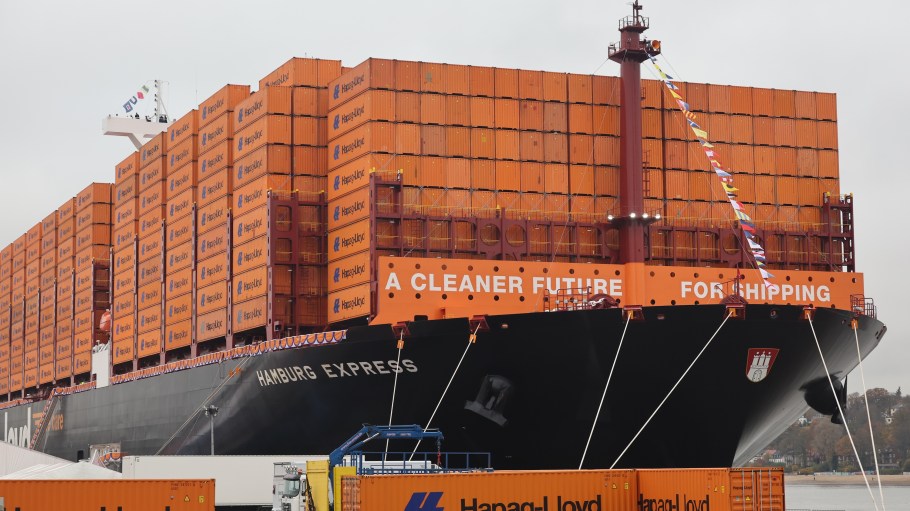
After the temporary tariff relief on Chinese imports into the U.S. resulted in a 50-percent one-week surge in bookings for Hapag-Lloyd on the trade route between countries, container flow accelerated even further in the weeks after.
Bookings out of China more than doubled in the three weeks after the 90-day trade truce was put into effect, according to CEO Rolf Habben Jansen.
“We now need to see over the upcoming couple of weeks what is going to happen, and how much of that cargo rush is going to remain,” said Habben Jansen in a recent online panel discussion hosted by the ocean carrier.
Related Stories
Despite various projections calling for a contraction in global container volumes for the year, Hapag-Lloyd revised its outlook upward from its previous flat growth forecast on the back of the recent uptick, projecting global container demand to increase 4 percent.
“I would still expect us to see decent growth in the second quarter,” said Habben Jansen.
While China-to-U.S. volumes account for roughly 5 percent of Hapag-Lloyd’s total business, the U.S. overall represents 27 percent of its volumes, Habben Jansen said. Approximately 22 percent of global container flows at the company go through American ports.
With the U.S. remaining a sizable chunk of the liner’s business, the concerns of volatility stemming from the stop-and-start nature of President Donald Trump’s tariff decisions makes it challenging to plan for.
Case in point, in the company’s earnings call in mid-May, the CEO said Hapag-Lloyd saw bookings decrease 20 percent on average in the period after the Liberation Day tariffs were applied and ahead of the tariff rollback.
But the China-to-U.S. demand picked up so quickly that Hapag-Lloyd and Gemini Cooperation partner Maersk introduced a new direct trans-Pacific service with a rotation of Xiamen, China; Busan, South Korea; and Long Beach, Calif.. The first sailing will take place out of Xiamen on June 24.
The “WC6” service will connect Busan and Long Beach with a transit time of 14 days, and a competitive direct Xiamen service into Long Beach in 18 days.
Hapag-Lloyd’s move reflects the industry at large, which has sought to add more capacity on the trans-Pacific trade lane to capitalize on shippers’ rush to get cargo space ahead of tariff deadlines in July and August.
As the Gemini alliance partners prep to start their new service offering, the carriers still lead the pack when it comes to schedule reliability, keeping their 90 percent schedule reliability goal intact across March and April. The alliance expects to be fully “phased in” by July, meaning that all shared vessels will sail on Gemini schedules.
“Only then will it be possible to truly evaluate their performance,” said Alan Murphy, CEO of Sea-Intelligence, in the monthly update.
Gemini Cooperation officially came in with 90.7 percent reliability, with MSC following suit far behind at 69.8 percent. The Premier Alliance of Ocean Network Express (ONE), HMM and Yang Ming recorded 53 percent reliability in the two-month stretch.
Habben Jansen said he was encouraged by the alliance’s ability to ensure Hapag-Lloyd’s first-quarter volumes surpassed the wider market with 9 percent growth, ahead of the 4.2 percent global growth experienced by the wider container shipping sector.
“That was the intention when we started [the partnership]. We knew that we needed to attract more volumes to fill those ships, also because we lose fewer sailings as we don’t do blank sailings, as we used to do,” Habben Jansen said. “And we sail on time, which basically means that we can use the ships more often. It’s very nice to see that also reflected in the numbers, and hopefully we’ll see more of that as we move into Q2.”
Although competitor CMA CGM has introduced another service line back on the Suez Canal route, Hapag-Lloyd does not have intentions of following suit—the attitude still taken by most major container shipping firms.
According to Habben Jansen, the story remains the same. There must be a clear indication that vessels and crew will be safe from potential Houthi attacks.
“If we go back then we will have to do that step by step, as we would like to avoid chaos in the Mediterranean and in Europe in particular, and to a lesser extent, on the East Coast of the U.S.,” said Habben Jansen. “Right now, we do not see any signs that it is going to be and remain safe in the near future.”