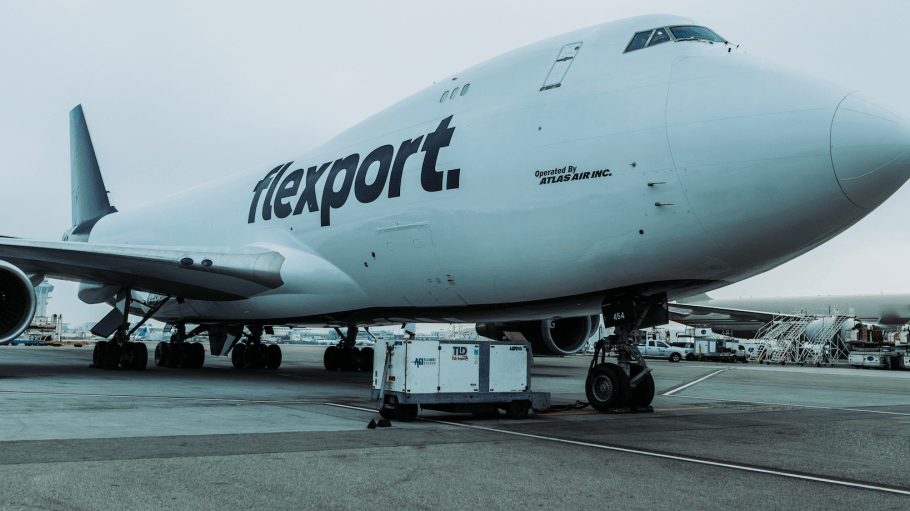
Flexport’s climate wing is taking initiative to decarbonize air freight.
In tandem with Chooose, a software-as-a-service (SaaS) platform built to integrate climate action into customer experiences, Flexport.org will offer a solution enabling customers to reduce lifecycle emissions by supporting sustainable aviation fuel (SAF).
The joint solution is part of Flexport.org’s suite of climate impact and technology solutions available through the Flexport platform, which already lets customers calculate emissions, access reporting and purchase verified carbon offsets or marine biofuels certificates. Flexport customers can track their purchases and monitor their cumulative impact over time.
Related Stories
Businesses leveraging air freight are under pressure to cut greenhouse gas (GHG) emissions. In October 2022, the United Nations’ air transportation governing body, the International Civil Aviation Organization (ICAO), committed to net-zero emissions across global air transport by 2050.
The Flexport and Chooose platforms are integrated via API to provide the digital freight forwarder’s customers with an in-app experience as they evaluate solutions to act on their carbon footprint when booking freight.
The program leverages a book-and-claim chain of custody model through which sustainability attributes associated with a physical product are separated from the physical flow of the product. In aviation, book-and-claim is a model that enables aviation customers to purchase the environmental benefits associated with a specific amount of physical sustainable aviation fuel (as compared to traditional jet fuels) without being connected to the physical supply.
Through this chain of custody model, Flexport customers can buy certificates that can be applied as direct reductions against their Scope 3 emissions, which occur outside of a company’s direct control across supply chain partners.
Any customer with air shipment emissions will be able to support sustainable aviation fuel, Flexport says, regardless of the origin or destination, carrier or trade lane. The solution is designed so users can directly address air freight emissions at the source, instead of relying on alternative paths, such as forestry management, to reduce their lifecycle carbon emissions.
Enterprise partners in sectors like aviation, travel, and logistics deploy Chooose to build, manage and report on carbon programs that engage their customers and advance their internal compliance or voluntary climate goals.
Outdoor apparel brand Cotopaxi, which already participates in Flexport’s offset program, will use the new feature.
“Urgently reducing our transportation emissions across our supply chain remains crucial if we’re to realize our aggressive net-zero reduction plan. We are thrilled to use SAF to decrease the footprint from our air shipments with the support of Flexport,” said Annie Agle, vice president of impact and sustainability at Cotopaxi, in a statement.
With Flexport’s help, Cotopaxi says its reduced emissions are equivalent to avoiding over 1,400 gallons of gasoline consumed.
All Flexport customers will have access to the solution within the Flexport platform’s Sustainability Dashboard.
“Sustainable aviation fuels are integral to decarbonizing the freight sector. Flexport’s partnership with Chooose will allow our customers to seamlessly address their air freight emissions in the Flexport Platform,” said Neel Jones Shah, executive vice president, global key accounts and chief customer officer, Flexport. “We are an early supporter of Choose, and Flexport is proud to announce this collaboration and commitment to reducing transportation emissions across our business.”
Sustainable aviation fuel is expected to play a pivotal role in decarbonizing the aviation sector in the coming years. Aviation accounts for approximately 2 percent of global greenhouse gas (GHG) emissions, but has grown at a faster rate in recent decades than rail, road or container shipping, according to the International Energy Agency.
In 2022, global sustainable aviation fuel production is estimated at 300 to 450 million liters, covering a minuscule 0.1 percent to 0.15 percent of total jet fuel demand, says the International Air Transport Association (IATA).
Despite being pricier than conventional jet fuel, every drop of the sustainable substitute produced was purchased by aircraft operators and their customers, the association said.
The fuel alternative has lower net lifecycle carbon emissions than fossil-based jet fuels, since its lifecycle greenhouse gas emissions are typically one-fifth of those from conventional jet fuels. It can be sustainably produced without depleting natural resources, and it is compatible with existing aircraft engines—all of which bodes well in making flight more carbon-efficient.
“Chooose is proud to power Flexport and its customers in addressing air freight carbon emissions. We developed the Chooose API to put impactful climate solutions in the hands of our partners and their customers,” said Andreas Slettvoll, CEO at Chooose, in a statement. “By offering a seamless emission calculation and purchase experience directly in their platform, Flexport is facilitating the much-needed acceleration of sustainable aviation fuel.”