FedEx lifted the bottom end of its guidance for fiscal year 2026 after a stronger-than-expected second quarter driven by higher domestic volumes and improving shipping rates. But the second half of the year is forecast to see $600 million in headwinds due to the prolonged grounding of its MD-11 aircraft and softness in its FedEx Freight division.
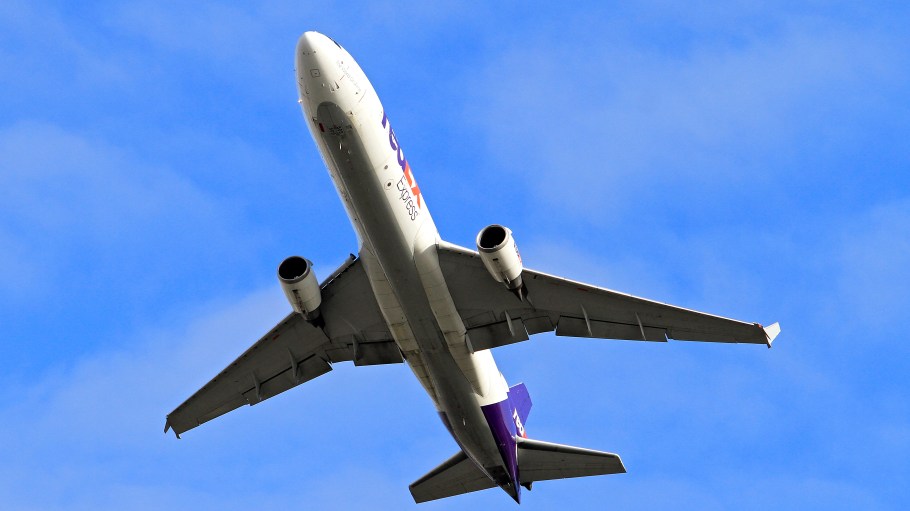
The logistics giant will incur $175 million in costs in the second half related to the aircraft grounding, with most of those expenses coming in the third quarter starting Dec. 1. The Federal Aviation Administration (FAA) ordered the temporary nationwide grounding of all MD-11 flights after a UPS jet crashed after takeoff in Louisville, Ky. in November.
Related Stories
“It’s an expensive time of year to be getting outsourced lift to begin with, let alone when you have fleet grounded,” said John Dietrich, chief financial officer at FedEx, during a Thursday earnings call.
Accounting for roughly 4 percent of FedEx’s air delivery fleet, the MD-11s will return to service in the company’s March-to-May fourth quarter.
At the time of the grounding, FedEx owned 34 MD-11s, with 25 actively in service. Eighteen of those aircraft were flying domestic routes, meaning the disruption hit the core of FedEx’s U.S. air network just as peak season ramped up.
According to FedEx CEO Raj Subramaniam, the company is shifting volume to other types of aircraft within its fleet, as well as third-party aircraft, to make up for the capacity loss. The delivery company is also moving more domestic volumes via trucking.
This response also dovetails with a broader recalibration of FedEx’s air freight strategy, one that goes well beyond a single fleet issue. During the quarter, the company reduced its own “purple tail” trans-Pacific Asia-bound capacity by about 25 percent year over year. Third-party or “white tail” capacity on those lanes fell even more sharply, down nearly 35 percent.
Those cuts reflect ongoing weakness in China-to-U.S. export demand, exacerbated by the shifting trade policies throughout 2025 and continued softness in industrial volumes.
At the same time, FedEx is not retreating from international air, but redirecting its focus. Capacity has been shifted toward Asia-to-Europe lanes, which management says carry a more attractive mix: more than 75 percent of volumes are higher-margin B2B shipments.
As for its less-than-truckload (LTL) division, FedEx Freight, the logistics giant expects to feel roughly $160 million in cost headwinds ahead of its June 1 spinoff.
The trucking unit saw average daily shipments decline 4 percent in the second quarter, sending revenue down 2 percent, largely due to continued weakness in the industrial economy.
FedEx now forecasts a $300 million decline in adjusted operating income at FedEx Freight compared to the $100 million expectation shared in September. Of those costs, $100 million will come from separation expenses.
The Freight segment has already incurred one-time spinoff costs of $152 million, FedEx said.
Despite the headwinds, FedEx’s overall volume growth has driven a more upbeat outlook across the wider company.
The company projects fiscal 2026 revenue growth of between 5 percent and 6 percent from the prior year, up from a previous range of between 4 percent and 6 percent. On a per-share basis, FedEx now expects adjusted earnings between $17.80 and $19, lifting the bottom end from the prior $17.20.
Average daily domestic volumes in the second quarter increased 6 percent to 14.7 million packages, with revenue per U.S. package jumping 5 percent to $14.47. Total revenue from domestic packages increased 12 percent to $13.4 billion.
These numbers helped propel overall revenue 7 percent to $23.5 billion at FedEx, up from $22.8 billion expected by analysts polled by FactSet. Revenue rose 8 percent to $20.4 billion when not accounting for the LTL segment.
Net income totaled $956 million, up from $741 million in the year before.
The company is improving its balance sheet as it maneuvers through massive cost cuts, having closed more than 150 facilities this year as part of its Network 2.0 plan, which is designed to consolidate the FedEx delivery network with fewer stations and routes and increase shipping efficiency.
Currently, 24 percent of eligible average daily volume is flowing through 355 Network 2.0-optimized facilities. By next year’s peak season, this number is expected to accelerate to around 65 percent, Subramaniam said.
FedEx plans to close 30 percent of its package distribution facilities by the end of the fiscal year 2027 as part of the network transformation plan. Those moves are designed to make future capacity swings—whether driven by demand or fleet issues—easier to absorb.
The adjustment runs parallel to chief competitor UPS as both companies aim to slash costs and consolidate their logistics networks.