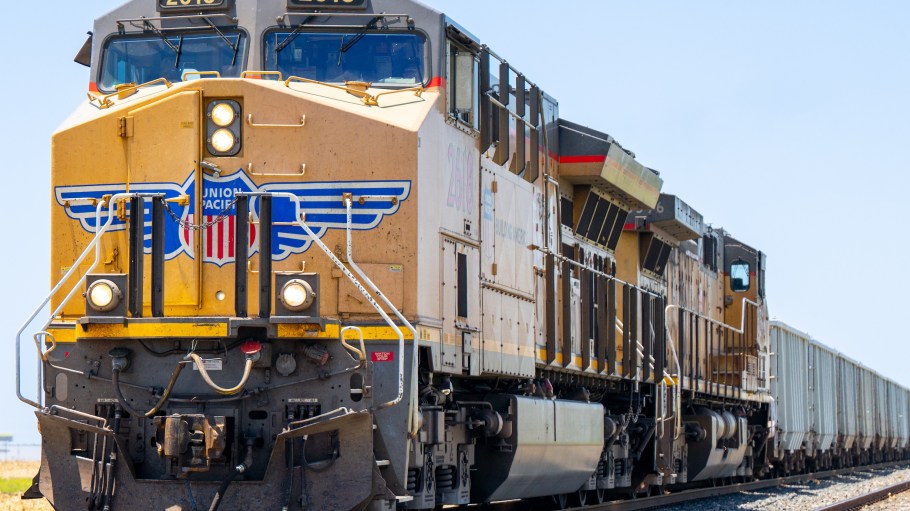
In the past week, the pending $85 billion Union Pacific-Norfolk Southern deal got arguably its two biggest endorsements yet.
President Donald Trump told reporters in the Oval Office Friday that the acquisition “sounds good to me,” giving a seeming go-ahead to a looming agreement that had already drawn a vote of confidence from one of his cabinet members, Commerce Secretary Howard Lutnick.
The Surface Transportation Board (STB) still has to review the merger application, which the Class I railroads plan on filing by Jan. 29.
Related Stories
And on Monday, the country’s largest railroad transportation union, SMART-TD, also voiced its support for the merger after securing job protection guarantees for its members.
The union’s support is an about-face from its previous, albeit unofficial, position. In July, after the railroads announced the deal, SMART-TD said in a statement it had intended to oppose the deal. The union represents roughly 125,000 active and retired railroad, bus and mass transit workers.
Trump’s comments heaped praise upon Union Pacific CEO Jim Vena, saying he was a “big fan of the head of the railroad.” The president and members of his administration had meet with Vena more than a week prior to discuss the acquisition.
“Union Pacific is a great railroad, and they want to add a railroad that had a mistake at a place very close to my heart,” Trump said, referring to the derailment of a Norfolk Southern train in East Palestine, Ohio, in 2023. That accident spilled toxic chemicals and forced residents to leave the area for days at a time.
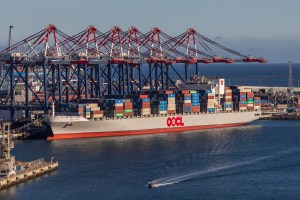
If approved by the STB, the transaction would create the largest railroad company in the U.S., and the country’s first modern transcontinental railroad. The combined company would connect more than 50,000 miles of tracks across 43 states, access roughly 100 ports and serve 10 international gateways with Mexico and Canada.
Trump’s support could accelerate what is a lengthy review process that expects to close in early 2027.
Under STB regulations, railroad mergers are required to prove that a deal would both serve the public interest and enhance competition, a step beyond merger requirements applied to other industries.
However, the Trump administration’s shakeup of the board signals that it could be moving in a pro-merger direction. Trump appointed board member Patrick Fuchs as chair earlier in the year, with the board currently undergoing a review of its regulatory framework.
President Trump fired STB member Robert Primus in late August, which gave Republicans a 2-1 majority on the board, before nominating a new prospective member Richard Kloster. Primus was the lone board member to dissent from a March 2023 decision to approve Canadian Pacific’s $31 billion acquisition of Kansas City Southern, now known as Canadian Pacific Kansas City (CPKC).
Kloster, a railroad consultant and founder of Integrity Rail Partners, still has to be confirmed by the Senate.
While SMART-TD condemned the sacking of Primus, the labor group’s endorsement comes as the union said the agreement guarantees its members job protection across train and yard service for the length of their carriers.
Union Pacific has committed that these employees will not face involuntary furloughs because of the merger, the union said. Along with “lifetime job security,” the union said the planned new railroad would conduct preferential hiring for terminal employees affected by the proposed merger.
“This is an unprecedented guarantee in the history of American railroading,” SMART-TD said in a statement.
Ahead of the endorsement, Union Pacific and Norfolk Southern had indicated they would preserve union jobs if a deal is approved.
“This is a proud day for our members,” said SMART-TD president Jeremy Ferguson in a stateement. “For generations, railroaders have worried about what mergers might mean for their jobs and whether or not they would be given the opportunity to reach retirement on the rail.”
There are still parties publicly railing against the deal.
Earlier this month, the Rail Customer Coalition (RCC), a group comprised of trade associations representing the manufacturing, energy and agricultural industries reliant on railroads, wrote a letter to the STB relaying their concerns with the proposed rail consolidation.
The RCC noted that just four Class I railroads control 90 percent of freight traffic.
“Past rail mergers have shown what happens when consolidation goes unchecked: service suffers, costs increase, and jobs disappear,” the RCC said. “A transcontinental merger could spark a new wave of consolidation, leaving captive shippers with even fewer Class I rail companies and competitive joint line options to choose from. This is in direct contrast to the President’s executive orders aimed at promoting American prosperity, curbing anti-competitive practices, and preventing monopolistic behavior.”