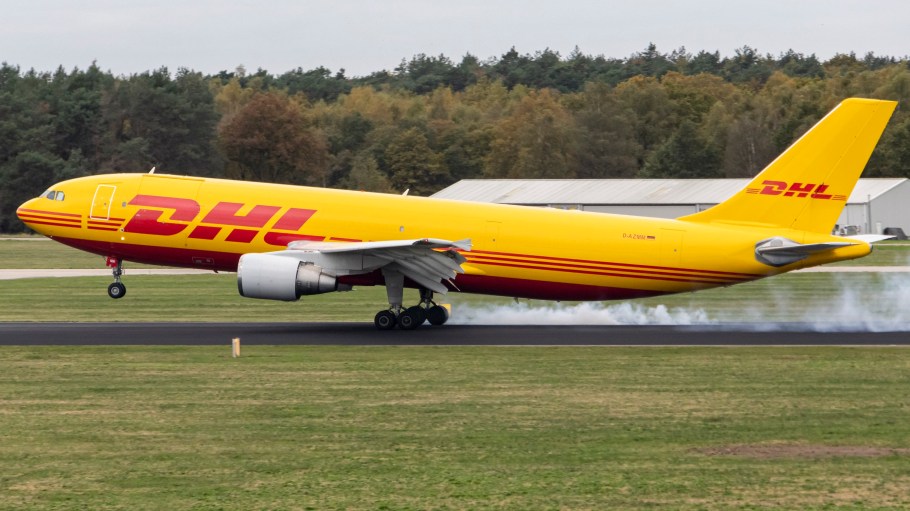
The end of the de minimis provision worldwide is tanking air freight shipments entering the U.S. at DHL, with third quarter volume by weight declining 32 percent year-over-year at the logistics giant’s DHL Express division.
However, DHL has largely maneuvered de minimis’ demise smoothly due to capacity adjustments as the team cut aviation costs 8.5 percent, with net income jumping 11.9 percent to 840 million euros ($973.6 million).
According to the company, the scrapping of the trade exemption has so far had only a limited impact on its earnings, even as the courier temporarily suspended most shipping to and from the U.S. earlier in the quarter due to the new customs regulations.
Related Stories
And while revenue fell 2.3 percent to 20.1 billion euros ($23.3 billion), even with tariff headwinds, lower volumes on U.S. bound flights and lower freight rates, it grew 3.2 percent excluding impacts from foreign currency fluctuation.
For the Express segment, the shifts in U.S. trade policy have namely hit the DHL’s business-to-consumer (B2C) volumes, which went down 23 percent in the quarter. B2B volumes declined 2.2 percent.
“E-commerce has clearly taken a much more severe drop than B2B volumes,” said Tobias Meyer, CEO of DHL Group, during a third-quarter earnings call. “That’s something that we very clearly see, and I think everybody would expect as well. Those B2B volumes are goods that are essential in many ways to the U.S. economy, to U.S.-based customers.”
The dip in total volumes across B2C and B2B mirrors that of the second quarter, when volumes on DHL Express’ “time definite international” cross-border delivery service decreased 31 percent.
In the event the Supreme Court strikes down U.S.-levied tariffs on other countries, Meyer does not expect a recovery in the B2C volumes. Brands that had previously flooded the air cargo market with duty-free shipments under $800 no longer can leverage that threshold for direct-to-consumer deliveries.
“We think that the step down that has happened is permanent,” said Meyer. “We would love to definitely bring some business back, but we currently do not plan for that.”
DHL isn’t planning for much relief against the tariffs, even if the court rules that President Donald Trump cannot levy tariffs under the International Emergency Economic Powers Act (IEEPA), “we all know that there are other legal grounds that the president could use to impose tariffs,” said Meyer.
Despite the collapse in B2C volumes, DHL expects there will be a “B2C peak season,” not just across the DHL Express air division, but also its Post & Parcel Germany and DHL eCommerce parcel delivery segments.
With the expected peak season in play, DHL Express plans to temporarily deploy 10 additional Boeing 777 freighters on certain routes.
Guidance for DHL Group remains unchanged ahead of the holiday season. The logistics firm expects to generate operating profit of at least 6 billion euros (roughly $7 billion) and free cash flow (excluding M&A) of approximately 3 billion euros ($3.5 billion) in 2025.
Across the individual units at DHL, the Express business saw revenue decline 3.2 percent to 5.9 billion euros ($6.8 billion), while operating profit increased 1 percent to 692 million euros ($801.8 million). Global Forwarding revenue sank 9.2 percent to 4.6 billion euros ($5.3 billion), whereas operating profit fell 29.6 percent to 195 million euros ($225.9 million).
Contract logistics provider DHL Supply Chain’s revenue inched down 0.4 percent to 4.4 billion euros ($5.1 billion) on a 1.6 percent increase in operating profit to 278 million euros ($322.1 million).
DHL’s stock has jumped more than 13 percent since the earnings report on Wed. Nov. 12.
The German company isn’t the only global logistics titan with some good news as the peak season kicks into gear.
In a positive sign ahead of the holiday rush, FedEx revealed a favorable guidance for its fiscal second quarter, which concludes at the end of November.
At the Baird Annual Global Industrial Conference Tuesday, chief financial officer John Dietrich said the courier would surpass the prior year quarter’s $4.05 per share in adjusted earnings.
The number would be the expected $4.02 of adjusted earnings per share, according to estimates from analysts compiled by Bloomberg. The commentary popped the company’s stock more than 5 percent after midday Wednesday, with rival UPS’ stock also increasing 1 percent in sympathy.