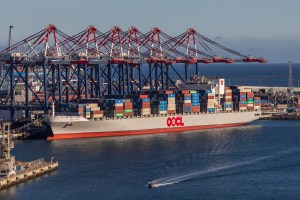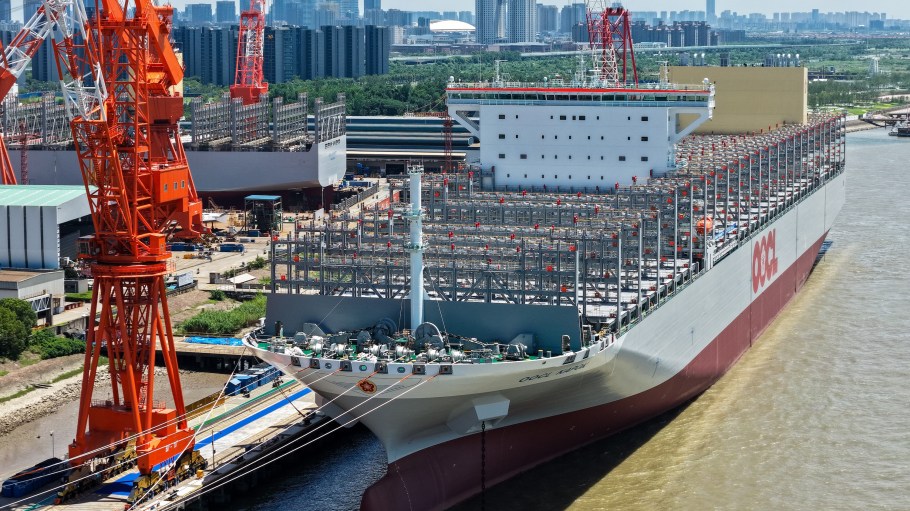
Cosco Shipping and Orient Overseas Container Line (OOCL) could encounter more than $2 billion in combined fees next year for docking at U.S. ports after the surcharges go into effect in October.
According to a report from HSBC Global Investment Research, Cosco Shipping is expected to pay $1.53 billion in these fees in 2026 if the Chinese state-owned ocean carrier doesn’t adjust its networks.
OOCL, Cosco’s subsidiary that had already suggested it would incur “a relatively large impact” from the U.S. Trade Representative (USTR)-levied policy, is projected to fork over $654 million in fees without a network overhaul.
Related Stories
The Cosco hit would amount to 5.3 percent of revenue estimates for the 2026 fiscal year and erode 74 percent of consensus earnings before interest and tax (EBIT) margin forecasts, while potential fees against OOCL would represent 7.1 percent of revenue and cut projected EBIT margins by 65 percent.
On Oct. 14, the USTR will charge an extra fee of $50 per net ton on Chinese vessel operators for every voyage that includes U.S. ports. An additional $30 per net ton will be tacked on each year through 2028.
Non-Chinese container shipping lines will be subject to the port fees only if they deploy Chinese-built ships for American port calls. Chinese-built vessels that carry fewer than 4,000 20-foot equivalent units (TEUs) and those that make short-haul voyages will be exempted from fees.
Using data from container shipping research firm Alphaliner, HSBC noted that 86 Cosco-operated ships called U.S. ports as of Aug. 1.
HSBC calculated the potential cost for Cosco Shipping and OOCL based on incurring a $600 fee per 40-foot container.
Cosco and OOCL have long been speculated that they would work with their partners in the vessel-sharing Ocean Alliance—CMA CGM and Evergreen—to soften the financial blow that would come with docking at U.S. ports.
CMA CGM already indicated in May it will not have to pay the fees, with less than half of the company’s 670 vessels built in China. For Taiwan-based Evergreen, the company only has six large container ships from China as of April, with none placed on U.S. routes, the container shipping firm said.
“As far as I am aware, there is not a cost-sharing process in the Ocean Alliance for this, hence the cost falls on Cosco and OOCL,” said Lars Jensen, container shipping expert and CEO of Vespucci Maritime, in a post on LinkedIn. “But that would de facto increase friction between the partners as you would be in a situation where for example Cosco would pay a very high port fee for calling a U.S. port, yet a substantial part of the cargo on the vessel would be for CMA CGM and Evergreen.”
The HSBC report suggested that CMA CGM and Evergreen would deploy more non-Chinese-built ships on the trans-Pacific route, while Cosco and OOCL add capacity on other trade lanes.
“They could also resort to services that bypass the U.S. and rely on transshipments from Canada, Mexico or the Caribbean which could increase demand for feeder services,” the HSBC report said.
Similarly, Jensen expects to see some network changes from Ocean Alliance on the U.S.-bound services, in which they use more vessels from CMA CGM and Evergreen where feasible, and then likely retract services from Cosco and OOCL.
For example, a Cosco service from China to the Pacific Northwest would only call at Canadian ports, rather than American gateways, he said.
“With U.S. import and export demand growth continuing to decline, we should anyhow expect carriers to institute larger blank sailings programs as we get into Q4,” Jensen said. “For Ocean Alliance the expectation should therefore be that Cosco- and OOCL-operated services will be the first ones on the chopping block.”
According to HSBC, 21 percent of ocean freight capacity across the trans-Pacific and trans-Atlantic trade lanes consisted of China-built tonnage, while only 15 percent of port calls in 2024 were made by Chinese-constructed vessels.
The report noted that other vessel-sharing alliances have already taken some precautions to ensure they will not get impacted by the fines.
The Gemini Cooperation of Maersk and Hapag-Lloyd, which share roughly 340 vessels within their network, already deploy South Korean-built vessels on the Asia-to-U.S. route, the report said.
And the Premier Alliance, which consists of Ocean Network Express (ONE), Hyundai Merchant Marine (HMM) and Yang Ming, split its Mediterranean Pacific South 2 (MS2) service into two services earlier this month—into an Asia-to-Mediterranean service and a trans-Pacific service—removing 10 Chinese-built ships in the process.