Cosco Shipping rebuked the U.S. Trade Representative’s (USTR) decision to levy port docking fees on Chinese-owned and -operated ships Friday, calling the move “discriminatory” against the country’s maritime, logistics and shipbuilding industries.
“We firmly oppose the accusations and the subsequent measures. Such measures not only distort fair competition and impede the normal functioning of the global shipping industry, but also threaten its stable and sustainable development,” said Cosco Shipping in a statement. “Ultimately, these actions risk undermining the security, resilience and orderly operation of global industrial and supply chains.”
Related Stories
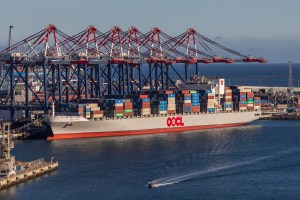
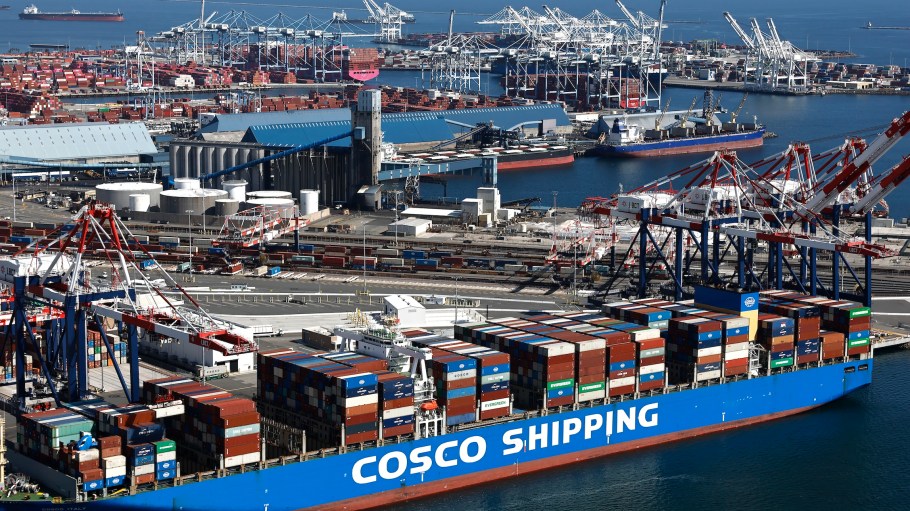
Chinese state-owned Cosco Shipping and its subsidiary Orient Overseas Container Line (OOCL) are expected to endure the biggest blow of any of the major global ocean carriers. Combined, both container shipping firms made over 1,300 U.S. port calls in the 12 months through March, according to data from S&P Global Market Intelligence.
“Cosco/OOCL will be hit harder than other carriers,” said Lars Jensen, CEO of container shipping consultancy Vespucci Maritime, in a post on LinkedIn Friday. “This is likely to cause a network adjustment in Ocean Alliance such that CMA CGM and Evergreen will be operating U.S.-bound services as much as possible. Other carriers will shuffle vessels where possible to have Chinese ships in other trades.”
Importers using Cosco or OOCL may have to rethink their partnerships, as 17 percent of U.S. inbound container cargo from the Far East comes on Chinese carriers, according to Linerlytica.
The updated proposal from the USTR dialed back the initial port fees, which would have initially charged liners up to $1.5 million per port call depending on percentage of Chinese-built ships in a fleet. Those fees were cumulative, and would have charged carriers up to $1 million per stop if more than half of new orders came from Chinese shipyards.
Under the first iteration of the fees, Cosco would have had to pay $3.5 million per individual port call, and $10.5 million to stop at three U.S. ports. But the update softens the blow, with cumulative fees eliminated and charged based on a full U.S. voyage and not individual port call.
However, Cosco would still have to pay a pretty penny starting Oct. 14, when fees are set at $50 per net ton. Under that calculation, the average large 12,000 20-foot equivalent unit (TEU) Cosco container ship that carries roughly 60,000 tons would generate a $3 million fee for a full port rotation.
“We remain steadfast in our commitment to supporting global trade and delivering high-quality, reliable commercial shipping and logistics solutions to our clients worldwide,” Cosco said in its statement. “Looking ahead, we will continue to safeguard our clients’ interests while offering a comprehensive range of dependable services. We encourage all clients to stay informed about specific service offerings and protective measures provided by our subsidiaries across various business segments.”
Cosco has been the target of U.S. restrictions before. In January, the Department of Defense blacklisted the company, prompting some charterers to request brokers to not offer the Chinese firm’s vessels.
In response to the port fees, China’s commerce ministry agreed with Cosco that the move had “discriminatory characteristics” that “seriously harm the legitimate rights and interests of Chinese companies, disrupt the stability of the global supply and production chain” and “violate World Trade Organization rules.”
Multiple Chinese industry associations expressed their dismay with the port fees and the wider Section 301 investigation that prompted the penalties.
The China Association of the National Shipbuilding Industry (CANSI) and China Shipowner Association (CSA) released statements in opposition to the fees, with the former expressing “extreme indignation” over the USTR announcement.
“The decline of the U.S. shipbuilding industry is the result of its protectionism and has nothing to do with China,” CANSI said, suggesting the restrictions will lead to a surge in international shipping costs, and will also further aggravate the U.S.’s “domestic inflation dilemma.”
CSA claimed the Section 301 investigation, which determined that China had an “unreasonable” dominance of the maritime, logistics and shipbuilding industries, said the probe was “based on political bias” and “false facts and prejudice.”
The U.S. actions against the Chinese maritime industry The implementation of the new port fees followed the Federal Maritime Commission’s (FMC) decision to classify the Chinese-Polish Joint Stock Shipping Company (Chipolbrok) as an entity controlled by the Chinese government.
Headquartered in Shanghai, Chipolbrok is jointly owned by the governments of China and Poland. “Controlled” carriers are subject to increased regulatory oversight by the FMC.
Chipolbrok joins other China-based liners including Cosco, OOCL, Hede and Anji Shipping on the controlled carrier list, alongside HMM (Hyundai Merchant Marine), which is operated by the South Korean government.