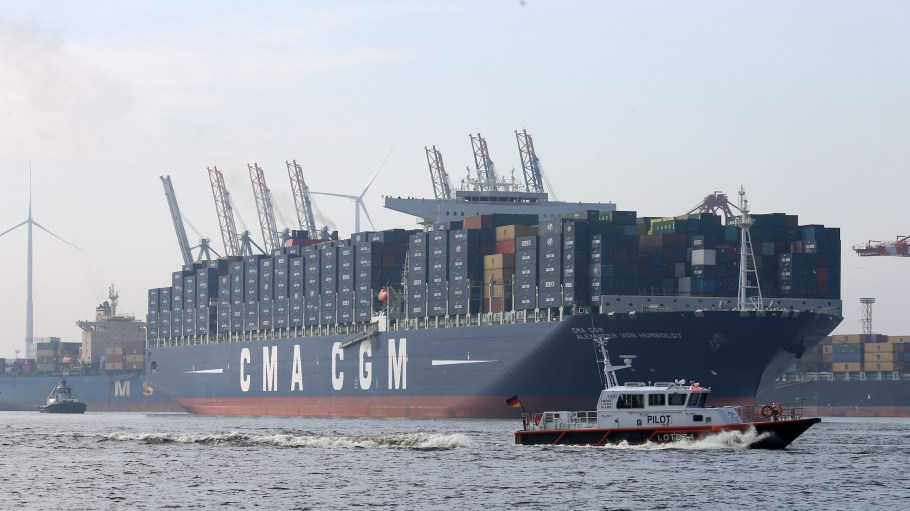
According to CMA CGM, there will be no avoiding the impacts if the Trump administration goes through with its proposal to impose fees on China-built and -operated ships docking at U.S. ports.
“China builds more than half of all container ships in the world, so this would have a significant effect on all shipping firms,” chief financial officer Ramon Fernandez told reporters early Monday.
Ocean carriers like CMA CGM, Maersk, Mediterranean Shipping Company (MSC) and China’s Cosco Shipping could all see fees of up to $1.5 million per port stop if the administration goes through with the impositions.
Related Stories
CMA CGM’s own fleet would feel the impacts of those fees, if implemented. Forty-one percent of its active fleet is built in China, according to Xeneta, while an even higher percentage of its orderbook (53 percent) is or will be built there.
Currently, U.S.-based subsidiary American President Lines (APL) has 10 U.S.-flagged vessels, Fernandez said.
The U.S. Trade Representative’s (USTR) office set up the proposal after determining that China’s dominance of the maritime, logistics and shipbuilding practices were “unreasonable” and disadvantaging the U.S. economy. Since President Donald Trump’s first administration, the U.S. has responded to several Chinese Section 301 trade violations by China by hitting them with a series of import tariffs.”
When asked about the updated Ocean Alliance, the vessel-sharing agreement involving CMA CGM and Asian partners Cosco, subsidiary Orient Overseas Container Line and Taiwan-based Evergreen, Fernandez said there are no indications the alliance could be called into question in view of U.S. policy.
The “Day 9” service officially launches in April 2025, and intends to deploy around 390 container vessels with an estimated total nominal capacity of nearly 5 million 20-foot equivalent units (TEUs) across 41 weekly service loops and more than 520 direct port pairs.
For the fourth quarter, CMA CGM saw revenue jump 38.8 percent to $14.7 billion on net income of $1.5 billion. Revenue far accelerated the amount of volume carried by the logistics giant as freight rates remained elevated from the year prior, with total TEUs jumping 7.8 percent from the prior fourth quarter to 5.93 million.
Fernandez said in the briefing that a rush to beat the tariffs levied by the Trump administration led to the strong shipping volumes.
CMA CGM would not issue a formal guidance for 2025, saying it remains “prudent” and is paying close attention to the changing economic and geopolitical situation.
Even just a few years after the supply chain saw worldwide congestion during the Covid-19 era of 2021 amid the acceleration of e-commerce growth, CMA CGM chairman and CEO Rodolphe Saadé remarked in a statement that the current market was characterized by “unprecedented uncertainty.”
The company expects global economic growth of around 3 percent for the year, with global trade expected to grow at the same rate.
The container shipping giant said the higher tariffs could have an impact on trade and “lead to a reorganization of global supply chains in the medium term.”
CMA CGM also cautioned that deliveries of new vessels, combined with any developments in the Red Sea, will be decisive factors in shaping the market. Both situations directly impact the overall availability of global ocean shipping capacity. If carriers were to make a full-time return to the Red Sea, that would free up capacity that has filled up for longer as ships reroute around southern Africa’s Cape of Good Hope.
According to data from container shipping research tool and database Alphaliner, 59 percent of new container shipping capacity was absorbed by the Asia-to-Europe trade lane over the past year, spiking ocean spot freight rates multiple times throughout 2024.
In the briefing, Fernandez said more companies may scrap older vessels if overcapacity persists in the wake of a Red Sea return. CMA CGM has made select travels through the Suez Canal on a case-by-case basis since the Houthis began attacking the Red Sea in late 2023. In those cases, the French Navy escorts the shipping firm’s vessels.
Under the uncertain environment, CMA CGM said it is paying close attention to the changing economic and geopolitical situation, “while remaining confident in its ability to weather the cycle thanks to its business diversification and financial strength.”
Going into 2025, the company still has eyes to expand its low-carbon fleet. To achieve net-zero carbon by 2050, the group has invested nearly $20 billion to order liquefied natural gas (LNG) and methanol-powered ships and will have 153 ships capable of using low-carbon energies in its fleet by 2029.