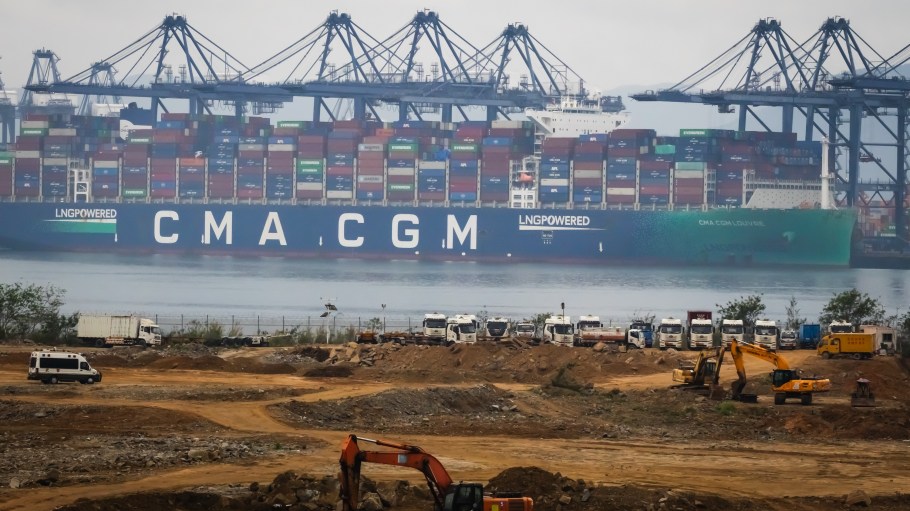
CMA CGM’s finance chief warned the container shipping industry that next year will see a slowdown in global trade.
“2026 won’t be a great year for shipping,” Ramon Fernandez, CMA CGM Group’s chief financial officer, during a third quarter earnings call. “We see uncertainty for the coming quarters.”
Although global container demand in 2025 has been better than expected after the U.S. implementation of country-specific tariffs earlier this year, a portion of the volume increases have been buoyed by front-loading into American ports ahead of the country’s tariff deadlines. In line with CMA CGM’s concerns, the Global Port Tracker from the National Retail Federation and Hackett Associates is expecting an inbound cargo downturn at U.S. ports for the first quarter of 2026.
Related Stories
Like two of its top competitors Maersk and Hapag-Lloyd, the container shipping giant saw its revenues decline in the third quarter, along with a deep plunge in net income.
Revenue at CMA CGM was down 11.3 percent to $14 billion, while profit sank 72.6 percent to $749 million. For the logistics titan’s shipping division, revenue saw a deeper decline of 17.4 percent to $9 billion.
CMA CGM’s volumes transported via container increased 2.3 percent from the year prior to 6.2 million 20-foot equivalent units (TEUs). However, the volume increase was smaller than the jumps of its carrier counterparts, with Maersk’s bumping 7 percent and Hapag-Lloyd’s accelerating 6.2 percent.
According to Container Trades Statistics, industrywide container market volume growth was 4.7 percent.
The France-based container shipping firm’s remained “dynamic,” according to the company’s earnings release, “supported by strong regional trade and south-south exchanges, while the major east-west routes were being reshaped” due to the U.S.-China trade war.
The company did manage to generate more revenue per TEU than the two competitors at $1,452 per container, compared to Maersk’s $1,146 per box and Hapag-Lloyd’s $1,391 average—suggesting that the company was able to take better advantage of the drop in freight rates throughout the third quarter.
Lending to the forward-looking concerns from CMA CGM is the potential for overcapacity of container ships worldwide if the Red Sea situation ends up clearing up.
Since late 2023, when the Houthi militant group in Yemen began attacking commercial vessels, most container ships instead rerouted their voyages away from the Suez Canal, instead going around Africa’s Cape of Good Hope. This lengthened transit times by one to two weeks, and led to periodic spikes in freight rates.
“The months ahead will likely be marked by increasing capacity in our industry and softer demand across the market,” said Rodolphe Saadé, chairman and CEO of CMA CGM Group, said, in a statement. “CMA CGM will continue to adapt, guided by our long-term vision and our constant commitment to serving our customers.”
Throughout the Red Sea crisis, CMA CGM has been the ocean carrier most willing to test the waters, having used escorts from the French Navy to ensure safe passage through the Suez Canal on rare occasions.
Although CMA CGM has not committed to a Red Sea return on a large scale, Fernandez said in the call that “if the situation gets better, then we will adapt to this environment.”
In November, the carrier deployed multiple ultra-large container ships in the waterway for the first time since before the Houthi attacks began in late 2023.
The CMA CGM Benjamin Franklin was the first such ship to make the Suez Canal voyage in two years, while another vessel, the Zheng He, traversed the waterway days later. Two more ultra-large boats, the Jules Verne and the group’s newest vessel, the Helium, also made the northbound journey.
The Suez Canal Authority’s chairman and managing director, Ossama Rabiee, who has been lobbying for ocean carries to come back to the Red Sea for months, said in a statement Saturday that “the Suez Canal is ready to receive mega container ships.”
CMA CGM could not confirm whether its partners in the Ocean Alliance vessel-sharing partnership—Cosco Shipping, subsidiary OOCL and Evergreen—would commit to a return.
“They make their own choices,” Fernandez said.
Regardless of whether the Suez Canal’s eventual reopening results in a flood of extra global shipping capacity, CMA CGM itself is expecting to add more of its own over the next few years.
Fernandez said in the call that the company could surpass Maersk at the end of 2027 to become the world’s second-largest container line by capacity behind Mediterranean Shipping Company (MSC).
Currently, CMA CGM has 128 more ships in its order book, according to container shipping consultancy Alphaliner, marking the most vessels on order among any ocean carrier.
“There is no alternative,” Fernandez said on the call. “We need to replace older vessels.”
The container line confirmed that it has ordered up to 10 ultra-large 22,000-TEU dual-fuel ships from China’s Dalian Shipbuilding. According to Fernandez, CMA CGM expects to own 160 dual-fuel ships by 2029, and charter or lease more than 40 more.