CMA CGM’s recent $20 billion investment in U.S. logistics and shipbuilding appears to be already be taking heat within its own market.
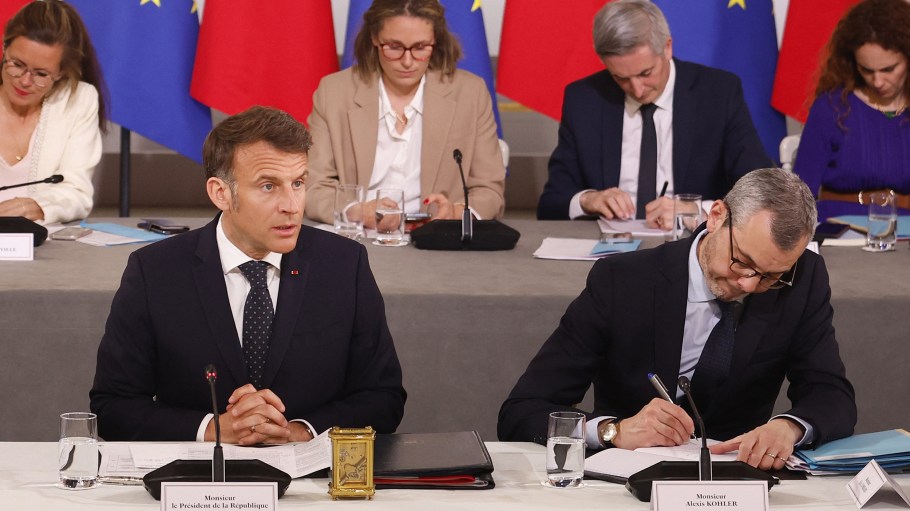
French President Emmanuel Macron wants European businesses to take a breather from investing in the U.S., at least until President Donald Trump’s sweeping global tariffs have more clarification.
“I think what’s important, and that’s all the work that must be done by sector, that the investments to come or investments announced in recent weeks should be suspended until things are clarified with the United States,” Macron said Thursday during a meeting with French industry representatives.
Related Stories
The CMA CGM venture is one of the prior major investments Macron likely referred to, alongside a $5 billion commitment made in January by Netherlands-headquartered automaker Stellantis. French electrical company Schneider Electric also said in March it would invest $700 million in the U.S.
Sourcing Journal reached out to CMA CGM.
Macron’s comments came a day after President Trump slapped the European Union with 20 percent import tariffs, which are expected to go into effect Wednesday. Baseline 10 percent duties on the E.U.—the same standard applied to the rest of the countries that were tariffed—went into effect Saturday.
“What would the message be of having big European players that invest billions in the American economy at the same time they are hitting us?” Macron said. “We must have collective solidarity.”
The E.U. has not established any directive of where its companies can conduct business in the wake of the “Liberation Day” tariffs, so the CMA CGM deal remains unaffected.
The logistics giant has made moves in the past that appeared to have political undertones. In 2022, it acquired a 75 percent stake in industrial logistics provider Gefco from Russian Railways after the start of the Russia-Ukraine war. To close that deal, the European Commission authorized an immediate purchase to avoid the deal being subject to international sanctions against the state-owned Russian Railways.
CMA CGM is also one of the few major container shipping lines that would sparingly make returns to the Red Sea, with the French Navy escorting its vessels before passing through the Suez Canal.
It remains to be seen if E.U.-based counterparts like Maersk and Hapag-Lloyd, or conglomerates across other sectors, would avoid further U.S. investments.
At the meeting, Macron suggested Brussels consider using the E.U.’s anti-coercion instrument—a never-before used regulatory tool initially introduced in 2023 to respond against trade restrictions China imposed on Lithuania. If Europe decides to invoke the law, it could impose new customs duties for goods entering the E.U., block access to government contracts, revoke U.S. banking licenses or restrict intellectual property rights.
The 27-nation trading bloc, which includes countries like France, Germany, Italy, Spain and the Netherlands as its largest economies, has already prepared $28 billion in targeted countermeasures on imports from the U.S. These products range from poultry and beef to clothing, carpets, wood, diamonds, dairy, beer and wine.
E.U. ministers overseeing trade met in Luxembourg on Monday to debate the bloc’s response, as well as discuss relations with China. According to a Reuters report, multiple ministers said the E.U.’s priority was to launch negotiations with the U.S. and avert an outright trade war.
As part of the wider four-year investment announced in early March, CMA CGM said it would create 10,000 American jobs, with CEO Rodolphe Saadé committing to tripling the number of its U.S.-flagged ships from 10 to 30.
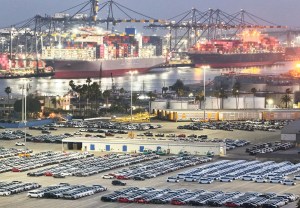
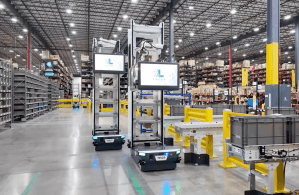
Those plans also include the development of an air cargo hub in Chicago for its air cargo division and the expansion of infrastructure at U.S. seaports like New York; Los Angeles; Houston; Miami; and Dutch Harbor, Alaska. Additionally, CMA CGM is building out an R&D hub in Boston to focus on developing advanced robotics and automation solutions.
Outside of the geopolitical tug of war, CMA CGM is investing 100 million euros ($109.2 million) in a partnership with generative AI firm Mistral AI. The ocean carrier has made it a point to bring more AI technology into its employee decision-making ecosystem, already having unveiled a partnership with Google last summer to help optimize vessel routes and container handling.
With the Mistral AI partnership, the shipping firm aims to streamline personalization of the customer experience through solutions such as automated claims processing, intelligent e-commerce tools, and advanced document management systems.
The partnership will also extend to CMA CGM’s AI media lab, with the carrier using it for content management and fact-checking.
CMA CGM and Mistral AI first partnered in June 2023 when Saadé contributed to a $113 million seed round for the tech startup. Under Saadé’s leadership, CMA CHM says it has committed 500 million euros ($546 million) to AI.