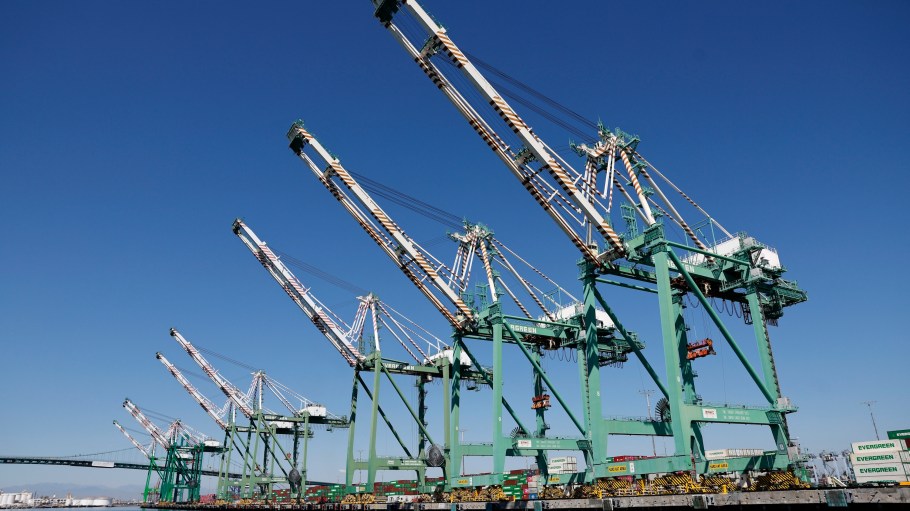
U.S. ports are urging the U.S. Trade Representative (USTR) to reconsider a new 100-percent tariff on Chinese-manufactured ship-to-shore (STS) cranes, citing billions in extra costs.
At a hearing in Washington on Monday, American Association of Port Authorities (AAPA) president and CEO Cary Davis testified that public port authorities would have to pay total tariffs, if imposed, of a combined $6.7 billion over the next decade.
“Applying a new 100 percent tariff to Chinese STS cranes will not create a domestic crane manufacturing industry out of thin air,” stated Davis, in official comments submitted to the Federal Register. “It will only increase costs for public port authorities.”
Related Stories
The 100-percent tariffs would expand on prior 25-percent tariffs slapped on the equipment in 2024 under the Biden administration. At the time, the 81-port AAPA also pushed back against those duties, but to no avail.
American ports currently have 55 cranes on order and another 151 are expected to be needed in six to 10 years, according to Davis’ testimony.
For example, Port Houston has eight STS cranes contracted for delivery by spring 2026 for $14 million each. But under the tariffs, the port would be spending an extra $302.4 million in added costs—potentially preventing the hub from investing in infrastructure elsewhere.
The port association suggested that the “logical first step” toward reshoring STS crane production would be for Congress to establish a tax credit for domestic production.
“USTR should forgo any further tariffs on STS cranes until such legislation is passed,” Davis said.
From there, the association recommended the USTR to forgo applying the 100-percent tariff to cranes that were ordered and contracted prior to the publication of the proposal on April 17.
Davis also called for the USTR to delay imposition of the 100-percent tariff for one or two years, saying that ports’ decisions on equipment and infrastructure investments are made years in advance.
“If a port authority needs a new STS crane to either replace aging equipment, expand the capacity of an existing terminal, or outfit a new terminal, altering procurement plans is complicated,” said Davis. “Adding millions of dollars in tariffs to a project’s budget can get the project scaled back, delayed, or cancelled entirely. Even with these tariffs, manufacturers cannot stand up production facilities in the U.S. and start producing cranes for several years.”
Finally, he asked USTR to clarify that the Section 301 tariffs are not additive to the 125-percent reciprocal and 20-percent fentanyl tariffs on China—both of which were responsible for most of the added hypothetical tariff costs.
American retailers and brands shared their own individual concerns with the USTR’s Section 301 punitive measures.
The American Apparel & Footwear Association (AAFA) is concerned that imposing tariffs on cranes, chassis and shipping containers without the availability of competitive alternatives will significantly raise shipping costs.
“Many companies have already increased prices in response to existing tariffs and cannot absorb further cost burdens,” said Nate Herman, senior vice president of policy at the AAFA, in a letter. “We strongly urge you not to raise the duty rates on the proposed products.”
If tariffs are deemed necessary, the AAFA requested that the duties be phased in gradually to allow businesses adequate time to adapt and plan for the resulting expenses.
The Retail Industry Leaders Association (RILA) had a more specific worry regarding the office’s “country of origin” test set forth in the proposal, in which tariffs would be placed on cranes manufactured by any company’s owned or controlled by a Chinese citizen rather than a state-owned enterprise.
“Here, USTR proposes to change well-established origin tests and adopt an expansive definition that requires importers of ship-to-shore cranes to exclude from its sourcing operations any business that may be owned by a Chinese national,” said Blake Harden, vice president of international trade at RILA. “This would create additional burdens and administrative challenges for businesses trying to make sourcing determinations around the globe, as well as create confusion and impede their ability to meet other customs obligations.”
RILA urged USTR to reconsider the expanded country of origin test.
Shanghai Zhenhua Heavy Industries (ZPMC), which manufactured 80 percent of cranes currently used at U.S. ports, denied it was a threat to U.S. national security interests and requested its removal from the list of items proposed under Section 301 tariffs.
“The proposed tariffs on STS cranes will undermine the U.S. economy and national security by negatively disrupting essential U.S. supply chains,” ZPMC said in a filing to the USTR Monday. “China’s STS cranes pose no alleged cybersecurity risk, and the proposed tariffs are not a legitimate remedy; and the proposed tariffs would negatively impact the global STS crane industry, including the United States, and would harm, rather than help, the U.S. economy and national security.”
The USTR Office and Ambassador Jamieson Greer have shown to be flexible in amending potential Section 301 penalties against China in the wake of public commentary.
When the office unveiled the crane proposal in April, it also revealed a finalized, pared back version of the previously criticized port docking fees levied on Chinese ships. The latest measures were more lenient on container shipping giants than originally expected, with ocean carriers like Maersk and CMA CGM already saying they won’t deal with any cost impact.