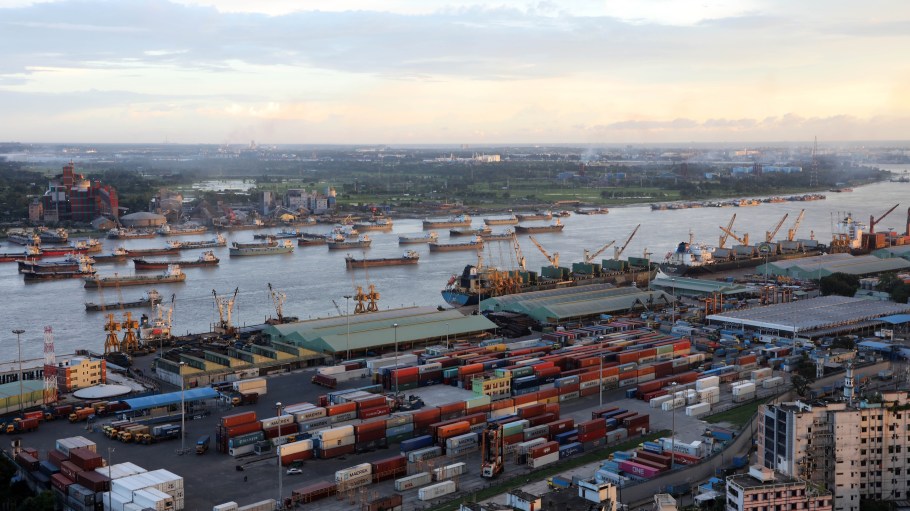
As the U.S. and China slap port docking fees on the opposing nations’ vessels, apparel importers and exporters will also need to keep an eye on added costs to call at Bangladesh’s busiest port.
Chattogram Port is implementing new service charges Wednesday that will hike rates by an average of 41 percent, according to the port’s authority. The new tariff will be applied to all ships and containers.
Nasir Uddin Chowdhury, former first vice president of the Bangladesh Garment Manufacturers and Exporters Association (BGMEA), said the lobbying group had requested the government to defer the service increase for a year, but this was rejected.
Related Stories
In an interview with the Bangladeshi publication The Daily Star, Chowdhury accused the government of being “intent on transferring most port jetties to foreign operators.”
Bangladesh’s government has plans to hand over the management of at least three port terminals, including Chattogram’s largest terminal, New Mooring Container Terminal, to foreign operators by December. Mediterranean Shipping Company (MSC) and DP World are among the operators expected to take control of the terminals.
“The tariff hike may have been designed to make port operations look more profitable for them [foreign operators], as they stand to gain the bulk of the additional revenue,” Chowdhury added.
The BGMEA has also warned that these cost escalations could undermine export competitiveness at a time of sluggish global demand, especially as high U.S.-levied tariffs already threaten the country’s export economy.
Mahfuzul Hoque Shah, former director of the Chittagong Chamber of Commerce and Industry, told another Bangladeshi publication, The Business Standard, “Inflation is already at 8.5 percent, and this move will push it even higher.”
Numerous stakeholders including the Chamber of Commerce and the Bangladesh Shipping Agents Association had proposed limiting the tariff hike to within 10 to 15 percent.
The Chattogram Port Authority has defended the price increases, noting that they are still lower than those of other countries.
But the International Finance Corporation now estimates that Chattogram has become the second-most expensive in the region with the new price hikes, surpassing 13 competing south Asian ports.
Due to the charges, major ocean carriers have begun to start passing costs onto the consumer.
MSC announced a “port cost recovery” surcharge ranging from $100 to $200 per 20-foot equivalent unit (TEU), effective Thursday. Dry containers will be charged $100, reefers $150, and hazardous cargo $200. The company said the fee applies to all destinations except the U.S. and Far East trades, which it describes as necessary to offset “significant local cost increases.”
Maersk and CMA CGM are also tacking on surcharges of their own.
Effective Wednesday, terminal handling charges at Maersk will cost $165 for 20-foot containers—an immediate $45 increase per TEU—and $310 for 40-foot containers.
CMA CGM introduced an emergency cost recovery surcharge of $45 for 20-foot dry containers and $70 for 40-foot boxes, with much higher rates for reefer, out-of-gauge and hazardous cargo. These will take effect Oct. 26.
Shippers likely won’t be able to make plans to avoid the charges, as Chattogram Port handles more than 92 percent of the total export and import cargo in and out of Bangladesh.
According to the September notification, container transportation fees have risen the most.
The average charge per TEU moved has jumped 37 percent from roughly $97 to $133, while fees on imported containers have gone up by $47 and export containers cost an extra $25. Loading and unloading containers from ships has risen about $25.
Around 60 percent of imports at Chattogram Port are handled at its outer anchorage. These containers will face smaller price increases as they are not loaded or unloaded at the port jetties.
This is the first large-scale revision of service charges at Chattogram Port since 1986. In the 2007-08 fiscal year, the port authority increased fees for five major services, including tugboats, water supply, wharf rent, container storage and container loading and unloading.
The CPA currently imposes tariffs or charges on over 150 services.
The move followed service charge increases at private inland container depots (ICDs) near the port. These yards host excess containers that are transported to and from the port.
As of September, ICDs have begun charging up to 60 percent more for handling export cargo and empty containers.