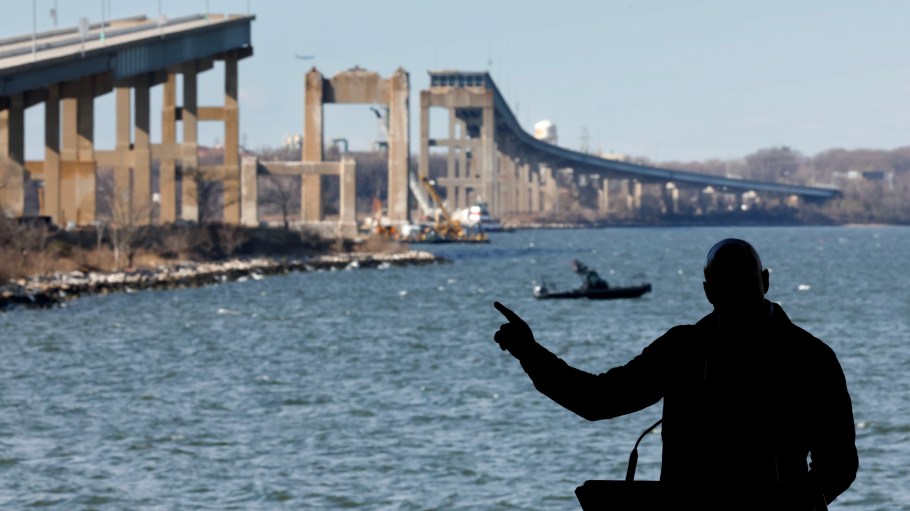
The reconstruction of Baltimore’s Francis Scott Key Bridge is already over budget and behind schedule.
The bridge, which collapsed last March due after a cargo ship crashed into one of its support pillars, is now anticipated to reopen in late 2030, according to the the Maryland Transportation Authority.
Initially, the bridge was supposed to be rebuilt by fall 2028.
And the price tag has gotten much steeper. Whereas original projections had an estimate between $1.7 billion and $1.9 billion, that range has ballooned to between $4.3 billion to $5.2 billion.
Related Stories
The incident resulted in the deaths of six workers, and closed off shipping access into and out of the Port of Baltimore for roughly two months.
“Preliminary cost and project time estimates were made less than two weeks after the initial crash and before any engineering or design studies were conducted,” said Maryland Governor Wes Moore in a statement. “Since then, national economic conditions have deteriorated and material costs have increased. At the same time, elevated costs have resulted from federal design and resilience standards—not discretionary state choices.”
Moore pointed to shifting U.S. trade policies from the Trump administration as a top culprit to price hikes on the materials needed to rebuild the 1.6-mile bridge. Overall, the issue appears to go beyond any recent tariffs. Highway construction costs have escalated 72 percent in the last five years, according to the Federal Highway Administration.
Under the Biden administration, the federal government had previously agreed to cover the full reconstruction costs, which generated some backlash among some Republicans. President Donald Trump, who has been scrutinizing federal funding for transportation projects since he took office in January, suggested in an August social media post criticizing Moore that he would have to rethink the financing.
On Tuesday, the National Transportation Safety Board (NTSB) determined that the Dali cargo ship had a signal wire that had loosened over time, resulting in the two blackouts that occurred and the vessel’s ensuing loss of propulsion. The wire ultimately disconnected from its breaker, which triggered the two power outages just three ships’ lengths from the bridge.
“When the Dali initially lost low-voltage power while underway, most of the vessel’s lighting and equipment essential for operation were also lost,” NTSB investigator Bart Barnum said.
During a hearing, the board emphasized that the collapse of the Key Bridge was preventable.
“The fact is, none of us should be here today. This tragedy should have never occurred. Lives should have never been lost,” NTSB chairwoman Jennifer Homendy said. “This was a complex, multimodal investigation, extremely complex, with tremendous challenges.”
According to another NTSB investigator, Todd Gianelloni, the crew periodically inspected the wiring system on the 947-foot Dali, but there were no instructions on how to check individual wire connections, and doing so would have been labor intensive and impractical on a ship with thousands of wires.
“Locating a loose wire in the thousands of miles of wiring is like looking for a loose bolt in the Eiffel Tower,” said Homendy.
Alongside the crash itself, the NTSB reiterated prior findings from March, saying there were a lack of countermeasures put in place to reduce the bridge’s vulnerability to a collapse due to the impact of an oceangoing vessel.
“If the MDTA had calculated the Key Bridge vulnerability, it would have been aware the risk of collapse was almost 30 times greater than the American Association of State Highway and Transportation Officials acceptable risk threshold,” said NTSB highway factors engineer Scott Parent in a statement. “The MDTA would have had information to proactively identify strategies to reduce the bridge’s risk of collapse.”
Parent said that in 2006, an MDTA official found bridge pier protection was inadequate, but no meaningful action was taken thereafter.
According to NTSB investigators, the force of the Dali when it struck the Key Bridge was nearly five times the structural capacity of the bridge.
The final report is expected to be released in a few weeks.
Various lawsuits have been filed against the Singaporean owner and operator of the Maersk-chartered Dali vessel in the time after the accident took place. The companies paid $102 million in civil penalties last October after being slapped with a civil suit by the Department of Justice.
Most recently, the owner-operator duo, Grace Ocean Private Limited and Synergy Marine Private Limited, filed a lawsuit against the ship’s builder Hyundai Heavy Industries. In that suit, the companies accused the South Korean firm of negligence in designing and manufacturing a critical switchboard on the ship.