Amazon’s fourth-quarter earnings call heavily focused on the tech titan’s big $100 billion bet on AI in 2025, and introduced a soft first-quarter outlook that disappointed Wall Street—all while a record $20 billion in net profit seemingly went under the radar.
But one elephant in the room notably did not get addressed by the e-commerce giant.
Unlike many retail industry concerns shared about the current global trade climate, tariffs were not mentioned on the call by Amazon CEO Andy Jassy, chief financial officer Brian Olsavsky or any of the analysts in attendance.
Related Stories
Neither was there any mention of the Section 321 de minimis provision, which was shut down as part of President Donald Trump’s executive order to impose the additional 10 percent tariffs on all China-made goods.
Sourcing Journal reached out to Amazon for comment.
Tariffs would appear to be more of a concern for the company’s third-party sellers than Amazon itself, since 62 percent of items sold on its marketplace are from third parties.
“There certainly are e-commerce sellers based in the U.S. that have arrangements with suppliers in China, and are fulfilling directly from China,” said Judah Levine, head of research at freight booking platform Freightos. “There are some small businesses that use de minimis to bring goods that they sell, so it will definitely impact some e-commerce sellers.”
Analysts from Morgan Stanley wrote in a Monday note that 25 percent of the merchandise sold through Amazon’s first-party retail business, though which the company sells products purchased from manufacturers, comes from China.
The e-commerce giant’s low-cost Shein and Temu competitor, Amazon Haul, which also ships products from Chinese merchants directly to U.S. customers, would also feel the heat from the tacked-on tariffs and halting of de minimis.
“That piece of it will be impacted,” said Levine. But the future of the channel is now unknown. At the very minimum, scrapping the duty-free trade provision would require those packages to go through U.S. customs—and require an extra processing fee for formal entry.
Given that Amazon Haul quietly launched in November and represents a minuscule amount of merchandise, Amazon’s overall business isn’t likely to see any material hit. If anything, the wider blow to both Shein and Temu could likely benefit the U.S. Big Tech firm and its sellers, which still “for the most part, bring in bulk inventory by ocean freight,” Levine told Sourcing Journal.
As the future of Trump’s tariffs puts retail under the microscope, Amazon keeps chugging along like usual, with net sales increasing 10 percent to $115.6 billion on net income of $20 billion in the fourth quarter, or $1.86 per diluted share.
The $20 billion in net income represents a whopping 88 percent increase over the fourth quarter of 2023, bringing the company to record levels of profit and smashing the previous quarter’s record of $15.3 billion.
For Jassy and co., the name of the game has been cutting costs to create an operationally leaner business that supports these high margins.
Despite the broad cost cuts, Amazon’s logistics network has continued to thrive, with the Jeff Bezos-founded company expanding the number of same-day delivery sites by more than 60 percent in 2024, which now serve more than 140 metro areas.
“Our per-unit transportation costs continue to decline as we build out and optimize our last-mile network,” Jassy said. “Overall, we’ve reduced our global cost to serve on a per-unit basis for the second year in a row.”
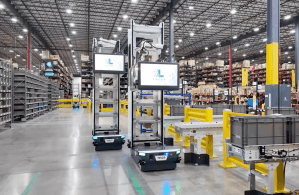
Jassy said the company recently rolled out its redesigned U.S. inbound fulfillment network, which consists of warehouses near major ports designed to minimize ground transportation expenses and streamline the flow of goods into its wider fulfillment network.
“While still in its early stages…ahead of Black Friday in November, we’d improved the percentage of ordered units available in the ideal building by over 40 percent year over year,” Jassy said. “We’ve also spent considerable time optimizing the number of items sent to customers in the same package, which reduces packaging, is more convenient for customers, and less expensive for us to fulfill.”
Unfortunately for Amazon, the performance didn’t impress Wall Street on multiple grounds, with shares sinking as much as 5 percent in trading Friday on softer-than-expected first-quarter guidance.
For the first quarter, Amazon expects net sales growth between 5 percent and 9 percent, or between $151 billion and $155.5 billion, with an “unusually large, unfavorable impact” of approximately $2.1 billion from foreign exchange rates. Analysts were anticipating a midpoint of $158 billion.
Operating income is expected to be between $14 billion and $18 billion, compared with $15.3 billion in first quarter of 2024.
Other factors playing into the selloff included Amazon Web Services (AWS) generating revenue just shy of expectations, as well as the announcement that it would spend roughly $100 billion in capital expenditures in 2025. That CapEx amount will largely be spent on AI investments to support the cloud service, tech infrastructure to support the North America and international segments and capacity for our fulfillment and transportation network.